How the First Letter was Written

image

image

ONCE upon a most early time was a Neolithic man. He was not a Jute or an Angle, or even a Dravidian, which he might well have been, Best Beloved, but never mind why. He was a Primitive, and he lived cavily in a Cave, and he wore very few clothes, and he couldn’t read and he couldn’t write and he didn’t want to, and except when he was hungry he was quite happy. His name was Tegumai Bopsulai, and that means, ‘Manโ€“whoโ€“doesโ€“notโ€“putโ€“hisโ€“footโ€“forwardโ€“inโ€“aโ€“hurry’ but we, O Best Beloved, will call him Tegumai, for short.

And his wife’s name was Teshumai Tewindrow, and that means, ‘Ladyโ€“whoโ€“asksโ€“aโ€“veryโ€“manyโ€“questions’ but we, O Best Beloved, will call her Teshumai, for short. And his little girlโ€“daughter’s name was Taffimai Metallumai, and that means, ‘Smallโ€“personโ€“withoutโ€“anyโ€“mannersโ€“whoโ€“oughtโ€“toโ€“beโ€“spanked’ but I’m going to call her Taffy. And she was Tegumai Bopsulai’s Best Beloved and her own Mummy’s Best Beloved, and she was not spanked half as much as was good for her; and they were all three very happy. As soon as Taffy could run about she went everywhere with her Daddy Tegumai, and sometimes they would not come home to the Cave till they were hungry, and then Teshumai Tewindrow would say, ‘Where in the world have you two been to, to get so shocking dirty? Really, my Tegumai, you’re no better than my Taffy.’

Now attend and listen!

One day Tegumai Bopsulai went down through the beaverโ€“swamp to the Wagai river to spear carpโ€“fish for dinner, and Taffy went too. Tegumai’s spear was made of wood with shark’s teeth at the end, and before he had caught any fish at all he accidentally broke it clean across by jabbing it down too hard on the bottom of the river. They were miles and miles from home (of course they had their lunch with them in a little bag), and Tegumai had forgotten to bring any extra spears.

‘Here’s a pretty kettle of fish!’ said Tegumai. ‘It will take me half the day to mend this.’

‘There’s your big black spear at home,’ said Taffy. ‘Let me run back to the Cave and ask Mummy to give it me.’

‘It’s too far for your little fat legs,’ said Tegumai. ‘Besides, you might fall into the beaverโ€“swamp and be drowned. We must make the best of a bad job.’ He sat down and took out a little leather mendyโ€“bag, full of reindeerโ€“sinews and strips of leather, and lumps of bee’sโ€“wax and resin, and began to mend the spear.

Taffy sat down too, with her toes in the water and her chin in her hand, and thought very hard. Then she saidโ€”

‘I say, Daddy, it’s an awful nuisance that you and I don’t know how to write, isn’t it? If we did we could send a message for the new spear.’

‘Taffy,’ said Tegumai, ‘how often have I told you not to use slang? โ€œAwfulโ€ isn’t a pretty word, but it would be a convenience, now you mention it, if we could write home.’

Just then a Strangerโ€“man came along the river, but he belonged to a far tribe, the Tewaras, and he did not understand one word of Tegumai’s language. He stood on the bank and smiled at Taffy, because he had a little girlโ€“daughter of his own at home. Tegumai drew a hank of deerโ€“sinews from his mendyโ€“bag and began to mend his spear.

‘Come here’, said Taffy. ‘Do you know where my Mummy lives?’ And the Strangerโ€“man said ‘Um!’ being, as you know, a Tewara.

‘Silly!’ said Taffy, and she stamped her foot, because she saw a shoal of very big carp going up the river just when her Daddy couldn’t use his spear.

‘Don’t bother grownโ€“ups,’ said Tegumai, so busy with his spearโ€“mending that he did not turn round.

‘I aren’t’, said Taffy. ‘I only want him to do what I want him to do, and he won’t understand.’

‘Then don’t bother me, said Tegumai, and he went on pulling and straining at the deerโ€“sinews with his mouth full of loose ends. The Strangerโ€“manโ€”a genuine Tewara he wasโ€”sat down on the grass, and Taffy showed him what her Daddy was doing. The Strangerโ€“man thought, this is a very wonderful child. She stamps her foot at me and she makes faces. She must be the daughter of that noble Chief who is so great that he won’t take any notice of me.’ So he smiled more politely than ever.

‘Now,’ said Taffy, ‘I want you to go to my Mummy, because your legs are longer than mine, and you won’t fall into the beaverโ€“swamp, and ask for Daddy’s other spearโ€”the one with the black handle that hangs over our fireplace.’

The Strangerโ€“man (and he was a Tewara) thought, ‘This is a very, very wonderful child. She waves her arms and she shouts at me, but I don’t understand a word of what she says. But if I don’t do what she wants, I greatly fear that that haughty Chief, Manโ€“whoโ€“turnsโ€“hisโ€“backโ€“onโ€“callers, will be angry.’ He got up and twisted a big flat piece of bark off a birchโ€“tree and gave it to Taffy. He did this, Best Beloved, to show that his heart was as white as the birchโ€“bark and that he meant no harm; but Taffy didn’t quite understand.

‘Oh!’ said she. ‘Now I see! You want my Mummy’s livingโ€“address? Of course I can’t write, but I can draw pictures if I’ve anything sharp to scratch with. Please lend me the shark’s tooth off your necklace.’

The Strangerโ€“man (and he was a Tewara) didn’t say anything, So Taffy put up her little hand and pulled at the beautiful bead and seed and sharkโ€“tooth necklace round his neck.

The Strangerโ€“man (and he was a Tewara) thought, ‘This is a very, very, very wonderful child. The shark’s tooth on my necklace is a magic shark’s tooth, and I was always told that if anybody touched it without my leave they would immediately swell up or burst, but this child doesn’t swell up or burst, and that important Chief, Manโ€“whoโ€“attendsโ€“strictlyโ€“toโ€“hisโ€“business, who has not yet taken any notice of me at all, doesn’t seem to be afraid that she will swell up or burst. I had better be more polite.’

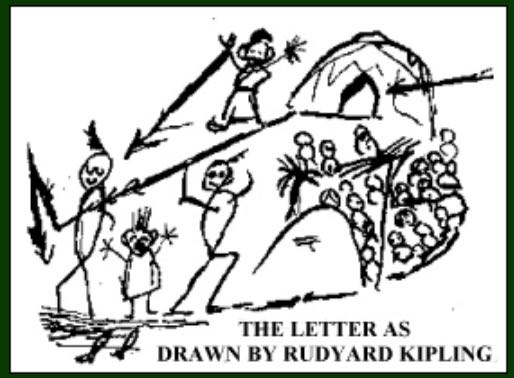
So he gave Taffy the shark’s tooth, and she lay down flat on her tummy with her legs in the air, like some people on the drawingโ€“room floor when they want to draw pictures, and she said, ‘Now I’ll draw you some beautiful pictures! You can look over my shoulder, but you mustn’t joggle. First I’ll draw Daddy fishing. It isn’t very like him; but Mummy will know, because I’ve drawn his spear all broken.

Well, now I’ll draw the other spear that he wants, the blackโ€“handled spear. It looks as if it was sticking in Daddy’s back, but that’s because the shark’s tooth slipped and this piece of bark isn’t big enough. That’s the spear I want you to fetch; so I’ll draw a picture of me myself ‘splaining to you. My hair doesn’t stand up like I’ve drawn, but it’s easier to draw that way. Now I’ll draw you. I think you’re very nice really, but I can’t make you pretty in the picture, so you mustn’t be ‘fended. Are you ‘fended?’

The Strangerโ€“man (and he was a Tewara) smiled. He thought, ‘There must be a big battle going to be fought somewhere, and this extraordinary child, who takes my magic shark’s tooth but who does not swell up or burst, is telling me to call all the great Chief’s tribe to help him. He is a great Chief, or he would have noticed me.’

‘Look,’ said Taffy, drawing very hard and rather scratchily, ‘now I’ve drawn you, and I’ve put the spear that Daddy wants into your hand, just to remind you that you’re to bring it. Now I’ll show you how to find my Mummy’s livingโ€“address. You go along till you come to two trees (those are trees), and then you go over a hill (that’s a hill), and then you come into a beaverโ€“swamp all full of beavers. I haven’t put in all the beavers, because I can’t draw beavers, but I’ve drawn their heads, and that’s all you’ll see of them when you cross the swamp. Mind you don’t fall in! Then our Cave is just beyond the beaverโ€“swamp. It isn’t as high as the hills really, but I can’t draw things very small.
image

That’s my Mummy outside. She is beautiful. She is the most beautifullest Mummy there ever was, but she won’t be ‘fended when she sees I’ve drawn her so plain. She’ll be pleased of me because I can draw. Now, in case you forget, I’ve drawn the spear that Daddy wants outside our Cave. It’s inside really, but you show the picture to my Mummy and she’ll give it you. I’ve made her holding up her hands, because I know she’ll be so pleased to see you. Isn’t it a beautiful picture? And do you quite understand, or shall I ‘splain again?’

The Strangerโ€“man (and he was a Tewara) looked at the picture and nodded very hard. He said to himself, ‘If I do not fetch this great Chief’s tribe to help him, he will be slain by his enemies who are coming up on all sides with spears. Now I see why the great Chief pretended not to notice me! He feared that his enemies were hiding in the bushes and would see him. Therefore he turned to me his back, and let the wise and wondetful child draw the terrible picture showing me his difficulties. I will away and get help for him from his tribe.’ He did not even ask Taffy the road, but raced off into the bushes like the wind, with the birchโ€“bark in his hand, and Taffy sat down most pleased.
image

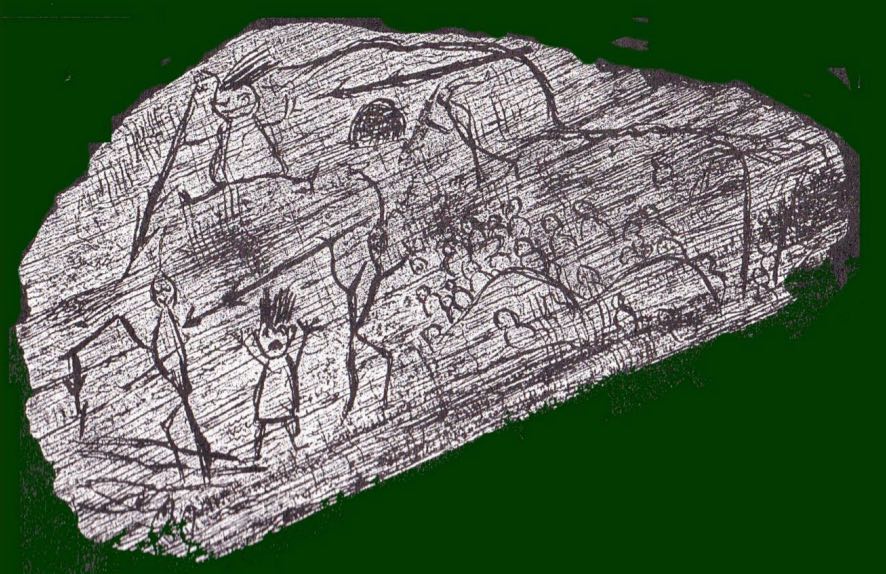
Now this is the picture that Taffy had drawn for him!

‘What have you been doing, Taffy?’ said Tegumai. He had mended his spear and was carefully waving it to and fro.

‘It’s a little berangement of my own, Daddy dear,’ said Taffy. ‘If you won’t ask me questions, you’ll know all about it in a little time, and you’ll be surprised. You don’t know how surprised you’ll be, Daddy! Promise you’ll be surprised.’

‘Very well,’ said Tegumai, and went on fishing.

The Strangerโ€“manโ€”did you know he was a Tewara?โ€”hurried away with the picture and ran for some miles, till quite by accident he found Teshumai Tewindrow at the door of her Cave, talking to some other Neolithic ladies who had come in to a Primitive lunch. Taffy was very like Teshumai, especially about the upper part of the face and the eyes, so the Strangerโ€“manโ€”always a pure Tewaraโ€”smiled politely and handed Teshumai the birchโ€“bark. He had run hard, so that he panted, and his legs were scratched with brambles, but he still tried to be polite.

As soon as Teshumai saw the picture she screamed like anything and flew at the Strangerโ€“man. The other Neolithic ladies at once knocked him down and sat on him in a long line of six, while Teshumai pulled his hair. ‘It’s as plain as the nose on this Strangerโ€“man’s face,’ she said. ‘He has stuck my Tegumai all full of spears, and frightened poor Taffy so that her hair stands all on end; and not content with that, he brings me a horrid picture of how it was done. Look!’ She showed the picture to all the Neolithic ladies sitting patiently on the Strangerโ€“man. ‘Here is my Tegumai with his arm broken; here is a spear sticking into his back; here is a man with a spear ready to throw; here is another man throwing a spear from a Cave, and here are a whole pack of people’ (they were Taffy’s beavers really, but they did look rather like people) ‘coming up behind Tegumai. Isn’t it shocking!’

‘Most shocking!’ said the Neolithic ladies, and they filled the Strangerโ€“man’s hair with mud (at which he was surprised), and they beat upon the Reverberating Tribal Drums, and called together all the chiefs of the Tribe of Tegumai, with their Hetmans and Dolmans, all Neguses, Woons, and Akhoonds of the organisation, in addition to the Warlocks, Angekoks, Jujuโ€“men, Bonzes, and the rest, who decided that before they chopped the Strangerโ€“man’s head off he should instantly lead them down to the river and show them where he had hidden poor Taffy.

By this time the Strangerโ€“man (in spite of being a Tewara) was really annoyed. They had filled his hair quite solid with mud; they had rolled him up and down on knobby pebbles; they had sat upon him in a long line of six; they had thumped him and bumped him till he could hardly breathe; and though he did not understand their language, he was almost sure that the names the Neolithic ladies called him were not ladylike. However, he said nothing till all the Tribe of Tegumai were assembled, and then he led them back to the bank of the Wagai river, and there they found Taffy making daisyโ€“chains, and Tegumai carefully spearing small carp with his mended spear.

‘Well, you have been quick!’ said Taffy. ‘But why did you bring so many people? Daddy dear, this is my surprise. Are you surprised, Daddy?’

‘Very,’ said Tegumai; ‘but it has ruined all my fishing for the day. Why, the whole dear, kind, nice, clean, quiet Tribe is here, Taffy.’

And so they were. First of all walked Teshumai Tewindrow and the Neolithic ladies, tightly holding on to the Strangerโ€“man, whose hair was full of mud (although he was a Tewara). Behind them came the Head Chief, the Viceโ€“Chief, the Deputy and Assistant Chiefs (all armed to the upper teeth), the Hetmans and Heads of Hundreds, Platoffs with their Platoons, and Dolmans with their Detachments; Woons, Neguses, and Akhoonds ranking in the rear (still armed to the teeth). Behind them was the Tribe in hierarchical order, from owners of four caves (one for each season), a private reindeerโ€“run, and two salmonโ€“leaps, to feudal and prognathous Villeins, semiโ€“entitled to half a bearskin of winter nights, seven yards from the fire, and adscript serfs, holding the reversion of a scraped marrowโ€“bone under heriot (Aren’t those beautiful words, Best Beloved?). They were all there, prancing and shouting, and they frightened every fish for twenty miles, and Tegumai thanked them in a fluid Neolithic oration.

Then Teshumai Tewindrow ran down and kissed and hugged Taffy very much indeed; but the Head Chief of the Tribe of Tegumai took Tegumai by the topโ€“knot feathers and shook him severely.

‘Explain! Explain! Explain!’ cried all the Tribe of Tegumai.

‘Goodness’ sakes alive!’ said Tegumai. ‘Let go of my topโ€“knot. Can’t a man break his carpโ€“spear without the whole countryside descending on him? You’re a very interfering people.’

‘I don’t believe you’ve brought my Daddy’s blackโ€“handled spear after all,’ said Taffy. ‘And what are you doing to my nice Strangerโ€“man?’

They were thumping him by twos and threes and tens till his eyes turned round and round. He could only gasp and point at Taffy.

‘Where are the bad people who speared you, my darling?’ said Teshumai Tewindrow.

‘There weren’t any,’ said Tegumai. ‘My only visitor this morning was the poor fellow that you are trying to choke. Aren’t you well, or are you ill, O Tribe of Tegumai?’

‘He came with a horrible picture,’ said the Head Chief,โ€”’a picture that showed you were full of spears.’

‘Erโ€”umโ€”Pr’aps I’d better ‘splain that I gave him that picture,’ said Taffy, but she did not feel quite comfy.

‘You!’ said the Tribe of Tegumai all together. ‘Smallโ€“personโ€“withโ€“noโ€“mannersโ€“whoโ€“oughtโ€“toโ€“beโ€“spanked! You?’

‘Taffy dear, I’m afraid we’re in for a little trouble,’ said her Daddy, and put his arm round her, so she didn’t care.

‘Explain! Explain! Explain!’ said the Head Chief of the Tribe of Tegumai, and he hopped on one foot.

‘I wanted the Strangerโ€“man to fetch Daddy’s spear, so I drawded it,’ said Taffy. ‘There wasn’t lots of spears. There was only one spear. I drawded it three times to make sure. I couldn’t help it looking as if it stuck into Daddy’s headโ€”there wasn’t room on the birchโ€“bark; and those things that Mummy called bad people are my beavers. I drawded them to show him the way through the swamp; and I drawded Mummy at the mouth of the Cave looking pleased because he is a nice Strangerโ€“man, and I think you are just the stupidest people in the world,’ said Taffy. ‘He is a very nice man. Why have you filled his hair with mud? Wash him!’

Nobody said anything at all for a longtime, till the Head Chief laughed; then the Strangerโ€“man (who was at least a Tewara) laughed; then Tegumai laughed till he fell down flat on the bank; then all the Tribe laughed more and worse and louder. The only people who did not laugh were Teshumai Tewindrow and all the Neolithic ladies. They were very polite to all their husbands, and said ‘Idiot!’ ever so often.

Then the Head Chief of the Tribe of Tegumai cried and said and sang,’O Smallโ€“personโ€“withโ€“outโ€“anyโ€“mannersโ€“whoโ€“oughtโ€“toโ€“beโ€“spanked, you’ve hit upon a great invention!’

‘I didn’t intend to; I only wanted Daddy’s blackโ€“handled spear,’ said Taffy.

‘Never mind. It is a great invention, and some day men will call it writing. At present it is only pictures, and, as we have seen toโ€“day, pictures are not always properly understood. But a time will come, O Babe of Tegumai, when we shall make lettersโ€”all twentyโ€“six of ’em,โ€”and when we shall be able to read as well as to write, and then we shall always say exactly what we mean without any mistakes. Let the Neolithic ladies wash the mud out of the stranger’s hair.’

‘I shall be glad of that,’ said Taffy, ‘because, after all, though you’ve brought every single other spear in the Tribe of Tegumai, you’ve forgotten my Daddy’s blackโ€“handled spear.’

Then the Head Chief cried and said and sang, ‘Taffy dear, the next time you write a pictureโ€“letter, you’d better send a man who can talk our language with it, to explain what it means. I don’t mind it myself, because I am a Head Chief, but it’s very bad for the rest of the Tribe of Tegumai, and, as you can see, it surprises the stranger.’

Then they adopted the Strangerโ€“man (a genuine Tewara of Tewar) into the Tribe of Tegumai, because he was a gentleman and did not make a fuss about the mud that the Neolithic ladies had put into his hair. But from that day to this (and I suppose it is all Taffy’s fault), very few little girls have ever liked learning to read or write. Most of them prefer to draw pictures and play about with their Daddiesโ€”just like Taffy.


image

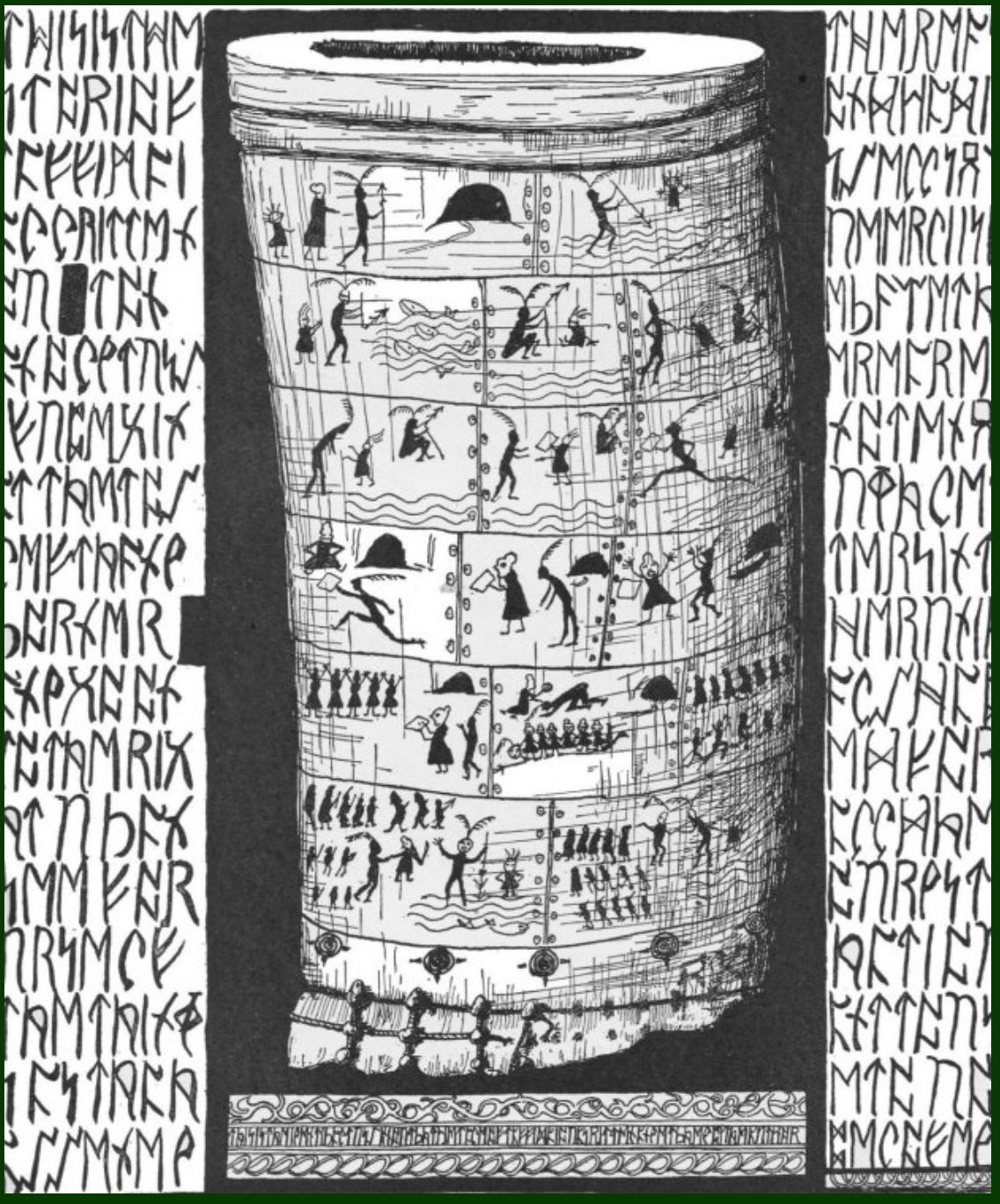
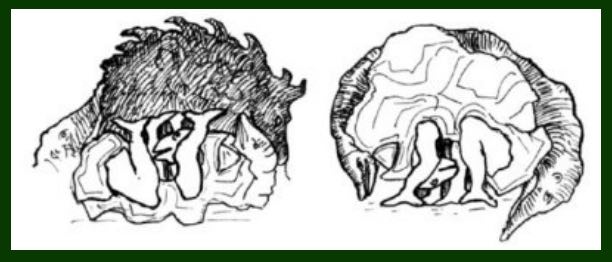
This is the story of Taffimai Metallumai carved on an old tusk a very long time ago by the Ancient Peoples. If you read my story, or have it read to you, you can see how it is all told out on the tusk. The tusk was part of an old tribal trumpet that belonged to the Tribe of Tegumai.

The pictures were scratched on it with a nail or something, and then the scratches were filled up with black wax, but all the dividing lines and the five little rounds at the bottom were filled with red wax. When it was new there was a sort of network of beads and shells and precious stones at one end of it, but now that has been broken and lostโ€“ all except the little bit that you see.

The letter round the tusk are magicโ€”Runic magicโ€”and if you can read them you will find out something rather new. The tusk is of’ ivoryโ€”very yellow and scratched. It is two feet long and two feet round, and weighs eleven pounds nine ounces.


THERE runs a road by Merrow Downโ€”
       A grassy track toโ€“day it isโ€”
An hour out of Guildford town,
       Above the river Wey it is.

Here, when they heard the horseโ€“bells ring,
       The ancient Britons dressed and rode
To watch the dark Phoenicians bring
       Their goods along the Western Road.

And here, or hereabouts, they met
       To hold their racial talks and suchโ€”
To barter beads for Whitby jet,
       And tin for gay shell torques and such.

But long and long before that time
       (When bison used to roam on it)
Did Taffy and her Daddy climb
       That down, and had their home on it.

Then beavers built in Broadstone brook
       And made a swamp where Bramley stands:
And hears from Shere would come and look
       For Taffimai where Shamley stands.

The Wey, that Taffy called Wagai,
       Was more than six times bigger then;
And all the Tribe of Tegumai
       They cut a noble figure then! image


some notes by Lisa Lewis image

Here is a PDF version of the story


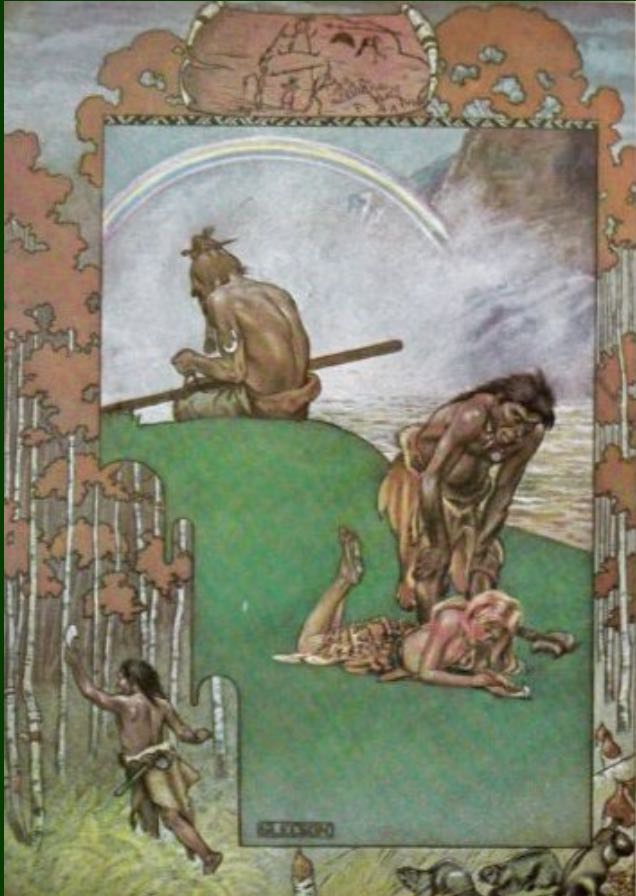
The black & white illustrations are by Rudyard Kipling himself, the coloured titled picture was created by Joseph M. Gleeson in 1912.

The Beginning of the Armadilloes

image
listen to the tale
image

THIS, O Best Beloved, is another story of the High and Far-Off Times. In the very middle of those times was a Stickly-Prickly Hedgehog, and he lived on the banks of the turbid Amazon, eating shelly snails and things. And he had a friend, a Slow-Solid Tortoise, who lived on the banks of the turbid Amazon, eating green lettuces and things. And so that was all right, Best Beloved. Do you see?

But also, and at the same time, in those High and Far-Off Times, there was a Painted Jaguar, and he lived on the banks of the turbid Amazon too; and he ate everything that he could catch. When he could not catch deer or monkeys he would eat frogs and beetles; and when he could not catch frogs and beetles he went to his Mother Jaguar, and she told him how to eat hedgehogs and tortoises.

She said to him ever so many times, graciously waving her tail, ‘My son, when you find a Hedgehog you must drop him into the water and then he will uncoil, and when you catch a Tortoise you must scoop him out of his shell with your paw.’ And so that was all right, Best Beloved.

This is an inciting map of the Turbid Amazon done in Red and Black. It hasn’t anything to do with the story except that there are two Armadillos in it โ€”up by the top. The inciting part are the adventures that happened to the men who went along the road marked in red. I meant to draw Armadilloes when I began the map, and I meant to draw manatees and spider โ€“tailed monkeys and big snakes and lots of Jaguars, but it was more inciting to do the map and the venturesome adventures in red. image

(spool down to the bottom to follow the trail of Kipling’s explorers: Ed.)

image

You begin at the bottom left โ€“hand corner and follow the little arrows all about, and then you come quite round again to where the adventuresome people went home in a ship called the Royal Tiger. This is a most adventuresome picture, and all the adventures are told about in writing so you can be quite sure which is an adventure and which is a tree or a boat. image

(in the printed books the map can’t be shown big enough to see the marvellous details Kipling put in, as explorers did in the sixteenth century. We are lucky to be able to make it big on the screen. We hope he would have been pleased. We think he would have been very incited by the World Wide Web: Ed.)

One beautiful night on the banks of the turbid Amazon, Painted Jaguar found Stickly-Prickly Hedgehog and Slow-Solid Tortoise sitting under the trunk of a fallen tree. They could not run away, and so Stickly-Prickly curled himself up into a ball, because he was a Hedgehog, and Slow-Solid Tortoise drew in his head and feet into his shell as far as they would go, because he was a Tortoise; and so that was all right, Best Beloved. Do you see?

‘Now attend to me,’ said Painted Jaguar, ‘because this is very important. My mother said that when I meet a Hedgehog I am to drop him into the water and then he will uncoil, and when I meet a Tortoise I am to scoop him out of his shell with my paw. Now which of you is Hedgehog and which is Tortoise? because, to save my spots, I can’t tell.’

‘Are you sure of what your Mummy told you?’ said Stickly-Prickly Hedgehog. ‘Are you quite sure? Perhaps she said that when you uncoil a Tortoise you must shell him out the water with a scoop, and when you paw a Hedgehog you must drop him on the shell.’

‘Are you sure of what your Mummy told you?’ said Slow-and-Solid Tortoise. ‘Are you quite sure? Perhaps she said that when you water a Hedgehog you must drop him into your paw, and when you meet a Tortoise you must shell him till he uncoils.’

‘I don’t think it was at all like that,’ said Painted Jaguar, but he felt a little puzzled; ‘but, please, say it again more distinctly.’

‘When you scoop water with your paw you uncoil it with a Hedgehog,’ said Stickly-Prickly. ‘Remember that, because it’s important.’ ‘But,’ said the Tortoise, ‘when you paw your meat you drop it into a Tortoise with a scoop. Why can’t you understand?’

‘You are making my spots ache,’ said Painted Jaguar; ‘and besides, I didn’t want your advice at all. I only wanted to know which of you is Hedgehog and which is Tortoise.’ ‘I shan’t tell you,’ said Stickly-Prickly. ‘but you can scoop me out of my shell if you like.’

‘Aha!’ said Painted Jaguar. ‘Now I know you’re Tortoise. You thought I wouldn’t! Now I will.’ Painted Jaguar darted out his paddy-paw just as Stickly-Prickly curled himself up, and of course Jaguar’s paddy-paw was just filled with prickles. Worse than that, he knocked Stickly-Prickly away and away into the woods and the bushes, where it was too dark to find him. Then he put his paddy-paw into his mouth, and of course the prickles hurt him worse than ever. As soon as he could speak he said, ‘Now I know he isn’t Tortoise at all. But’ โ€”and then he scratched his head with his un-prickly paw โ€”’how do I know that this other is Tortoise?’

‘But I am Tortoise,’ said Slow-and-Solid. ‘Your mother was quite right. She said that you were to scoop me out of my shell with your paw. Begin.’

‘You didn’t say she said that a minute ago,’ said Painted Jaguar, sucking the prickles out of his paddy-paw. ‘You said she said something quite different.’

‘Well, suppose you say that I said that she said something quite different, I don’t see that it makes any difference; because if she said what you said I said she said, it’s just the same as if I said what she said she said. On the other hand, if you think she said that you were to uncoil me with a scoop, instead of pawing me into drops with a shell, I can’t help that, can I?’

‘But you said you wanted to be scooped out of your shell with my paw,’ said Painted Jaguar.

‘If you’ll think again you’ll find that I didn’t say anything of the kind. I said that your mother said that you were to scoop me out of my shell,’ said Slow-and-Solid.

‘What will happen if I do?’ said the Jaguar most sniffily and most cautious.

‘I don’t know, because I’ve never been scooped out of my shell before; but I tell you truly, if you want to see me swim away you’ve only got to drop me into the water.’

‘I don’t believe it,’ said Painted Jaguar. ‘You’ve mixed up all the things my mother told me to do with the things that you asked me whether I was sure that she didn’t say, till I don’t know whether I’m on my head or my painted tail; and now you come and tell me something I can understand, and it makes me more mixy than before. My mother told me that I was to drop one of you two into the water, and as you seem so anxious to be dropped I think you don’t want to be dropped. So jump into the turbid Amazon and be quick about it.’

‘I warn you that your Mummy won’t be pleased. Don’t tell her I didn’t tell you,’ said Slow-Solid.

‘If you say another word about what my mother said โ€”’ the Jaguar answered, but he had not finished the sentence before Slow-and-Solid quietly dived into the turbid Amazon, swam under water for a long way, and came out on the bank where Stickly-Prickly was waiting for him.

‘That was a very narrow escape,’ said Stickly-Prickly. ‘I don’t rib Painted Jaguar. What did you tell him that you were?’

‘I told him truthfully that I was a truthful Tortoise, but he wouldn’t believe it, and he made me jump into the river to see if I was, and I was, and he is surprised. Now he’s gone to tell his Mummy. Listen to him!’

They could hear Painted Jaguar roaring up and down among the trees and the bushes by the side of the turbid Amazon, till his Mummy came.

‘Son, son!’ said his mother ever so many times, graciously waving her tail, ‘what have you been doing that you shouldn’t have done?’

‘I tried to scoop something that said it wanted to be scooped out of its shell with my paw, and my paw is full of per-ickles,’ said Painted Jaguar.

‘Son, son!’ said his mother ever so many times, graciously waving her tail, ‘by the prickles in your paddy-paw I see that that must have been a Hedgehog. You should have dropped him into the water.

‘I did that to the other thing; and he said he was a Tortoise, and I didn’t believe him, and it was quite true, and he has dived under the turbid Amazon, and he won’t come up again, and I haven’t anything at all to eat, and I think we had better find lodgings somewhere else. They are too clever on the turbid Amazon for poor me!’

‘Son, son!’ said his mother ever so many times, graciously waving her tail, ‘now attend to me and remember what I say. A Hedgehog curls himself up into a ball and his prickles stick out every which way at once. By this you may know the Hedgehog.’

‘I don’t like this old lady one little bit,’ said Stickly-Prickly, under the shadow of a large leaf. ‘I wonder what else she knows?’

‘A Tortoise can’t curl himself up,’ Mother Jaguar went on, ever so many times, graciously waving her tail. ‘He only draws his head and legs into his shell. By this you may know the tortoise.’

‘I don’t like this old lady at all โ€”at all,’ said Slow-and-Solid Tortoise. ‘Even Painted Jaguar can’t forget those directions. It’s a great pity that you can’t swim, Stickly-Prickly.’

‘Don’t talk to me,’ said Stickly-Prickly. ‘Just think how much better it would be if you could curl up. This is a mess! Listen to Painted Jaguar.’

Painted Jaguar was sitting on the banks of the turbid Amazon sucking prickles out of his Paws and saying to himself โ€”

'Can't curl, but can swim โ€”
Slow-Solid, that's him!
Curls up, but can't swim โ€”
Stickly-Prickly, that's him!'

‘He’ll never forget that this month of Sundays,’ said Stickly-Prickly. ‘Hold up my chin, Slow-and-Solid. I’m going to try to learn to swim. It may be useful.’

‘Excellent!’ said Slow-and-Solid; and he held up Stickly-Prickly’s chin, while Stickly-Prickly kicked in the waters of the turbid Amazon.

‘You’ll make a fine swimmer yet,’ said Slow-and-Solid. ‘Now, if you can unlace my back-plates a little, I’ll see what I can do towards curling up. It may be useful.’

image

Stickly-Prickly helped to unlace Tortoise’s back-plates, so that by twisting and straining Slow-and-Solid actually managed to curl up a tiddy wee bit.

‘Excellent!’ said Stickly-Prickly; ‘but I shouldn’t do any more just now. It’s making you black in the face. Kindly lead me into the water once again and I’ll practice that side-stroke which you say is so easy.’ And so Stickly-Prickly practiced, and Slow-Solid swam alongside.

‘Excellent!’ said Slow-and-Solid. ‘A little more practice will make you a regular whale. Now, if I may trouble you to unlace my back and front plates two holes more, I’ll try that fascinating bend that you say is so easy. Won’t Painted Jaguar be surprised!’

‘Excellent!’ said Stickly-Prickly, all wet from the turbid Amazon. ‘I declare, I shouldn’t know you from one of my own family. Two holes, I think, you said? A little more expression, please, and don’t grunt quite so much, or Painted Jaguar may hear us. When you’ve finished, I want to try that long dive which you say is so easy. Won’t Painted Jaguar be surprised!’

And so Stickly-Prickly dived, and Slow-and-Solid dived alongside.

‘Excellent!’ said Slow-and-Solid. ‘A leetle more attention to holding your breath and you will be able to keep house at the bottom of the turbid Amazon. Now I’ll try that exercise of putting my hind legs round my ears which you say is so peculiarly comfortable. Won’t Painted Jaguar be surprised!’

‘Excellent!’ said Stickly-Prickly. ‘But it’s straining your back-plates a little. They are all overlapping now, instead of lying side by side.’

‘Oh, that’s the result of exercise,’ said Slow-and-Solid. ‘I’ve noticed that your prickles seem to be melting into one another, and that you’re growing to look rather more like a pinecone, and less like a chestnut-burr, than you used to.’

‘Am I?’ said Stickly-Prickly. ‘That comes from my soaking in the water. Oh, won’t Painted Jaguar be surprised!’

They went on with their exercises, each helping the other, till morning came; and when the sun was high they rested and dried themselves. Then they saw that they were both of them quite different from what they had been.

‘Stickly-Prickly,’ said Tortoise after breakfast, ‘I am not what I was yesterday; but I think that I may yet amuse Painted Jaguar. ‘That was the very thing I was thinking just now,’ said Stickly-Prickly. ‘I think scales are a tremendous improvement on prickles โ€”to say nothing of being able to swim. Oh, won’t Painted Jaguar be surprised! Let’s go and find him.’

By and by they found Painted Jaguar, still nursing his paddy-paw that had been hurt the night before. He was so astonished that he fell three times backward over his own painted tail without stopping.

‘Good morning!’ said Stickly-Prickly. ‘And how is your dear gracious Mummy this morning?’

‘She is quite well, thank you,’ said Painted Jaguar; ‘but you must forgive me if I do not at this precise moment recall your name.’

‘That’s unkind of you,’ said Stickly-Prickly, ‘seeing that this time yesterday you tried to scoop me out of my shell with your paw.’

‘But you hadn’t any shell. It was all prickles,’ said Painted Jaguar. ‘I know it was. Just look at my paw!’

‘You told me to drop into the turbid Amazon and be drowned,’ said Slow-Solid. ‘Why are you so rude and forgetful to-day?’

‘Don’t you remember what your mother told you?’ said Stickly-Prickly, โ€”

'Can't curl, but can swim โ€”
Slow-Solid, that's him!
Curls up, but can't swim โ€”
Stickly-Prickly, that's him!'

Then they both curled themselves up and rolled round and round Painted Jaguar till his eyes turned truly cart-wheels in his head.

image

This is a picture of the whole story of the Jaguar and the Hedgehog and the Tortoise and the Armadillo all in a heap. It looks rather the same any way you turn it. The Tortoise is in the middle, learning how to bend, and that is why the shelly plates on his back are so spread apart. He is standing on the Hedgehog, who is waiting to learn how to swim. The Hedgehog is a Japanesy Hedgehog, because I couldn’t find our own Hedgehogs in the garden when I wanted to draw them. (It was daytime, and they had gone to bed under the dahlias.)

Speckly Jaguar is looking over the edge, with his paddy-paw carefully tied up by his mother, because he pricked himself scooping the Hedgehog. He is much surprised to see what the Tortoise is doing, and his paw is hurting him. The snouty thing with the little eye that Speckly Jaguar is trying to climb over is the Armadillo that the Tortoise and the Hedgehog are going to turn into when they have finished bending and swimming. It is all a magic picture, and that is one of the reasons why I haven’t drawn the Jaguar’s whiskers. The other reason was that he was so young that his whiskers had not grown. The Jaguar’s pet name with his Mummy was Doffles. image

Then he went to fetch his mother.

‘Mother,’ he said, ‘there are two new animals in the woods to-day, and the one that you said couldn’t swim, swims, and the one that you said couldn’t curl up, curls; and they’ve gone shares in their prickles, I think, because both of them are scaly all over, instead of one being smooth and the other very prickly; and, besides that, they are rolling round and round in circles, and I don’t feel comfy.’

‘Son, son!’ said Mother Jaguar ever so many times, graciously waving her tail, ‘a Hedgehog is a Hedgehog, and can’t be anything but a Hedgehog; and a Tortoise is a Tortoise, and can never be anything else.’

‘But it isn’t a Hedgehog, and it isn’t a Tortoise. It’s a little bit of both, and I don’t know its proper name.’

‘Nonsense!’ said Mother Jaguar. ‘Everything has its proper name. I should call it “Armadillo” till I found out the real one. And I should leave it alone.’

So Painted Jaguar did as he was told, especially about leaving them alone; but the curious thing is that from that day to this, O Best Beloved, no one on the banks of the turbid Amazon has ever called Stickly-Prickly and Slow-Solid anything except Armadillo. There are Hedgehogs and Tortoises in other places, of course (there are some in my garden); but the real old and clever kind, with their scales lying lippety-lappety one over the other, like pine-cone scales, that lived on the banks of the turbid Amazon in the High and Far-Off Days, are always called Armadillos, because they were so clever.

So that’s all right, Best Beloved. Do you see?

I'VE NEVER sailed the Amazon,
I've never reached Brazil;
But the Don and Magdalena,
They can go there when they will!

Yes, weekly from Southampton,
Great steamers, white and gold,
Go rolling down to Rio
Roll downโ€”roll down to Rio!
And I'd like to roll to Rio
Some day before I'm old!

I've never seen a Jaguar,
Nor yet an Armadill
O dilloing in his armour,
And I s'pose I never will,

Unless I go to Rio
These wonders to behold
Roll downโ€”roll down to Rio
Roll really down to Rio!
Oh, I'd love to roll to Rio
Some day before I'm old! 
image


some notes from Lisa Lewis image

Here is a PDF version of the story


The black & white illustrations are by Rudyard Kipling himself, the coloured titled picture was created by Joseph M. Gleeson in 1912.

The Sing-song of Old Man Kangaroo

image


listen to the tale


image

NOT always was the Kangaroo as now we do behold him, but a Different Animal with four short legs. He was grey and he was woolly, and his pride was inordinate: he danced on an outcrop in the middle of Australia, and he went to the Little God Nqa.

He went to Nqa at six before breakfast, saying, ‘Make me different from all other animals by five this afternoon.’

Up jumped Nqa from his seat on the sandflat and shouted, ‘Go away!’

image

THIS is a picture of Old Man Kangaroo when he was the Different Animal with four short legs. I have drawn him grey and woolly, and you can see that he is very proud because he has a wreath of flowers in his hair. He is dancing on an outcrop (that means a ledge of rock) in the middle of Australia at six o’clock before breakfast.

You can see that it is six o’clock, because the sun is just getting up . The thing with the ears and the open mouth is Little God Nqa. Nqa is very much surprised because he has never seen a Kangaroo dance like that before.

Little God Nqa is just saying, ‘Go away,’ but the Kangaroo is so busy dancing that he has not heard him yet. The Kangaroo hasn’t any real name except Boomer. He lost it because he was so proud. image

He was grey and he was woolly, and his pride was inordinate: he danced on a rock-ledge in the middle of Australia, and he went to the Middle God Nquing.

He went to Nquing at eight after breakfast, saying, ‘Make me different from all other animals; make me, also, wonderfully popular by five this afternoon.’

Up jumped Nquing from his burrow in the spinifex and shouted, ‘Go away!’

He was grey and he was woolly, and his pride was inordinate: he danced on a sandbank in the middle of Australia, and he went to the Big God Nqong.

He went to Nqong at ten before dinner-time, saying, ‘Make me different from all other animals; make me popular and wonderfully run after by five this afternoon.’

Up jumped Nqong from his bath in the salt-pan and shouted, ‘Yes, I will!’

Nqong called Dingo โ€”Yellow-Dog Dingo โ€”always hungry, dusty in the sunshine, and showed him Kangaroo. Nqong said, ‘Dingo! Wake up, Dingo! Do you see that gentleman dancing on an ashpit? He wants to be popular and very truly run after. Dingo, make him so!’

Up jumped Dingo โ€”Yellow-Dog Dingo โ€”and said, ‘What, that cat-rabbit?’

Off ran Dingo โ€”Yellow-Dog Dingo โ€”always hungry, grinning like a coal-scuttle, โ€”ran after Kangaroo.

Off went the proud Kangaroo on his four little legs like a bunny.

This, O Beloved of mine, ends the first part of the tale!

He ran through the desert; he ran through the mountains; he ran through the salt-pans; he ran through the reed-beds; he ran through the blue gums; he ran through the spinifex; he ran till his front legs ached.

He had to!

Still ran Dingo โ€”Yellow-Dog Dingo โ€”always hungry, grinning like a rat-trap, never getting nearer, never getting farther, โ€”ran after Kangaroo.

He had to!

Still ran Kangaroo โ€”Old Man Kangaroo. He ran through the ti-trees; he ran through the mulga; he ran through the long grass; he ran through the short grass; he ran through the Tropics of Capricorn and Cancer; he ran till his hind legs ached.

He had to!

Still ran Dingo โ€”Yellow-Dog Dingo โ€”hungrier and hungrier, grinning like a horse-collar, never getting nearer, never getting farther; and they came to the Wollgong River.

Now, there wasn’t any bridge, and there wasn’t any ferry-boat, and Kangaroo didn’t know how to get over; so he stood on his legs and hopped.

He had to!

He hopped through the Flinders; he hopped through the Cinders; he hopped through the deserts in the middle of Australia. He hopped like a Kangaroo.

First he hopped one yard; then he hopped three yards; then he hopped five yards; his legs growing stronger; his legs growing longer. He hadn’t any time for rest or refreshment, and he wanted them very much.

Still ran Dingo โ€”Yellow-Dog Dingo โ€”very much bewildered, very much hungry, and wondering what in the world or out of it made Old Man Kangaroo hop.

For he hopped like a cricket; like a pea in a saucepan; or a new rubber ball on a nursery floor.

He had to!

He tucked up his front legs; he hopped on his hind legs; he stuck out his tail for a balance-weight behind him; and he hopped through the Darling Downs.

He had to!

Still ran Dingo โ€”Tired-Dog Dingo โ€”hungrier and hungrier, very much bewildered, and wondering when in the world or out of it would Old Man Kangaroo stop.

Then came Nqong from his bath in the salt-pans, and said, ‘It’s five o’clock.’

image

This is the picture of Old Man Kangaroo at five in the afternoon, when he had got his beautiful hind legs just as Big God Nquong had promised. You can see that it is five o’clock, because Big God Nquorng’s Pet tame clock says so.

That is Nqong, in his bath, sticking his feet out. Old Man Kangaroo is being rude to Yellow-Dog Dingo. Yellow-Dog Dingo has teen trying to catch Kangaron all across Australia. You can see the marks of Kangaroo’s big new feet running ever so far back over the bare hills. Yellow-Dog Dingo is drawn black, because I am not alowed to paint these pictures with real colours out of the paint-box; and besides Yellow-Dog Dingo got dreadlully black and dusty after running through the Flinders and the Cinders.

I don’t know the names of the flowers growing round Nqong’s bath. The two little squatty things out in the desert are the other two gods that Old Man Kangaroo spokc to earlv in thc morning. That thing with the letters on it is OId Man Kangaroo’s pouch. He had to have a pouch just as he had to have legs. image

Down sat Dingo โ€”Poor Dog Dingo โ€”always hungry, dusky in the sunshine; hung out his tongue and howled.

Down sat Kangaroo โ€”Old Man Kangaroo โ€”stuck out his tail like a milking-stool behind him, and said, ‘Thank goodness that’s finished!’

Then said Nqong, who is always a gentleman, ‘Why aren’t you grateful to Yellow-Dog Dingo? Why don’t you thank him for all he has done for you?’

Then said Kangaroo โ€”Tired Old Kangaroo โ€”’He’s chased me out of the homes of my childhood; he’s chased me out of my regular meal-times; he’s altered my shape so I’ll never get it back; and he’s played Old Scratch with my legs.’

Then said Nqong, ‘Perhaps I’m mistaken, but didn’t you ask me to make you different from all other animals, as well as to make you very truly sought after? And now it is five o’clock.’

‘Yes,’said Kangaroo. ‘I wish that I hadn’t. I thought you would do it by charms and incantations, but this is a practical joke.’

‘Joke!’said Nqong from his bath in the blue gums. ‘Say that again and I’ll whistle up Dingo and run your hind legs off.’

‘No,’said the Kangaroo. ‘I must apologise. Legs are legs, and you needn’t alter ’em so far as I am concerned. I only meant to explain to Your Lordliness that I’ve had nothing to eat since morning, and I’m very empty indeed.’

‘Yes,’said Dingo โ€”Yellow-Dog Dingo, โ€”’I am just in the same situation. I’ve made him different from all other animals; but what may I have for my tea?’

Then said Nqong from his bath in the salt-pan, ‘Come and ask me about it tomorrow, because I’m going to wash.’

So they were left in the middle of Australia, Old Man Kangaroo and Yellow-Dog Dingo, and each said, ‘That’s your fault.’

THIS is the mouth-filling song
Of the race that was run by a Boomer,
Run in a single burstโ€”
Only event of its kind.
Started by big God Nqong
From Warrigaborrigarooma,
Old Man Kangaroo first:
Yellow-Dog Dingo behind. Kangaroo bounded away,
His back-legs working like pistons โ€”
Bounded from morning till dark,
Twenty-five feet to a bound.
Yellow-Dog Dingo lay
Like a yellow cloud in the distance โ€”
Much too busy to bark.
My! but they covered the ground! Nobody knows where they went,
Or followed the track that they flew in,
For that Continent
Hadn't been given a name.
They ran thirty degrees,
From Torres Straits to the Leeuwin
(Look at the Atlas, please),
And they ran back as they came. S'posing you could trot
From Adelaide to the Pacific,
For an afternoon's run
Half what these gentlemen did.
You would feel rather hot,
But your legs would develop terrific โ€”
Yes, my importunate son,
You'd be a Marvellous Kid!
image


some notes by Lisa Lewis image

Here is a PDF version of the story

The black & white illustrations are by Rudyard Kipling himself, the coloured titled picture was created by Joseph M. Gleeson in 1912.
The Elephantโ€™s Child

listen to the tale


IN the High and Far-Off Times the Elephant, O Best Beloved, had no trunk. He had only a blackish, bulgy nose, as big as a boot, that he could wriggle about from side to side; but he couldn’t pick up things with it. But there was one Elephantโ€”a new Elephantโ€”an Elephant’s Childโ€”who was full of ‘satiable curtiosity, and that means he asked ever so many questions. And he lived in Africa, and he filled all Africa with his ‘satiable curtiosities.

He asked his tall aunt, the Ostrich, why her tail-feathers grew just so, and his tall aunt the Ostrich spanked him with her hard, hard claw. He asked his tall uncle, the Giraffe, what made his skin spotty, and his tall uncle, the Giraffe, spanked him with his hard, hard hoof. And still he was full of ‘satiable curtiosity! He asked his broad aunt, the Hippopotamus, why her eyes were red, and his broad aunt, the Hippopotamus, spanked him with her broad, broad hoof; and he asked his hairy uncle, the Baboon, why melons tasted just so, and his hairy uncle, the Baboon, spanked him with his hairy, hairy paw. And still he was full of ‘satiable curtiosity!

He asked questions about everything that he saw, or heard, or felt, or smelt, or touched, and all his uncles and his aunts spanked him. And still he was full of ‘satiable curtiosity!

One fine morning in the middle of the Precession of the Equinoxes this ‘satiable Elephant’s Child asked a new fine question that he had never asked before. He asked, ‘What does the Crocodile have for dinner?’ Then everybody said, ‘Hush!’ in a loud and dretful tone, and they spanked him immediately and directly, without stopping, for a long time.

By and by, when that was finished, he came upon Kolokolo Bird sitting in the middle of a wait-a-bit thorn-bush, and he said, ‘My father has spanked me, and my mother has spanked me; all my aunts and uncles have spanked me for my ‘satiable curtiosity; and still I want to know what the Crocodile has for dinner!’

Then Kolokolo Bird said, with a mournful cry, ‘Go to the banks of the great grey-green, greasy Limpopo River, all set about with fever-trees, and find out.’

That very next morning, when there was nothing left of the Equinoxes, because the Precession had preceded according to precedent, this ‘satiable Elephant’s Child took a hundred pounds of bananas (the little short red kind), and a hundred pounds of sugar-cane (the long purple kind), and seventeen melons (the greeny-crackly kind), and said to all his dear families, ‘Goodbye. I am going to the great grey-green, greasy Limpopo River, all set about with fever-trees, to find out what the Crocodile has for dinner.’ And they all spanked him once more for luck, though he asked them most politely to stop.

Then he went away, a little warm, but not at all astonished, eating melons, and throwing the rind about, because he could not pick it up.

He went from Graham’s Town to Kimberley, and from Kimberley to Khama’s Country, and from Khama’s Country he went east by north, eating melons all the time, till at last he came to the banks of the great grey-green, greasy Limpopo River, all set about with fever-trees, precisely as Kolokolo Bird had said.

Now you must know and understand, O Best Beloved, that till that very week, and day, and hour, and minute, this ‘satiable Elephant’s Child had never seen a Crocodile, and did not know what one was like. It was all his ‘satiable curtiosity.

The first thing that he found was a Bi-Coloured-Python-Rock-Snake curled round a rock.

”Scuse me,’ said the Elephant’s Child most politely, ‘but have you seen such a thing as a Crocodile in these promiscuous parts?’

‘Have I seen a Crocodile?’ said the Bi-Coloured-Python-Rock-Snake, in a voice of dretful scorn. ‘What will you ask me next?’

”Scuse me,’ said the Elephant’s Child, ‘but could you kindly tell me what he has for dinner?’

Then the Bi-Coloured-Python-Rock-Snake uncoiled himself very quickly from the rock, and spanked the Elephant’s Child with his scalesome, flailsome tail.

‘That is odd,’ said the Elephant’s Child, ‘because my father and my mother, and my uncle and my aunt, not to mention my other aunt, the Hippopotamus, and my other uncle, the Baboon, have all spanked me for my ‘satiable curtiosityโ€”and I suppose this is the same thing.

So he said good-bye very politely to the Bi-Coloured-Python-Rock-Snake, and helped to coil him up on the rock again, and went on, a little warm, but not at all astonished, eating melons, and throwing the rind about, because he could not pick it up, till he trod on what he thought was a log of wood at the very edge of the great grey-green, greasy Limpopo River, all set about with fever-trees.

But it was really the Crocodile, O Best Beloved, and the Crocodile winked one eyeโ€”like this!

”Scuse me,’ said the Elephant’s Child most politely, ‘but do you happen to have seen a Crocodile in these promiscuous parts?’

Then the Crocodile winked the other eye, and lifted half his tail out of the mud; and the Elephant’s Child stepped back most politely, because he did not wish to be spanked again.

‘Come hither, Little One,’ said the Crocodile. ‘Why do you ask such things?’

”Scuse me,’ said the Elephant’s Child most politely, ‘but my father has spanked me, my mother has spanked me, not to mention my tall aunt, the Ostrich, and my tall uncle, the Giraffe, who can kick ever so hard, as well as my broad aunt, the Hippopotamus, and my hairy uncle, the Baboon, and including the Bi-Coloured-Python-Rock-Snake, with the scalesome, flailsome tail, just up the bank, who spanks harder than any of them; and so, if it’s quite all the same to you, I don’t want to be spanked any more.’

‘Come hither, Little One,’ said the Crocodile, ‘for I am the Crocodile,’ and he wept crocodile-tears to show it was quite true.

Then the Elephant’s Child grew all breathless, and panted, and kneeled down on the bank and said, ‘You are the very person I have been looking for all these long days. Will you please tell me what you have for dinner?’

‘Come hither, Little One,’ said the Crocodile, ‘and I’ll whisper.’

Then the Elephant’s Child put his head down close to the Crocodile’s musky, tusky mouth, and the Crocodile caught him by his little nose, which up to that very week, day, hour, and minute, had been no bigger than a boot, though much more useful.

‘I think, said the Crocodileโ€”and he said it between his teeth, like thisโ€”’I think to-day I will begin with Elephant’s Child!’

At this, O Best Beloved, the Elephant’s Child was much annoyed, and he said, speaking through his nose, like this, ‘Led go! You are hurtig be!’

Then the Bi-Coloured-Python-Rock-Snake scuffled down from the bank and said, ‘My young friend, if you do not now, immediately and instantly, pull as hard as ever you can, it is my opinion that your acquaintance in the large-pattern leather ulster’ (and by this he meant the Crocodile) ‘will jerk you into yonder limpid stream before you can say Jack Robinson.’

This is the way Bi-Coloured-Python-Rock-Snakes always talk.

Then the Elephant’s Child sat back on his little haunches, and pulled, and pulled, and pulled, and his nose began to stretch. And the Crocodile floundered into the water, making it all creamy with great sweeps of his tail, and he pulled, and pulled, and pulled.

And the Elephant’s Child’s nose kept on stretching; and the Elephant’s Child spread all his little four legs and pulled, and pulled, and pulled, and his nose kept on stretching; and the Crocodile threshed his tail like an oar, and he pulled, and pulled, and pulled, and at each pull the Elephant’s Child’s nose grew longer and longerโ€”and it hurt him hijjus!

image

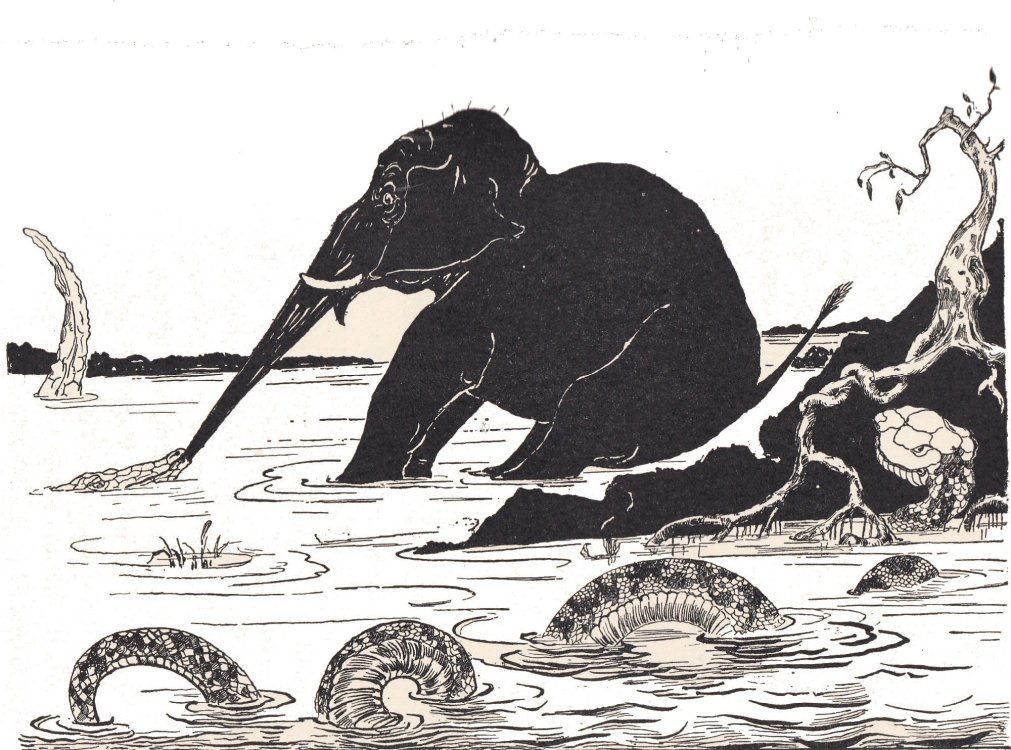
This is the Elephant’s Child having his nose pulled by the Crocodile. He is much surprised and astonished and hurt, and he is talking through his nose and saying, ‘Led go! You are hurtig be!’ He is pulling very hard, and so is the Crocodile; but the Bi-Coloured-Python-Rock-Snake is hurrying through the water to help the Elephant’s Child. All that black stuff is the banks of the great grey-green, greasy Limpopo River (but I am not allowed to paint these pictures), and the bottly-tree with the twisty roots and the eight leaves is one of the fever trees that grow there.

Underneath the truly picture are shadows of African animals walking into an African ark. There are two lions, two ostriches, two oxen, two I camels, two sheep, and two other things that look like rats, but I think they are rock-rabbits. They don’t mean anything. I put them in because I thought they looked pretty. They would look very fine if I were allowed to paint them.

image

Then the Elephant’s Child felt his legs slipping, and he said through his nose, which was now nearly five feet long, ‘This is too butch for be!’

Then the Bi-Coloured-Python-Rock-Snake came down from the bank, and knotted himself in a double-clove-hitch round the Elephant’s Child’s hind legs, and said, ‘Rash and inexperienced traveller, we will now seriously devote ourselves to a little high tension, because if we do not, it is my impression that yonder self-propelling man-of-war with the armour-plated upper deck’ (and by this, O Best Beloved, he meant the Crocodile), ‘will permanently vitiate your future career.

That is the way all Bi-Coloured-Python-Rock-Snakes always talk.

So he pulled, and the Elephant’s Child pulled, and the Crocodile pulled; but the Elephant’s Child and the Bi-Coloured-Python-Rock-Snake pulled hardest; and at last the Crocodile let go of the Elephant’s Child’s nose with a plop that you could hear all up and down the Limpopo.

Then the Elephant’s Child sat down most hard and sudden; but first he was careful to say ‘Thank you’ to the Bi-Coloured-Python-Rock-Snake; and next he was kind to his poor pulled nose, and wrapped it all up in cool banana leaves, and hung it in the great grey-green, greasy Limpopo to cool. ‘What are you doing that for?’ said the Bi-Coloured-Python-Rock-Snake.

”Scuse me,’ said the Elephant’s Child, ‘but my nose is badly out of shape, and I am waiting for it to shrink’.

‘Then you will have to wait a long time, said the Bi-Coloured-Python-Rock-Snake. ‘Some people do not know what is good for them.’

The Elephant’s Child sat there for three days waiting for his nose to shrink. But it never grew any shorter, and, besides, it made him squint. For, O Best Beloved, you will see and understand that the Crocodile had pulled it out into a really truly trunk same as all Elephants have to-day.

At the end of the third day a fly came and stung him on the shoulder, and before he knew what he was doing he lifted up his trunk and hit that fly dead with the end of it.

”Vantage number one!’ said the Bi-Coloured-Python-Rock-Snake. ‘You couldn’t have done that with a mere-smear nose. Try and eat a little now.’

Before he thought what he was doing the Elephant’s Child put out his trunk and plucked a large bundle of grass, dusted it clean against his fore-legs, and stuffed it into his own mouth.

‘Vantage number two!’ said the Bi-Coloured-Python-Rock-Snake. ‘You couldn’t have done that with a mear-smear nose. Don’t you think the sun is very hot here?’

‘It is,’ said the Elephant’s Child, and before he thought what he was doing he schlooped up a schloop of mud from the banks of the great grey-green, greasy Limpopo, and slapped it on his head, where it made a cool schloopy-sloshy mud-cap all trickly behind his ears.

‘Vantage number three!’ said the Bi-Coloured-Python-Rock-Snake. ‘You couldn’t have done that with a mere-smear nose. Now how do you feel about being spanked again?’

”Scuse me,’ said the Elephant’s Child, ‘but I should not like it at all.’

‘How would you like to spank somebody?’ said the Bi-Coloured-Python-Rock-Snake.

‘I should like it very much indeed,’ said the Elephant’s Child.

‘Well,’ said the Bi-Coloured-Python-Rock-Snake, ‘you will find that new nose of yours very useful to spank people with.’

‘Thank you,’ said the Elephant’s Child, ‘I’ll remember that; and now I think I’ll go home to all my dear families and try.’

image

So the Elephant’s Child went home across Africa frisking and whisking his trunk. When he wanted fruit to eat he pulled fruit down from a tree, instead of waiting for it to fall as he used to do.

When he wanted grass he plucked grass up from the ground, instead of going on his knees as he used to do. When the flies bit him he broke off the branch of a tree and used it as fly-whisk; and he made himself a new, cool, slushy-squshy mud-cap whenever the sun was hot. When he felt lonely walking through Africa he sang to himself down his trunk, and the noise was louder than several brass bands.

He went especially out of his way to find a broad Hippopotamus (she was no relation of his), and he spanked her very hard, to make sure that the Bi-Coloured-Python-Rock-Snake had spoken the truth about his new trunk. The rest of the time he picked up the melon rinds that he had dropped on his way to the Limpopoโ€”for he was a Tidy Pachyderm.

One dark evening he came back to all his dear families, and he coiled up his trunk and said, ‘How do you do?’ They were very glad to see him, and immediately said, ‘Come here and be spanked for your ‘satiable curtiosity.’

‘Pooh,’ said the Elephant’s Child. ‘I don’t think you peoples know anything about spanking; but I do, and I’ll show you.’ Then he uncurled his trunk and knocked two of his dear brothers head over heels.

‘O Bananas!’ said they, ‘where did you learn that trick, and what have you done to your nose?’

‘I got a new one from the Crocodile on the banks of the great grey-green, greasy Limpopo River,’ said the Elephant’s Child. ‘I asked him what he had for dinner, and he gave me this to keep.’

‘It looks very ugly,’ said his hairy uncle, the Baboon.

‘It does,’ said the Elephant’s Child. ‘But it’s very useful,’ and he picked up his hairy uncle, the Baboon, by one hairy leg, and hove him into a hornet’s nest.

Then that bad Elephant’s Child spanked all his dear families for a long time, till they were very warm and greatly astonished. He pulled out his tall Ostrich aunt’s tail-feathers; and he caught his tall uncle, the Giraffe, by the hind-leg, and dragged him through a thorn-bush; and he shouted at his broad aunt, the Hippopotamus, and blew bubbles into her ear when she was sleeping in the water after meals; but he never let any one touch Kolokolo Bird.

At last things grew so exciting that his dear families went off one by one in a hurry to the banks of the great grey-green, greasy Limpopo River, all set about with fever-trees, to borrow new noses from the Crocodile. When they came back nobody spanked anybody any more; and ever since that day, O Best Beloved, all the Elephants you will ever see, besides all those that you won’t, have trunks precisely like the trunk of the ‘satiable Elephant’s Child.

I keep six honest serving-men:
      (They taught me all I knew)
Their names are What and Where and When
      And How and Why and Who.
I send them over land and sea, I send them east and west; But after they have worked for me, I give them all a rest. I let them rest from nine till five. For I am busy then, As well as breakfast, lunch, and tea, For they are hungry men:
But different folk have different views: I know a person smallโ€” She keeps ten million serving-men, Who get no rest at all!
She sends 'em abroad on her own affairs, From the second she opens her eyesโ€” One million Hows, two million Wheres, And seven million Whys!
image

some notes by Lisa Lewis image

Here is a PDF version of the story


The black & white illustrations are by Rudyard Kipling himself, the coloured titled picture was created by Joseph M. Gleeson in 1912.

How the Leopard got his Spots

image

IN the days when everybody started fair, Best Beloved, the Leopard lived in a place called the High Veldt. ‘Member it wasn’t the Low Veldt, or the Bush Veldt, or the Sour Veldt, but the ‘sclusively bare, hot, shiny High Veldt, where there was sand and sandyโ€“coloured rock and ‘sclusively tufts of sandyโ€“yellowish grass.

The Giraffe and the Zebra and the Eland and the Koodoo and the Hartebeest lived there; and they were ‘sclusively sandyโ€“yellowโ€“brownish all over; but the Leopard, he was the ‘sclusivest sandiestโ€“yellowishโ€“brownest of them allโ€”a greyishโ€“yellowish cattyโ€“shaped kind of beast, and he matched the ‘sclusively yellowishโ€“greyishโ€“brownish colour of the High Veldt to one hair. This was very bad for the Giraffe and the Zebra and the rest of them; for he would lie down by a ‘sclusively yellowishโ€“greyishโ€“brownish stone or clump of grass, and when the Giraffe or the Zebra or the Eland or the Koodoo or the Bushโ€“Buck or the Bonteโ€“Buck came by he would surprise them out of their jumpsome lives. He would indeed!

And, also, there was an Ethiopian with bows and arrows (a ‘sclusively greyishโ€“brownishโ€“yellowish man he was then), who lived on the High Veldt with the Leopard; and the two used to hunt togetherโ€”the Ethiopian with his bows and arrows, and the Leopard ‘sclusively with his teeth and clawsโ€”till the Giraffe and the Eland and the Koodoo and the Quagga and all the rest of them didn’t know which way to jump, Best Beloved. They didn’t indeed!

After a long timeโ€”things lived for ever so long in those daysโ€”they learned to avoid anything that looked like a Leopard or an Ethiopian; and bit by bitโ€”the Giraffe began it, because his legs were the longestโ€”they went away from the High Veldt. They scuttled for days and days and days till they came to a great forest, ‘sclusively full of trees and bushes and stripy, speckly, patchyโ€“blatchy shadows, and there they hid: and after another long time, what with standing half in the shade and half out of it, and what with the slipperyโ€“slidy shadows of the trees falling on them, the Giraffe grew blotchy, and the Zebra grew stripy, and the Eland and the Koodoo grew darker, with little wavy grey lines on their backs like bark on a tree trunk; and so, though you could hear them and smell them, you could very seldom see them, and then only when you knew precisely where to look.

They had a beautiful time in the ‘sclusively specklyโ€“spickly shadows of the forest, while the Leopard and the Ethiopian ran about over the ‘sclusively greyishโ€“yellowishโ€“reddish High Veldt outside, wondering where all their breakfasts and their dinners and their teas had gone. At last they were so hungry that they ate rats and beetles and rockโ€“rabbits, the Leopard and the Ethiopian, and then they had the Big Tummyโ€“ache, both together; and then they met Baviaanโ€”the dogโ€“headed, barking Baboon, who is Quite the Wisest Animal in All South Africa.

image


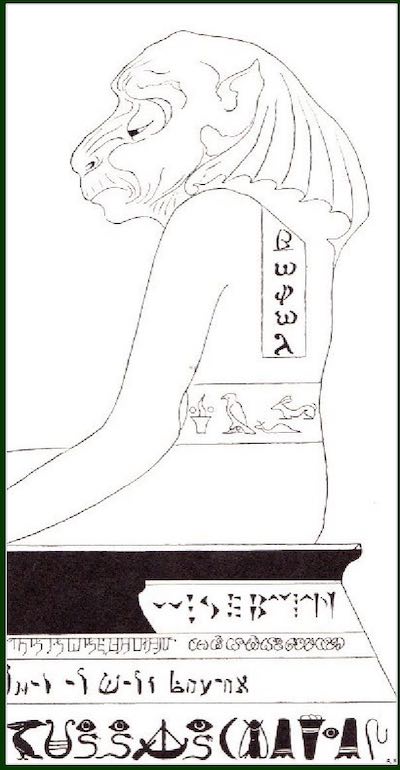
This is Wise Baviaan, the dogโ€“headede Baboon, who is Quite the Wisest Animal in all South Africa, I have drawn him from a stautue that I made up out of my own head, and I have written his name on his belt and on his shoulder and on the thing he is sitting on.

I have written it in what is not called Coptic and Hieroglyphic and Cuneiformic and Bengalic and Burmic and Hebric, all because he is so wise. He is not beautiful, but he is very wise; and I should like to paint him with paintbox colours but I am not allowed.

The umbrellaโ€“ish thing about his head is his Conventional Mane.image

Said Leopard to Baviaan (and it was a very hot day), ‘Where has all the game gone?’

And Baviaan winked. He knew.

Said the Ethiopian to Baviaan, ‘Can you tell me the present habitat of the aboriginal Fauna?’ (That meant just the same thing, but the Ethiopian always used long words. He was a grownโ€“up.)

And Baviaan winked. He knew.

Then said Baviaan, ‘The game has gone into other spots; and my advice to you, Leopard, is to go into other spots as soon as you can.’

And the Ethiopian said, ‘That is all very fine, but I wish to know whither the aboriginal Fauna has migrated.’

Then said Baviaan, ‘The aboriginal Fauna has joined the aboriginal Flora because it was high time for a change; and my advice to you, Ethiopian, is to change as soon as you can.’

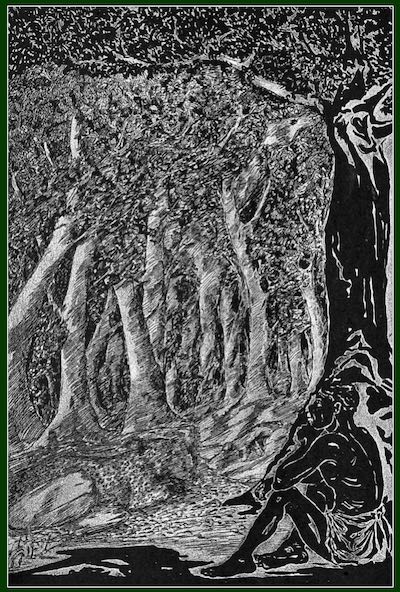
That puzzled the Leopard and the Ethiopian, but they set off to look for the aboriginal Flora, and presently, after ever so many days, they saw a great, high, tall forest full of tree trunks all ‘sclusively speckled and sprottled and spottled, dotted and splashed and slashed and hatched and crossโ€“hatched with shadows. (Say that quickly aloud, and you will see how very shadowy the forest must have been.)

‘What is this,’ said the Leopard, ‘that is so ‘sclusively dark, and yet so full of little pieces of light?’

‘I don’t know, said the Ethiopian, ‘but it ought to be the aboriginal Flora. I can smell Giraffe, and I can hear Giraffe, but I can’t see Giraffe.’

‘That’s curious,’ said the Leopard. ‘I suppose it is because we have just come in out of the sunshine. I can smell Zebra, and I can hear Zebra, but I can’t see Zebra.’

‘Wait a bit, said the Ethiopian. ‘It’s a long time since we’ve hunted ’em. Perhaps we’ve forgotten what they were like.’

‘Fiddle!’ said the Leopard. ‘I remember them perfectly on the High Veldt, especially their marrowโ€“bones. Giraffe is about seventeen feet high, of a ‘sclusively fulvous goldenโ€“yellow from head to heel; and Zebra is about four and a half feet high, of a’sclusively greyโ€“fawn colour from head to heel.’

‘Umm, said the Ethiopian, looking into the specklyโ€“spickly shadows of the aboriginal Floraโ€“forest. ‘Then they ought to show up in this dark place like ripe bananas in a smokehouse.’

But they didn’t. The Leopard and the Ethiopian hunted all day; and though they could smell them and hear them, they never saw one of them.

‘For goodness’ sake,’ said the Leopard at teaโ€“time, ‘let us wait till it gets dark. This daylight hunting is a perfect scandal.’

So they waited till dark, and then the Leopard heard something breathing sniffily in the starlight that fell all stripy through the branches, and he jumped at the noise, and it smelt like Zebra, and it felt like Zebra, and when he knocked it down it kicked like Zebra, but he couldn’t see it. So he said, ‘Be quiet, O you person without any form. I am going to sit on your head till morning, because there is something about you that I don’t understand.’

Presently he heard a grunt and a crash and a scramble, and the Ethiopian called out, ‘I’ve caught a thing that I can’t see. It smells like Giraffe, and it kicks like Giraffe, but it hasn’t any form.’

‘Don’t you trust it,’ said the Leopard. ‘Sit on its head till the morningโ€”same as me. They haven’t any formโ€”any of ’em.’

So they sat down on them hard till bright morningโ€“time, and then Leopard said, ‘What have you at your end of the table, Brother?’

The Ethiopian scratched his head and said, ‘It ought to be ‘sclusively a rich fulvous orangeโ€“tawny from head to heel, and it ought to be Giraffe; but it is covered all over with chestnut blotches. What have you at your end of the table, Brother?’

And the Leopard scratched his head and said, ‘It ought to be ‘sclusively a delicate greyishโ€“fawn, and it ought to be Zebra; but it is covered all over with black and purple stripes. What in the world have you been doing to yourself, Zebra? Don’t you know that if you were on the High Veldt I could see you ten miles off? You haven’t any form.’

‘Yes,’ said the Zebra, ‘but this isn’t the High Veldt. Can’t you see?’

‘I can now,’ said the Leopard. ‘But I couldn’t all yesterday. How is it done?’

‘Let us up,’ said the Zebra, ‘and we will show you.

They let the Zebra and the Giraffe get up; and Zebra moved away to some little thornโ€“bushes where the sunlight fell all stripy, and Giraffe moved off to some tallish trees where the shadows fell all blotchy.

‘Now watch,’ said the Zebra and the Giraffe. ‘This is the way it’s done. Oneโ€”twoโ€”three! And where’s your breakfast?’

Leopard stared, and Ethiopian stared, but all they could see were stripy shadows and blotched shadows in the forest, but never a sign of Zebra and Giraffe. They had just walked off and hidden themselves in the shadowy forest.

‘Hi! Hi!’ said the Ethiopian. ‘That’s a trick worth learning. Take a lesson by it, Leopard. You show up in this dark place like a bar of soap in a coalโ€“scuttle.’

‘Ho! Ho!’ said the Leopard. ‘Would it surprise you very much to know that you show up in this dark place like a mustardโ€“plaster on a sack of coals?’

‘Well, calling names won’t catch dinner, said the Ethiopian. ‘The long and the little of it is that we don’t match our backgrounds. I’m going to take Baviaan’s advice. He told me I ought to change; and as I’ve nothing to change except my skin I’m going to change that.’

‘What to?’ said the Leopard, tremendously excited.

‘To a nice working blackishโ€“brownish colour, with a little purple in it, and touches of slatyโ€“blue. It will be the very thing for hiding in hollows and behind trees.’

So he changed his skin then and there, and the Leopard was more excited than ever; he had never seen a man change his skin before.

‘But what about me?’ he said, when the Ethiopian had worked his last little finger into his fine new black skin.

‘You take Baviaan’s advice too. He told you to go into spots.’

‘So I did,’ said the Leopard. I went into other spots as fast as I could. I went into this spot with you, and a lot of good it has done me.’

‘Oh,’ said the Ethiopian, ‘Baviaan didn’t mean spots in South Africa. He meant spots on your skin.’

‘What’s the use of that?’ said the Leopard.

‘Think of Giraffe,’ said the Ethiopian. ‘Or if you prefer stripes, think of Zebra. They find their spots and stripes give them perโ€“fect satisfaction.’

‘Umm,’ said the Leopard. ‘I wouldn’t look like Zebraโ€”not for ever so.’

‘Well, make up your mind,’ said the Ethiopian, ‘because I’d hate to go hunting without you, but I must if you insist on looking like a sunโ€“flower against a tarred fence.’

‘I’ll take spots, then,’ said the Leopard; ‘but don’t make ’em too vulgarโ€“big. I wouldn’t look like Giraffeโ€”not for ever so.’

‘I’ll make ’em with the tips of my fingers,’ said the Ethiopian. ‘There’s plenty of black left on my skin still. Stand over!’

Then the Ethiopian put his five fingers close together (there was plenty of black left on his new skin still) and pressed them all over the Leopard, and wherever the five fingers touched they left five little black marks, all close together. You can see them on any Leopard’s skin you like, Best Beloved. Sometimes the fingers slipped and the marks got a little blurred; but if you look closely at any Leopard now you will see that there are always five spotsโ€”off five fat black fingerโ€“tips.

image


THIS is the picture of the Leopard and the Ethiopian after they had taken Wise Baviaan’s advice and the Leopard had gone into other spots and the Ethiopian had changed his skin. The Leopard was called Spots, and he has been called Spots ever since.

They are out hunting in the spicklyโ€“speckly forest, and they are looking for Mr. Oneโ€“Twoโ€“Threeโ€“Where’sโ€“yourโ€“Breakfast. If you look a little you will see Mr. Oneโ€“Twoโ€“Three not far away.

The Ethiopian has hidden behind a splotchyโ€“blotchy tree because it matches his skin, and the Leopard is lying beside a spicklyโ€“speckly bank of stones because it matches his spots.

Mr. Oneโ€“Twoโ€“Threeโ€“Where’sโ€“yourโ€“Breakfast is standing up eating leaves from a tall tree. This is really a puzzleโ€“picture like ‘Findโ€“theโ€“Cat.’ image

‘Now you are a beauty!’ said the Ethiopian. ‘You can lie out on the bare ground and look like a heap of pebbles. You can lie out on the naked rocks and look like a piece of puddingโ€“stone. You can lie out on a leafy branch and look like sunshine sifting through the leaves; and you can lie right across the centre of a path and look like nothing in particular. Think of that and purr!’

‘But if I’m all this,’ said the Leopard, ‘why didn’t you go spotty too?’

‘Oh, plain black’s best’ said the Ethiopian. ‘Now come along and we’ll see if we can’t get even with Mr. Oneโ€“Twoโ€“Threeโ€“Where’sโ€“yourโ€“Breakfast!’

So they went away and lived happily ever afterward, Best Beloved. That is all.

Oh, now and then you will hear grownโ€“ups say, ‘Can the Ethiopian change his skin or the Leopard his spots?’ I don’t think even grownโ€“ups would keep on saying such a silly thing if the Leopard and the Ethiopian hadn’t done it onceโ€”do you? But they will never do it again, Best Beloved. They are quite contented as they are.

I AM the Most Wise Baviaan, saying in most wise tones,
'Let us melt into the landscapeโ€”just us two by our lones.'
People have comeโ€”in a carriageโ€”calling. But Mummy is there....
Yes, I can go if you take meโ€”Nurse says she don't care.
Let's go up to the pigโ€“sties and sit on the farmyard rails!
Let's say things to the bunnies, and watch 'em skitter their tails!
Let'sโ€”oh, anything, daddy, so long as it's you and me,
And going truly exploring, and not being in till tea!
Here's your boots (I've brought 'em), and here's your cap and stick,
And here's your pipe and tobacco. Oh, come along out of it โ€” quick.
image

some notes by Lisa Lewis

Here is a PDF version of the story


The black & white illustrations are by Rudyard Kipling himself, the coloured title picture was created by Joseph M. Gleeson in 1912.

This story has been edited to remove some offensive wording, as we specifically recommend it for young people


How the Rhinoceros got his Skin

image
listen to the story


image

ONCE upon a time, on an uninhabited island on the shores of the Red Sea, there lived a Parsee from whose hat the rays of the sun were reflected in more-than-oriental splendour. And the Parsee lived by the Red Sea with nothing but his hat and his knife and a cooking-stove of the kind that you must particularly never touch. And one day he took flour and water and currants and plums and sugar and things, and made himself one cake which was two feet across and three feet thick. It was indeed a Superior Comestible (that’s magic), and he put it on the stove because he was allowed to cook on the stove, and he baked it and he baked it till it was all done brown and smelt most sentimental. But just as he was going to eat it there came down to the beach from the Altogether Uninhabited Interior one Rhinoceros with a horn on his nose, two piggy eyes, and few manners.

image

In those days the Rhinoceros’s skin fitted him quite tight. There were no wrinkles in it anywhere. He looked exactly like a Noah’s Ark Rhinoceros, but of course much bigger. All the same, he had no manners then, and he has no manners now, and he never will have any manners. He said, ‘How!’ and the Parsee left that cake and climbed to the top of a palm tree with nothing on but his hat, from which the rays of the sun were always reflected in more-than-oriental splendour.

And the Rhinoceros upset the oil-stove with his nose, and the cake rolled on the sand, and he spiked that cake on the horn of his nose, and he ate it, and he went away, waving his tail, to the desolate and Exclusively Uninhabited Interior which abuts on the islands of Mazanderan, Socotra, and Promontories of the Larger Equinox. Then the Parsee came down from his palm-tree and put the stove on its legs and recited the following Sloka, which, as you have not heard, I will now proceed to relate:โ€”

'Them that takes cakes
Which the Parsee-man bakes
Makes dreadful mistakes.'

And there was a great deal more in that than you would think.

Because, five weeks later, there was a heat wave in the Red Sea, and everybody took off all the clothes they had. The Parsee took off his hat; but the Rhinoceros took off his skin and carried it over his shoulder as he came down to the beach to bathe. In those days it buttoned underneath with three buttons and looked like a waterproof. He said nothing whatever about the Parsee’s cake, because he had eaten it all; and he never had any manners, then, since, or henceforward. He waddled straight into the water and blew bubbles through his nose, leaving his skin on the beach.And there was a great deal more in that than you would think.

Presently the Parsee came by and found the skin, and he smiled one smile that ran all round his face two times. Then he danced three times round the skin and rubbed his hands. Then he went to his camp and filled his hat with cake-crumbs, for the Parsee never ate anything but cake, and never swept out his camp. He took that skin, and he shook that skin, and he scrubbed that skin, and he rubbed that skin just as full of old, dry, stale, tickly cake-crumbs and some burned currants as ever it could possibly hold. Then he climbed to the top of his palm-tree and waited for the Rhinoceros to come out of the water and put it on.

image

This is the Parsec Pestonjee Bomonjee sitting in his palm-tree and watching the Rhinoceros Strorks bathing near the beach of the Altogether Uninhabited Island after Strorks had taken off his skin.

The Parsec has rubbed the cake-crumbs into the skin, and he is smiling to think how they will tickle Strorks when Strorks puts it on again. The skin is just under the rocks below the palm-tree in a cool place ; that is why you can’t see it.

The Parsec is wearing a new more-than-oriental-splendour hat of the sort that Parsecs wear; and he has a knife in his hand to cut his name on palm-trees. The black things on the islands out at sea are bits of ships that got wrecked going down the Red Sea; but all the passengers were saved and went home.

The black thing in the water close to the shore is not a wreck at all. It is Strorks the Rhinoceros bathing without his skin. He was just as black underneath his skin as he was outside. I wouldn’t ask anything about the cooking-stove if I were you. image

And the Rhinoceros did. He buttoned it up with the three buttons, and it tickled like cake crumbs in bed. Then he wanted to scratch, but that made it worse; and then he lay down on the sands and rolled and rolled and rolled, and every time he rolled the cake crumbs tickled him worse and worse and worse. Then he ran to the palm-tree and rubbed and rubbed and rubbed himself against it. He rubbed so much and so hard that he rubbed his skin into a great fold over his shoulders, and another fold underneath, where the buttons used to be (but he rubbed the buttons off), and he rubbed some more folds over his legs. And it spoiled his temper, but it didn’t make the least difference to the cake-crumbs. They were inside his skin and they tickled. So he went home, very angry indeed and horribly scratchy; and from that day to this every rhinoceros has great folds in his skin and a very bad temper, all on account of the cake-crumbs inside.

But the Parsee came down from his palm-tree, wearing his hat, from which the rays of the sun were reflected in more-than-oriental splendour, packed up his cooking-stove, and went away in the direction of Orotavo, Amygdala, the Upland Meadows of Anantarivo, and the Marshes of Sonaput.

THIS Uninhabited Island
      Is off Cape Gardafui,
By the Beaches of Socotra
      And the Pink Arabian Sea:
But it's hotโ€“too hot from Suez
      For the likes of you and me
            Ever to go
            In a P. and 0.
And call on the Cakeโ€“Parsee!

ย 

some notes by Lisa Lewis image

Here is a PDF version of the story

ย 
ย 

The black & white illustrations are by Rudyard Kipling himself, the coloured one was created by Joseph M. Gleeson in 1912.

How the Camel got his Hump

image


listen to the tale
image
ย 

Now this is the next tale, and it tells how the Camel got his big hump.

In the beginning of years, when the world was so new and all, and the Animals were just beginning to work for Man, there was a Camel, and he lived in the middle of a Howling Desert because he did not want to work; and besides, he was a Howler himself. So he ate sticks and thorns and tamarisks and milkweed and prickles, most ‘scruciating idle; and when anybody spoke to him he said ‘Humph!’ Just ‘Humph!’ and no more.

Presently the Horse came to him on Monday morning, with a saddle on his back and a bit in his mouth, and said, ‘Camel, O Camel, come out and trot like the rest of us.’

‘Humph!’ said the Camel; and the Horse went away and told the Man.

Presently the Dog came to him, with a stick in his mouth, and said, ‘Camel, O Camel, come and fetch and carry like the rest of us.’

‘Humph!’ said the Camel; and the Dog went away and told the Man.

Presently the Ox came to him, with the yoke on his neck and said, ‘Camel, O Camel, come and plough like the rest of us.’

‘Humph!’ said the Camel; and the Ox went away and told the Man.

At the end of the day the Man called the Horse and the Dog and the Ox together, and said, ‘Three, O Three, I’m very sorry for you (with the world so new-and-all); but that Humph-thing in the Desert can’t work, or he would have been here by now, so I am going to leave him alone, and you must work double-time to make up for it.’

That made the Three very angry (with the world so new-and-all), and they held a palaver, and an indaba, and a punchayet, and a pow-wow on the edge of the Desert; and the Camel came chewing on milkweed most ‘scruciating idle, and laughed at them. Then he said ‘Humph!’ and went away again.

image

Presently there came along the Djinn in charge of All Deserts, rolling in a cloud of dust (Djinns always travel that way because it is Magic), and he stopped to palaver and pow-pow with the Three.

‘Djinn of All Deserts,’ said the Horse, ‘is it right for any one to be idle, with the world so new-and-all?’

‘Certainly not,’ said the Djinn.

‘Well,’ said the Horse, ‘there’s a thing in the middle of your Howling Desert (and he’s a Howler himself) with a long neck and long legs, and he hasn’t done a stroke of work since Monday morning. He won’t trot.’

‘Whew!’ said the Djinn, whistling, ‘that’s my Camel, for all the gold in Arabia! What does he say about it?’

‘He says “Humph!”‘ said the Dog; ‘and he won’t fetch and carry.’

‘Does he say anything else?’

‘Only “Humph!”; and he won’t plough,’ said the Ox.

‘Very good,’ said the Djinn. ‘I’ll humph him if you will kindly wait a minute.’

The Djinn rolled himself up in his dust-cloak, and took a bearing across the desert, and found the Camel most ‘scruciatingly idle, looking at his own reflection in a pool of water.

‘My long and bubbling friend,’ said the Djinn, ‘what’s this I hear of your doing no work, with the world so new-and-all?’

‘Humph!’ said the Camel.

The Djinn sat down, with his chin in his hand, and began to think a Great Magic, while the Camel looked at his own reflection in the pool of water.

image

This is the picture of the Djinn making the beginnings of the Magic that brought the Humph to the Camel. First he drew a line in the air with his finger, and it became solid; and then he made a cloud, and then he made an egg – you can see them at the bottom of the picture – and then there was a magic pumpkin that turned into a big white flame.

Then the Djinn took his magic fan and fanned that flame till the flame turned into a Magic by itself. It was a good Magic and a very kind Magic really, though it had to give the Camel a Humph because the Camel was lazy. The Djinn in charge of All Deserts was one of the nicest of the Djinns, so he would never do anything really unkind. image

‘You’ve given the Three extra work ever since Monday morning, all on account of your ‘scruciating idleness,’ said the Djinn; and he went on thinking Magics, with his chin in his hand.

‘Humph!’ said the Camel.

‘I shouldn’t say that again if I were you,’ said the Djinn; ‘you might say it once too often. Bubbles, I want you to work.’

And the Camel said ‘Humph!’ again; but no sooner had he said it than he saw his back, that he was so proud of, puffing up and puffing up into a great big lolloping humph.

image

Here is the picture of the Djinn in charge of All Deserts guiding the Magic with his magic fan. The Camel is eating a twig of acacia, and he has just finished saying “humph” once too often (the Djinn told him he would), and so the Humph is coming.

The long towelly-thing growing out of the thing like an onion is the Magic, and you can see the Humph on its shoulder. The Humph fits on the flat part of the Camel’s back. The Camel is too busy looking at his own beautiful self in the pool of water to know what is going to happen to him.

Underneath the truly picture is a picture of the World so new-and-all. There are two smoky volcanoes in it, some other mountains and some stones and a lake and a black island and a twisty river and a lot of other things, as well as a Noah’s Ark. I couldn’t draw all the deserts that the Djinn was in charge of, so I only drew one, but it is a most deserty desert. image

‘Do you see that?’ said the Djinn. ‘That’s your very own humph that you’ve brought upon your very own self by not working. To-day is Thursday, and you’ve done no work since Monday, when the work began. Now you are going to work.’

‘How can I,’ said the Camel, ‘with this humph on my back?’

‘That’s made a-purpose,’ said the Djinn, ‘all because you missed those three days. You will be able to work now for three days without eating, because you can live on your humph; and don’t you ever say I never did anything for you. Come out of the Desert and go to the Three, and behave. Humph yourself!’

And the Camel humphed himself, humph and all, and went away to join the Three. And from that day to this the Camel always wears a humph (we call it ‘hump’ now, not to hurt his feelings); but he has never yet caught up with the three days that he missed at the beginning of the world, and he has never yet learned how to behave.

THE Camel's hump is an ugly lump
      Which well you may see at the Zoo;
But uglier yet is the hump we get
      From having too little to do.
Kiddies and grown-ups too-oo-oo,
If we haven't enough to do-oo-oo,
             We get the humpโ€”
             Cameelious humpโ€”
The hump that is black and blue!

We climb out of bed with a frouzly head,
      And a snarly-yarly voice.
We shiver and scowl and we grunt and we growl
      At our bath and our boots and our toys;

And there ought to be a corner for me
(And I know' there is one for you)
             When we get the humpโ€”
             Cameelious humpโ€”
The hump that is black and blue!

The cure for this ill is not to sit still,
      Or frowst with a book by the fire;
But to take a large hoe and a shovel also,
      And dig till you gently perspire;

And then you will find that the sun and the wind,
And the Djinn of the Garden too,
             Have lifted the humpโ€”
             The horrible humpโ€”
The hump that is black and blue!

I get it as well as you-oo-oo
If I haven't enough to do-oo-oo!
             We all get humpโ€”
             Cameelious humpโ€”
Kiddies and grown-ups too! image


some notes by Lisa Lewis image

Here is a PDF version of the story

ย 

The black & white illustrations are by Rudyard Kipling himself, the coloured ones were created by Joseph M. Gleeson in 1912.

The Tabu Tale

A Just So Story
byย Rudyard Kipling


THE MOST IMPORTANT thing about Tegumai Bopsulai and his dear daughter, Taffimai Metallumai, were the Tabus of Tegumai, which were all Bopsulai.

Listen and attend, and remember, O Best Beloved; because we know about Tabus, you and I.

When Taffimai Metallumai (but you can still call her Taffy) went out into the woods hunting with Tegumai, she never kept still. She kept veryย unstill. She danced among dead leaves, she did. She snapped dry branches off, she did. She slid down banks and pits, she did quarries and pits of sand, she did. She splashed through swamps and bogs, she did; and she made a horrible noise! So all the animals that they hunted โ€“ squirrels, beavers, otters, badgers, and deer, and the rabbits โ€“ knew when Taffy and her Daddy were coming, and ran away.

Then Taffy said, ‘I’m awfully sorry, Daddy, dear.’ Then Tegumai said, ‘What’s the use of being sorry? The squirrels have gone, and the beavers have dived, the deer have jumped, and the rabbits are deep in their buries. You ought to be beaten, O Daughter of Tegumai, and I would, too, if I didn’t happen to love you.’ Just then he saw a squirrel kinking and prinking round the trunk of an ash-tree, and he said, ‘H’sh! There’s our lunch, Taffy, if you’ll only keep quiet.’

Taffy said, ‘Where? Where? Show me! Show!’ She said it in a raspy-gaspy whisper that would have frightened a steam-cow, and she skittered about in the bracken, being a ‘citable child; and the squirrel flicked his tail and went off in large, free, loopy-legs to about the middle of Sussex before he ever stopped.

Tegumai was severely angry. He stood quite still, making up his mind whether it would be better to boil Taffy, or skin Taffy, or tattoo Taffy, or cut her hair, or send her to bed for one night without being kissed; and while he was thinking, the Head Chief of the Tribe of Tegumai came through the woods all in his eagle-feathers.

He was the Head Chief of the High and the Low and the Middle Medicine for the whole Tribe of Tegumai, and he and Taffy were rather friends.

He said to Tegumai, ‘What is the matter, O Chiefest of Bopsulai? You look angry.’

‘I am angry,’ said Tegumai, and he told the Head Chief all about Taffy’s very unstillness in the woods; and about the way she frightened the game; and about her falling into swamps because she would look behind her when she ran; and about her falling out of trees because she wouldn’t take good hold on both sides of her; and about her getting her legs all greeny with duckweed from ponds and places, and bringing it sploshing into the Cave. The Head Chief shook his head till the eagle-feathers and the little shells on his forehead rattled, and then he said, ‘Well, well! I’ll see about it later. I wanted to talk to you, O Tegumai, on serious business.’

‘Talk away, O Head Chief,’ said Tegumai, and they both sat down politely.

‘Observe and take notice, O Tegumai,’ said the Head Chief. ‘The Tribe of Tegumai have been fishing the Wagai river ever so long and ever so much too much. Consequence is, there’s hardly any carp of any size left in it, and even the little carps are going away. What do you think of putting the big Tribal Tabu on it, so as to stop every one fishing there for six months?’

‘That’s a good plan, O Head Chief,’ said Tegumai. ‘But what will the consequence be if any of our people break tabu?’

‘Consequence will be, O Tegumai,’ said the Head Chief, ‘that we will make them understand it with sticks and stinging-nettles and dobs of mud; and if that doesn’t teach them, we’ll draw fine, freehand Tribal patterns on their backs with the cutty edges of mussel-shells. Come along with me, O Tegumai, and we will proclaim the Tribal Tabu on the Wagai river.’

Then they went up to the Head Chief’s head house, where all the Tribal Magic of Tegumai belonged; and they brought out theย Big Tribal Tabu-pole, made of wood, with the image of the Tribal Beaver of Tegumai and the other animals carved on top, and all the Tribal Tabuโ€“marks carved underneath.

Then they called up the Tribe of Tegumai with the Big Tribal Horn that roars and blores, and the Middle Tribal Conch that squeaks and squawks, and the Little Tribal Drum that taps and raps.

They made a lovely noise, and Taffy was allowed to beat the Little Tribal Drum, because she was rather friends with the Head Chief.

When all the Tribe had come together in front of the Head Chief’s house, the Head Chief stood up and said and sang: ‘O Tribe of Tegumai! The Wagai river has been fished too much, and the carp-fish are getting frightened. Nobody must fish in the Wagai river for six months. It is tabu both sides and the middle; on all islands and mud-banks. It is tabu to bring a fishing-spear nearer than ten man-strides to the bank of the river. It is tabu, it is tabu, it is most specially tabu, O Tribe of Tegumai! It is tabu for this month and next month and next month and next month and next month and next month. Now go and put up the Tabu-pole by the river, ‘and don’t let anybody pretend that they haven’t understood!’

The Tribal Totem Poleย 

Then the Tribe of Tegumai shouted, and put up the Tabu-pole by the banks of the Wagai river, and swiftly they ran down both banks (half the Tribe on one side and half on the other), and chased away all the small boys who hadn’t attended the meeting because they were looking for crayfish in the river; and then they all praised the Head Chief and Tegumai Bopsulai.

Tegumai went home after this, but Taffy stayed with the Head Chief, because they were rather friends. She was very much surprised. She had never seen a tabu put on anything before, and she said to the Head Chief, ‘What does Tabu mean azactly?’

The Head Chief said, ‘Tabu doesn’t mean anything till you break it, O Only Daughter of Tegumai; but when you break it, it means sticks and stinging-nettles and fine, freehand Tribal patterns drawn on your back with the cutty edges of mussel-shells.’

Then Taffy said, ‘Could I have a tabu of my own โ€“ a little small tabu to play with?’

Then the Head Chief said, ‘I’ll give you a little tabu of your own, just because you made up that picture-writing, which will one day grow into the ABC.’ (You remember howย Taffy and Tegumai made up the Alphabet?ย That was why she and the Head Chief were rather friends.)

He took off one of his magic necklaces โ€“ he had twenty-two of them โ€“ and it was made of bits of pink coral, and he said, ‘If you put this necklace on anything that belongs to you your own self, no one can touch that thing until you take the necklace off. It will only work inside your own Cave; and if you have left anything of yours lying about where you shouldn’t, the tabu won’t work till you have put that thing back in its proper place.’

‘Thank you very much indeed,’ said Taffy. ‘Now, what d’you truly s’pose it will do to my Daddy?’

‘I’m not quite sure,’ said the Head Chief. ‘He may throw himself down on the floor and shout, or he may have cramps, or he may just flop, or he may take Three Sorrowful Steps and say sorrowful words, and then you can pull his hair three times if you like.’ ‘And what will it do to my Mummy?’ said Taffy. ‘There aren’t any tabus on people’s Mummies,’ said the Head Chief.

‘Why not?’ said Taffy.

‘Because if there were tabus on people’s Mummies, people’s Mummies could put tabus on breakfasts, and dinners, and teas, and that would be very bad for the Tribe. Long and long ago the Tribe decided not to have tabus on people’s Mummies โ€“ anywhere โ€“ for anything.’

‘Well,’ said Taffy, ‘do you know if my Daddy has any tabus of his own that will work on me โ€“ s’posin’ I broke a tabu by accident?’ ‘You don’t mean to say,’ said the Head Chief, ‘that your Daddy has never put any tabus on you yet?’

‘No,’ said Taffy; ‘he only says “Don’t!” and gets angry.’ ‘Ah! I suppose he thought you were a kiddy,’ said the Head Chief. ‘Now, if you show him that you’ve a real tabu of your own, I shouldn’t be surprised if he put several real tabus on you.’

‘Thank you,’ said Taffy; ‘but I have a little garden of my own outside the Cave, and if you don’t mind I should like you to make this tabu-necklace work so that if I hang it up on the wild roses in front of the garden, and people go inside, they won’t be able to come out until they have said they are sorry.’

‘Oh, certainly, certainly,’ said the Head Chief. ‘Of course you can tabu your very own garden.’

‘Thank you,’ said Taffy; ‘and now I will go home and see if this tabu truly works.’

When she got back to the Cave, it was nearly time for dinner; and when she came to the door, Teshumai Tewindrow, her dear Mummy, instead of saying, ‘Where have you been, Taffy?’ said, ‘O Daughter of Tegumai, come in and eat,’ same as if she had been a grown-up person. That was because she saw a tabu-necklace on Taffy’s neck.

Her Daddy was sitting in front of the fire waiting for dinner, and he said the very same thing, and Taffy feltย mostย important.

She looked all round the Cave, to see that her own things (her private mendy-bag of otter-skin, with the shark’s teeth and the bone needles and the deer-sinew thread; her mud-shoes of birch-bark; her spear and her throwing-stick and her lunch-basket) were all in their proper places, and then she slipped off her tabu-necklace quite quickly and hung it over the handle of the little wooden water-bucket that she used to draw water with.

Then her Mummy said to Tegumai, her Daddy, quite accidental, ‘O Tegumai! Won’t you get us some fresh drinking-water for dinner?’

‘Certainly,’ said Tegumai, and he jumped up and lifted Taffy’s bucket with the tabu-necklace on it. Next minute he fell down flat on the floor and shouted; then he curled himself up and rolled round the cave; then he stood up and flopped several times.

‘My dear,’ said Teshumai Tewindrow, ‘it looks to me as if you had rather broken somebody’s tabu somehow. Does it hurt?’

‘Horribly,’ said Tegumai. He took Three Sorrowful Steps and put his head on one side, and shouted, ‘I broke tabu! I broke tabu! I broke tabu!’

‘Taffy, dear, that must be your tabu,’ said Teshumai Tewindrow. ‘You’d better pull his hair three times, or he will have to go on shouting till evening; and you know what Daddy is like when he once begins.’

Tegumai stooped down, and Taffy pulled his hair three times; and he wiped his face, and said, ‘My Tribal Word! That’s a dreadful strong tabu of yours, Taffy. Where did you get it from?’

‘The Head Chief gave it me. He told me you’d have cramps and flops if you broke it,’ said Taffy.

‘He was quite right. But he didn’t tell you anything about Sign Tabus, did he?’

‘No,’ said Taffy. ‘He said that if I showed you I had a real tabu of my own, you’d most likely put some real tabus on me.’

‘Quite right, my only daughter dear,’ said Tegumai. ‘I’ll give you some tabus that will simply amaze you โ€“ Stinging-Nettle Tabus, Sign Tabus, Black and White Tabus โ€“ dozens of tabus. Now attend to me. Do you know what this means?’

Tegumai skiffled his forefinger in the air snakyfashion. ‘That’s tabu on wriggling when you’re eating your dinner. It is an important tabu, and if you break it, you’ll have cramps โ€“ same as I did โ€“ or else I’ll have to tattoo you all over.’

Taffy sat quite still through dinner, and then Tegumai held up his right hand in front of him, the fingers close together. ‘That’s the Still Tabu, Taffy. Whenever I do that, you must stop as you are, whatever you are doing. If you are sewing, you must stop with the needle halfway through the deer-skin. If you’re walking, you stop on one foot. If you’re climbing, you stop on one branch. You don’t move until you see me go like this.’

Tegumai put up his right hand, and waved it in front of his face two or three times. ‘That’s the sign for Carry On. You can go on with whatever you are doing when you see me make that.’

‘Aren’t there any necklaces for that tabu?’ said Taffy.

‘Yes. There is a red-and-black necklace, of course, but how can I come tramping through the fern to give you a Still Tabu necklace every time I see a deer or a rabbit, and want you to be quiet?’ said Tegumai. ‘I thought you were a better hunter than that. Why, I might have to shoot an arrow over your head the minute after I had put Still Tabu on you.’

‘But how would I know what you were shooting at?’ said Taffy.

‘Watch my hand,’ said Tegumai. ‘You know the three little jumps a deer gives before he starts to run off – like this?’ He looped his finger three times in the air, and Taffy nodded. ‘When you see me do that, you’ll know we’ve found a deer. A little jiggle of the forefinger means a rabbit.’

‘Yes. Rabbits run like that,’ said Taffy, and jiggled her forefinger the same way.

‘Squirrel’s a long, climby-up twist in the air. Like this!’

‘Same as squirrels kinking round trees. I see,’ said Taffy.

‘Otter’s a long, smooth, straight wave in the air โ€“ like this.’

‘Same as otters swimming in a pool. I see,’ said Taffy.

‘And beaver’s just as if I was smacking somebody with my open hand.’

‘Same as beavers’ tails smacking on the water when they are frightened.ย Iย see.’

‘Those aren’t tabus. Those are just signs to show you what I am hunting. The Still Tabu is the thing you must watch, because it’s a big tabu.’

‘I can put the Still Tabu on, too,’ said Teshumai Tewindrow, who was sewing deer-skins together. ‘I can put it on you, Taffy, when you get too rowdy going to bed.’

‘What happens if I break it?’ said Taffy. ‘You can’t break a tabu except by accident.’ ‘But s’pose I did,’ said Taffy.

‘You’d lose your own tabu-necklace. You’d have to take it back to the Head Chief, and you’d just be called Taffy again, not Daughter of Tegumai. Or perhaps we’d change your name to Tabumai Skellumzulai โ€“ the Bad Thing who can’t keep a Tabu โ€“ and very likely you wouldn’t be kissed for a day and a night.’

‘Umm!’ said Taffy. ‘I don’t think tabus are fun at all.’ ‘Well, take your tabu-necklace back to the Head Chief, and say you want to be a kiddy again, O Only Daughter of Tegumai!’ said her Daddy. ‘No,’ said Taffy. ‘Tell me more about tabus. Can’t I have some more of my very own โ€“ my very own โ€“ strong tabus that give people Tribal Fits?’

‘No,’ said her Daddy. ‘You aren’t old enough to be allowed to give people Tribal Fits. That pink necklace will do quite well for you.’

‘Then tell me more about tabus,’ said Taffy.

‘But I am sleepy, daughter dear. I’ll just put tabu on anyone talking to me till the sun gets behind that hill, and we’ll go out in the evening and see if we can catch rabbits.

Ask Mummy about the other tabus. It’s a great comfort that you are a tabu-girl, because now I shan’t have to tell you anything more than once.’

Taffy talked quietly to her Mummy till the sun was in the right place. Then she waked Tegumai, and they both got their hunting things ready and went out into the woods. But just as she passed her little garden outside the Cave, Taffy took off her tabu-necklace and hung it on a rose-bush. Her garden-border was only marked with white stones, but she called the Rose the real gate into it, and all the Tribe knew it.

‘Who do you s’pose you’ll catch?’ said Tegumai. ‘Wait and see till we come back,’ said Taffy. ‘The Head Chief said that anyone who breaks that tabu will have to stay in my garden till I let him out.’ They went along through the woods, and crossed the Wagai river on a fallen tree, and they climbed up to the top of a big bare hill where there were plenty of rabbits in the fern.

‘Remember you’re a tabu-girl now,’ said Tegumai, when Taffy began to skitter about and ask questions instead of hunting for rabbits; and he made the Still Tabu sign, and Taffy stopped as if she had been all turned into one solid stone. She was stooping to tie up a shoestring, and she stayed still with her hand on the string (We know that kind of tabu, don’t we, Best Beloved?) only she looked hard at her Daddy, which you always must do when the Still Tabu is on. Presently, when he had walked a long way off, he turned round and made the Carry On sign. So she walked forward quietly through the bracken, always looking at her Daddy, and a rabbit jumped up in front of her. She was just going to throw her stick, when she saw Tegumai make the Still Tabu sign, and she stopped with her mouth half open and her throwing-stick in her hand. The rabbit ran towards Tegumai, and Tegumai caught it. Then he came across the fern and kissed his daughter and said, ‘That is what I call a superior girldaughter. It’s some pleasure to hunt with you now, Taffy.’

A little while afterwards, a rabbit jumped up where Tegumai couldn’t see it, but Taffy could, and she knew it was coming towards her if Tegumai did not frighten it; so she held up her hand, made the Rabbit Sign (so as he should know she wasn’t in fun), and she put the Still Tabu on her own Daddy! She did โ€“ indeed she did, Best Beloved!

Tegumai stopped with one foot half lifted to climb over an old tree-trunk. The rabbit ran past Taffy, and Taffy killed it with her throwing-stick; but she was so excited that she forgot to take off the Still Tabu for quite two minutes, and all that time Tegumai stood on one leg, not daring to put his other foot down. Then he came and kissed her and threw her up in the air, and put her on his shoulder and danced and said, ‘My Tribal Word and Testimony! This is what I call having a daughter that is a daughter, O Only Daughter of Tegumai!’ And Taffy was most tremenenssly and wonderhugely pleased.

It was almost dark when they went home. They had five rabbits and two squirrels, as well as a water-rat. Taffy wanted the water-rat’s skin for a purse. (People had to kill water-rats in those days because they couldn’t buy purses, but we know that water-rats are just as much tabu, these particular days, for you and me as anything else that is alive.)

‘I think I’ve kept you out a little too late,’ said Tegumai, when they were near home, ‘and Mummy won’t be pleased with us. Run home, Taffy! You can see the Cave-fire from here.’

Taffy ran along, and that very minute Tegumai heard something crackle in the bushes, and a big, lean, grey wolf jumped out and began to trot quietly after Taffy.

Now, all the Tegumai people hated wolves and killed them whenever they could, and Tegumai had never seen one so close to his Cave before.

He hurried after Taffy, but the wolf heard him, and jumped back into the bushes. Those wolves were afraid of grown-ups, but they used to try and catch the children of the Tribe. Taffy was swinging the water-rat and singing to herself โ€“ her Daddy had taken off all tabus โ€“ so she didn’t notice anything.

There was a little meadow close to the Cave, and by the mouth of the Cave Taffy saw a tall man standing in her rose-garden, but it was too dark to make out properly.

‘I do believe my tabu-necklace has truly caught somebody,’ she said, and she was just running up to look when she heard her Daddy say, ‘Still, Taffy! Still Tabu till I take it off!’ She stopped where she was โ€“ the water-rat in one hand and the throwing-stick in the other โ€“ only turning her head towards her Daddy to be ready for the Carry On sign.

It was the longest Still Tabu she had had put upon her all that day. Tegumai had stepped back close to the wood and was holding his stone throwing-hatchet in one hand, and with the other he was making the Still Tabu sign.

Then she thought she saw something black creeping sideways at her across the grass. It came nearer and nearer, then it moved back a little and then it crawled closer.

Then she heard her Daddy’s stone throwing-hatchet whirr past her shoulder just like a partridge, and at the same time another hatchet whirred out from her rose garden; and there was a howl, and a big grey wolf lay kicking on the grass, quite dead.

Then Tegumai picked her up and kissed her seven times and said, ‘My Tribal Word and Tegumai Testimony, Taffy, but you are a daughter to be proud of. Did you know what it was?’

‘I’m not sure,’ said Taffy. ‘But I think I guessed it was a wolf. I knew you wouldn’t let it hurt me.’

‘Good girl,’ said Tegumai, and he stooped over the wolf and picked up both hatchets. ‘Why, here’s the Head Chief’s hatchet!’ he said, and he held up the Head Chief’s magic throwing-hatchet, with the big greenstone head.

‘Yes,’ said the Head Chief from inside Taffy’s rosegarden, ‘and I’d be very much obliged if you would bring it back to me. I came to call on you this afternoon, and accidentally I stepped into Taffy’s garden before I saw her tabu-necklace on the rose-tree. So, of course, I had to wait, till Taffy came back to let me out.’

Then the Head Chief all in his feathers and shells took the Three Sorrowful Steps with his head on one side, and said, ‘I broke tabu! I broke tabu! I broke tabu!’ and bowed solemnly and statelily before Taffy, till his tall eagle-feathers nearly touched the ground, and he said and he sang, ‘O Daughter of Tegumai, I saw everything that happened. You are a true tabu-girl. I am very pleased at you. At first I wasn’t pleased, because I had to wait in your garden since six o’clock, and I know you only put tabu on your garden for fun.’

‘No, not fun,’ said Taffy. ‘I truly wanted to see if my tabu would catch anybody; but I didn’t know that a little tabu like mine would work on a big Head Chief like you, O Head Chief.’

‘I told you it worked. I gave it to you myself,’ said the Head Chief. ‘Of course it would work. But I don’t mind. I want to tell you, Taffy, my dear, that I wouldn’t have minded staying in your garden from twelve o’clock instead of only six o’clock to see how beautifully you kept that last Still Tabu that your Daddy put on you. I give you my Chiefly Word, Taffy, that a great many men in the Tribe wouldn’t have kept that tabu as you kept it, with that wolf crawling up to you across the grass.’

‘What are you going to do with the wolf-skin, O Head Chief?’ said Tegumai, because any animal that the Head Chief threw his hatchet at belonged to the Head Chief by the Tribal Custom of Tegumai.

‘I am going to give it to Taffy, of course, for a winter cloak, and I’ll make her a magic necklace of her very own out of the teeth and claws,’ said the Head Chief; ‘and I am going to have the story of Taffy and the Still Tabu painted on wood on the Tribal Tabu-Count, so that all the girl-daughters of the Tribe can see and know and remember and understand.’

Taffy’s Still Tabuย 

Then they all three went into the Cave, and Teshumai Tewindrow gave them a most beautiful supper, and the Head Chief took off his eagle-feathers and all his necklaces; and when it was time for Taffy to go to bed in her own little cave, Tegumai and the Head Chief came in to say good-night, and they romped all round the cave, and dragged Taffy over the floor on a deer-skin (same as some people are dragged about on a hearth-rug), and they finished by throwing the otter-skin cushions about and knocking down a lot of old spears and fishing-rods that were hung on the walls. At last things grew so rowdy that Teshumai Tewindrow came in, and said, ‘Still! Still Tabu on every one of you! How do you ever expect that child to go to sleep?’ And they said the really good-night, and Taffy went to sleep.

After that, what happened? Oh, Taffy learned all the tabus just like some people we know. She learned the White Shark Tabu, which made her eat up her dinner instead of playing with it (and that goes with a green-and-white necklace, you know); she learned the Grown-Up Tabu, which prevented her from talking when Neolithic ladies came to call (and, you know, a blue-and-white necklace goes with that); she learned the Owl Tabu, which prevented her staring at strangers (and a black-and-blue necklace goes with that); she learned the Open Hand Tabu (and we know a pure white necklace goes with that), which prevented her snapping and snarling when people borrowed things that belonged to her; and she learned five other tabus.

But the chief thing she learned, and the one that she never broke, not even by accident, was the Still Tabu. That was why she was takenย everywhereย that her Daddy went.


ยฉ The National Trust for Places of Historic Interest or Natural Beauty 2006


Railway Reform in Great Britain

page 1 of 5

KNOW, O MY MASTERS AND NOBLE PERSONS, there was, in the days of theย Caliph Haroun Alrashid, a certainย Afritย of little sense and great power, named Beiman Be-uql [Faithless and Senseless], dwelling in the city ofย Bagdad, who had devisedย brazen engines that ran upon iron roads. These, by the perfection of their operations, dilated the heart with wonder and the eye with amazement, for they resembled, as it were, littersย drawn by fire-breathing dragons. Now the Afrit did not make benefactions for the sake of the approbation ofย Allah, but for money. For such-and-such pieces of money the brazen engines of unexampled celerity accommodated themselves to the desires of the adventurous. They boreย the loverย to his beloved, the merchant to his market, the fisherman to his nets, and the weaver to his loom, as was permitted by the All-Merciful. The people of Bagdad, who are both amorous and adventurous, disported themselves by day and by night on these engines, and gave the Afrit gold as from a catapult; andย some twelve merchantsย of the city entered into a partnership with the Afrit, for the gains that accrued. Accordingly the Afrit became slothful and of a negligent disposition, forgetting that which is written:

‘Except sword contend against sword in battle how shall a sword be sharpened?ย Except his neighbour contend against himย in the market-place even the Very Veracious would sell rotten figs at enormous profit.’

Allah (Whose Name be exalted!) caused the belly of the Afrit to expand with fatness, and his eyes to be darkened with over-much meat; and he dismounted from the steed of zeal and stretched himself upon the pillow of shamelessness, and ceased to concern himself at all with the comings and the goings of his brazen engines.

The rumour of these things reached the ears of the Prince of the Faithful (whose perspicacity be rewarded!), and he calledย Mesrour, chief of the Eunuchs, and Giaffar into his presence, and he said: ‘What is the complaint against the Afrit that his engines are lacking in celerity?’ Upon which Mesrour kissed the ground, and said: ‘O my Lord, let the Prince of the Faithful go out into the city and make enquiry.’ Then Mesrour fetched the clothes of threeย Frankishย merchants, and they went out, all three, disguised as Frankish merchants, to theย placeย of the brazen engines, which is over against the chief quarter of Bagdad. And they met a young man with a pair ofย linen drawersย upon his shoulder and a linen cloth under his arm – for he would bathe in the water – and as he walked he wept and recited the following verses:

‘May Allah preserve the pure-intentioned from the engines of the Afrit! I am old in calamity, but expert in resignation. I enter the engines constrained only by stringent necessity: They regard the efflux of time as a drunkard regards the fallen petals of hisย chaplet: and they attain their ends solely by the fortuitousness of unmitigated fatuity.’

Then they went into theย caravanseraiย appointed for the coming and the departure, and it was as though a battle had passed that way; for the caravanserai was full of smoke, black and white, and the ground was piled with the baggage of the faithful – pots, and bundles, and food, and medicaments, and the implements of exercise and diversion, all in little heaps, and by each heap stood distressful women and children not a few, imploring guidance. Hereupon the Caliph enquired: ‘What have these done to merit extinction?’ And Giaffar replied: ‘They go a journey in the brazen engines,’ and he recited the following verses:

‘The Mercy of Allah is upon all things created, whereby the ignorant emerge from vicissitude. If it seem good in the eyes of the Fashioner of Events, doubt not that these, even these, shall ultimately arrive at their destination.’

Then came aย servant of the Afritย clad in bluish raiment, and cried:ย ‘With thy permission!’ย and smote the legs of Giaffar from under him by means of a small wheeled cart which he wheeled in haste, and he recited the following verses:

‘O True Believers!ย The first is behind the third, and the third is before the second. Advance boldly and turn to the right! Continue and turn to the left, for that brazen engine which departs forย Lawaz and Isbahanย upon the hour of second prayer lacking one eighth of an hour.

Come hither, O true Believers, and behold the brazen engine which departs forย Raidill: but go elsewhere if thou wouldst behold the towers ofย Harundill!

Ya Illah! Allah! Six is four and three is five; but the second and third are only little engines fromย Sha’ham.’

Then the Afrits of the engines shrieked with a lamentable shrieking, and the faithful were cast into turmoil. Then came Mesrour with written bonds which he had purchased from the Afrit for money, and upon each bond was written the following verses:

‘By the merit of thisย white bondย it is permitted to such an one, the son of such an one, to enter into such-and-such an one of my engines, and to sit in the place appointed for such as hold the white bonds, and to proceed to such-and-such a place.

But it isย forbiddenย to such an one to linger more than a day after that he has purchased the bond:ย nor may heย give away the bond even to his maternal uncle, but must strictly seat himself at the hour appointed. Moreover, I take Allah to witness that Iย wash my handsย thrice of all that may befall this person, either by the sloth and negligence of my Afrits, or by the sloth and negligence of any other Afrits, or by the errors of any of the creatures of Allah!’

And it was signed with the seal of the Afrit. And the Caliph said: ‘This is a notable bond. Whither go we?’

And Mesrour said: ‘To Isbahan by way of Lawaz. Come swiftly.’ So through the Protection of Allah, Who protects whom He will, they entered the litter appointed for such as hold the white bonds of the Afrit – a room of six seats and no more, of a bluish colour, with windows upon either side, and in the roof a lamp. Now there followed upon their heels the wife of a fisherman, perfumed with new wine, a woman of scandalous aspect; and four children who had never known the baths; and two men, sons of a kabab-seller; and a gambler upon the swiftness of horses; and a maiden, whose hair was like brass wire, who leered with the leer of invitation; and theย wet-nurseย of a sickly one.

When the Caliph perceived that their bonds were written onย blue or brown paperย only, and not one upon white, he said: ‘This is the place appointed solely for such as have the white bonds. I conjure ye by Allah, remove elsewhere!’ But they laughed, and the wife of the fisherman demanded of the maiden her opinion as to whether the Caliph resembled a water-bird of antiquity, and the two sons of the kabab-seller said:ย ‘Behold his hair!’ย which is the salutation of the unseemly. But the wet-nurse said: ‘Has Allah deprived thee of understanding, that thou hast forgotten the day is Saturday?’

At this the Caliph laughed and replied: ‘What is the merit of this one day which, by the ordinances of Allah, hath recurred once in the seven since the beginning?’ And the wet-nurse recited the following verses:

‘When the carpet of Opportunity is unrolled before thee, do not consider where thou shalt sit, but leap swiftly into the middle thereof, and take firm hold on all four comers.

Let the proud man be abashed, but consider thou thine own advancement.

What are the colours of bonds to the true believer, or the gradations of affluence to such as go in haste?’

page 2

So the Caliph said: ‘Of what good is the Afrit’s bond?’ And the maiden with the hair like brass wire laughed and said: ‘None to thee, O my beloved, but much to the Afrit,’ and she spoke with laxity of the Caliph’s wife (for she thought him to be a Frankish merchant) and of the legs and visage of Mesrour. So they abounded in impure talk and contention upon the way, and the wife of the fisherman vomited the wine from her stomach, and the Caliph’s heart became contracted on account of the incommodiousness of the situation.

Thus they reached the city of Lawaz, and waited for a brazen engine to bear them to Isbahan. Now there are someย eight alley-waysย in that city for the entry and departure of the engines, but no man, not even the servants of the Afrit, knows by which alley-way any one engine will enter or depart. And lest men should by study attain enlightenment the place is without lamps, and the alley-ways are joined by magic bridges and corridors, and mazes that are each the work of Afrits. Therefore the adventurous must lay hold upon the bridle of courage and pursueย the ballย of his goal with the mallet of ferocity.

After a great while Mesrour said: ‘O Prince of the Faithful, there is no escape from this pestilent locality till the Afrit brings a new engine, and it is reported to me by the veracious, whose skins are wrinkled through long waiting, that that engine is not here.’ Now upon the wall of the place was written: ‘At the hour of evening prayer a brazen engine will depart for Isbahan.’ This was written in large characters, but beneath had the Afrit written the following verses:

‘O true believers, who can do more than set forth his holy intentions?

This is a heart-lifting verse to read – the verse of the engines arriving and departing.

Consider it no more than as a song sung in a rose-garden, or as the voice of the nightingale among roses.

I have bound roses round the rod of Inaccuracy, and wreathed Emptiness with a desirable wreath:

But of the coming and the going of the engines I have washed my hands thrice.’

And it was signed with the seal of the Afrit.

Then the Caliph’s liver grew congested, and he said: ‘What are the promises of this impure Afrit?’ And Mesrour said; ‘As a stake in bran! Behold his shamelessness, and the names of those whom he has afflicted.’ And upon another wall was written that all might read:

‘Such an one, the son of such an one, was upon such-and-such a day beaten with fifty strokes of theย ferashย for that he tampered with a white bond of the Afrit.

And such an one, the son of such another, was fined an hundred pieces of gold because he gave the half of a white bond to his maternal uncle.

O true believers, read and fear!’

And the Caliph said: ‘Not content with afflicting us by the means of his own idleness and uncleanliness, he afflicts the faithful by means of the law. Assuredly I will subject him to the operations of a law which he does not comprehend, and pursue him with a torment which he has not in the least anticipated.’

Then they leaped upon a brazen engine that came out of the darkness, and it bore them to a city calledย ‘Alisham, and it ceased; and they waited in an extreme discomfort for yet other engines which came not. For three days and three nights the Caliph, and Mesrour, and Giaffar resigned the direction of their feet into the hands of the Afrit, but Allah (Whose Power is uplifting) maintained them alive. Throughout the length and the breadth of the Caliph’s dominions there was not one brazen engine which arrived upon the hour appointed; nor within an hour of that hour; nor was there any shame or penitence among the servants of the Afrit. There was no dependence upon their veracity and no refuge under the shadow of their assertions. And the Caliph spoke with men anxious to see their sick who desired them; and with merchants hastening to the market; with lovers seeking their beloveds; with women purchasing commodities; with muleteers, and craftsmen, and butchers, and courtezans, and widows, and the pious, and the clean and the unclean who had confided themselves to the engines of the Afrit. There was but one thing certain in all the machinations of the Afrit – that he had taken the money of the true believers, and that he had cheated them all every one. Then the Caliph returned to his palace and bathed and refreshed himself, and repaired toย the Lady Zobeide, his wife, and told her all that story. And she said: ‘O my Lord, I conjure thee to chastise the Afrit with a heavy chastisement.’ And the Caliph said: ‘He is an Afrit. How may a creature of Allah chastise a son of fire?’ Then the Lady Zobeide recited the following verses:

‘At the end and the beginning of all events permitted upon the Footstool of God sits either a Man or a Woman.

Can a Woman be more than a Woman? No, or she would be in Paradise. Can a Man be more than a Man? No, or he would be elsewhere.

Allah be exalted, Who has decreed that we of flesh and blood, confident in integrity, meet with nothing in the world other than Men or Women!’

And the Caliph took counsel with the Lady Zobeide and together they devised an excellent device.

Know, O masters and noble persons, that the first of the twelve merchants of Bagdad who had associated themselves with the Afrit for the sake of gain was called Ali, son ofย Abu Bakr, and he was wealthy and he loaned money to the Afrit and tookย usuryย therefor. His stall was in the market, but his house where he received his friends was in the rich quarter of the city of Bagdad.

Upon a day appointed, when he was making merry with his friends, there came to Ali a messenger with aย message, written upon pale paper, and the message said:

‘Peace be unto thee, O Ali, son of Abu Bakr. I am a man with red hair, the father of three sons and two daughters. Also my income is sufficient for my needs. I am delayed an hour upon my journey by the faithlessness of one of thy brazen engines, and I tell thee this for the love I bear thee.’

And Ali said: ‘Whose is this shamelessness? I am no more than an overseer of the partnership with the Afrit. What have I to do with brazen engines?’ Then came a second messenger with a second message and it said:

page 3

‘May we never be made sad by thy loss, O Ali, son of Abu Bakr. I am a widow lame of one leg, and I bear a little black bag. Moreover, it rains and I am cold. One of thy brazen engines has experienced a contraction of the interior, whereby it has ceased to proceed. Send hither an implement for its repair, if thou lovest me.’

And the skin of Ali’s forehead wrinkled, and he cursed the widow and her forefathers, and said: ‘By Allah, am I the refuge of the destitute? Bring no more such messages to this house, O messengers, but take them to my stall in the market that the clerks may receive them. This house is the house of my rest.’

And the messengers said: ‘Little rest for thee, O son of Abu Bakr, for there walks an host behind us bearing messages which are not to thy clerks, but to thee! Doubtless thou hast relieved a city by stealth, which is only now known to the grateful.’

And there came a third messenger with a package, intricately corded, demanding a price and receipt, and in its heart was a huge stone delicately wrapped, and on the wrapping was this message:

‘Allah preserve thee, O chief of the Directors of the brazen engines! I am the son of a barber newly affianced to be wed. It is reported to me in the city ofย Krahidinย that one of thy brazen engines has not arrived upon the hour appointed. I myself use not thy brazen engines, preferring mules when there is any haste; but I have found upon the roadside this large stone which, it may be, falling upon the iron road, has delayed thy engine. I send it thee for a love-gift, worthy of acceptation.’

Then the moisture ceased in the mouth of Ali, son of Abu Bakr, and his eyes manifested anxiety, and he said: ‘What is this calamity which has come upon me from associating with Afrits? May Allah confound all red-haired men, with all lame widows and the affianced sons of barbers!’

Then enteredย Fatimaย his wife, and her countenance was dark, and she bit her lips and said: ‘What dost thou know ofย Cypress-Branch, O man of impure associates?’ And he said: ‘I am in no humour to jest. Begone!’ And she exhibited a message upon pale paper which the messengers had delivered to her, and she read it aloud, and it said:

‘To the Lady Fatima, wife of Ali, Greeting! Kiss thy husband for me. I am slender as an Oriental willow-shoot, and of unequalled gait. Ali has caused me to be delayed in the city ofย Tabrizizย because of the unveracity of his brazen engines. Wherefore I am unable to bestow upon him the kiss of affection, and supplicate thee to be my substitute.’

And the message was signed ‘Cypress-Branch.’

Then Ali took off his turban and cast it upon the floor, and tore his hair, for his wife was old and of an unforgiving disposition, and she ceased not to load him with reproaches for an hour; and she retired into her apartments and wept. Then Ali left her and went out, and he saw a multitude of messengers advancing in their stately procession, or sitting in the court and playing games of chance upon his doorstep, or winking upon his female slaves. In each man’s hand was a message upon pale paper, or a packet intricately corded, demanding receipt, and to none might the messages be given except to Ali, son of Abu Bakr. So he dismissed his friends and forsook diversion, and he wrote receipts until evening, and he wept and said: ‘By Allah, this life is unendurable!’

Then there came a messenger to him and cried: ‘I conjure thee by thy ancestors to hasten to the hall of the merchants, O son of Abu Bakr, for they have called a council and thy attendance is requisite.’ And Ali said: ‘It is the custom of those who are in partnership with the Afrit to meet but four times a year. Wherefore do they meet now?’

And the messenger said: ‘Inconvenience has overtaken them and they are afraid.’

Then Ali put on his turban and washed his face and went to the hall of the merchants, and the first that greeted him cried: ‘O son of Abu Bakr, hast thou seen the inscriptions by the roadside where our brazen engines go up and down?’

And Ali said: ‘No, I have sufficiency of sorrow in mine own house.’

And they told him that within a night had sprung up intolerable inscriptions over against all the fields through which the brazen engines passed.

Then Ali laughed and said; ‘This is the work of a red-haired man and of a woman lame in one leg and of the newly affianced son of a barber.’ And they said: ‘Allah preserve thy understanding, O Ali! Thou art mad.’ And he laughed yet louder and said; ‘It is the work of Cypress-Branch.’ Upon this the unmarried drew away from him, fearing the excess of his madness, but such as were married embraced him and said: ‘Is thy house also darkened by the machinations of Cypress-Branch and Jasmine, and Musk and Almond-Blossom? Verily this is an evil day for the upright.’ So Ali’s bosom expanded, for he said: ‘Fellowship in calamity diminishes the sharpness of sorrow. Shew me the inscriptions.’

The first inscription was white and blue, three-and-thirty times repeated upon high poles to the left and right hand of the iron road to Isbahan, and it said:

‘There are no engines like the brazen engines of the Afrit. Let us therefore thank Allah!’

The second inscription was blue on white, an hundred times repeated upon painted wood to the left and right hand of the iron road to Krahidin and Tabriziz; and it said only:

‘O True Believer, why dost thou not walk?’

And the third inscription was red upon black, an hundred and nineteen times repeated on the right and the left hand of the iron road, and it said:

‘When the Artificer of all Things created Eternity He foresaw that the brazen engines of the Afrit would require a reasonable time to reach their destination.’

This was the nature of the three inscriptions, and they were offensive to all the twelve merchants. Then said Ali, son of Abu Bakr: ‘Let us issue a proclamation demanding the heads of those who have caused the intolerable inscriptions to be written, lest we become a mock to the people of Bagdad.’ This they did, but there appeared forthwith an officer of the law, and cried: ‘I conjure ye by your pure forefathers to declare by what authority ye have issued the proclamation: for I am the servant of a great company of the oppressed, who have hired the ground in the fields whereon those inscriptions stand. May Allah render them salutary to you, O merchants!’ And he haled them before the Caliph on account of their proclamation, and the people assembled in multitude likeย pelicansย on a lake and waited on the judgment of the Caliph. Then the Prince of the Faithful took up the first inscription and said: ‘What is your complaint, O traffickers with the Afrit; for it is not said whether there be engines worse or better than the engines of the Afrit, but only that there are no engines resembling them? This is no more than extreme laudation: yet if there be doubt, call thy witnesses.’ And the twelve merchants scratched with the toe of distress upon the ankle

page 4

of embarrassment and said nothing, and the Caliph spoke to the people: ‘O True Believers, are there any engines like to the engines of the Afrit?’ Then there came forward seven-and-fifty men, young and old, and thirty-four women, old and young, and said that were there no engines like to the engines of the Afrit. And he said: ‘Do ye thank Allah therefor?’ And they said: ‘We thank Allah by day and by night.’ So he fined the twelve merchants a thousand pieces of gold each. Then he took the second inscription and said: ‘Where was this found?’ And the merchants said: ‘In a field.’ And he said: ‘Do men walk in a field?’ And they said: ‘Yes.’ And he said: ‘Do the brazen engines walk in the field?’ And they said: ‘No.’ Then the Caliph said: ‘Where is the offence of this enquiry, seeing that those who go by the brazen engines are not walking, and that those who walk in the fields are not in the brazen engines?’ And he fined the twelve merchants two thousand pieces of gold each. And he took up the third inscription, and the veins of his forehead swelled, and he said: ‘Do ye deny that Allah created Eternity?’ And they said: ‘We do not deny.’ And he said: ‘Do ye deny that the brazen engines require a reasonable time wherein to reach their destination?’ And they said: ‘We do not deny.’ And he said: ‘Do ye know for what reason Allah created Eternity?’ And they said: ‘Who are we to fathom the secrets of Allah?’ Then he said: ‘What is your complaint?’ and he fined them three thousand pieces of gold each, and the people extolled the justice of the Caliph (upon whom be blessing!), but the merchants wept.

When they had returned to their hall. Ali, son of Abu Bakr, said: ‘By Allah, O my masters, we have fallen into grievous calamity, and I see no method of delivery from the inscriptions wherewith we are tormented, except we expedite these accursed engines.’ And the merchants said: ‘It is impossible, for it hath never been.’ Then Ali recited the following verses:

‘We are as those who have ascended a blossomingย mulberry-tree, from which there is access neither to Heaven nor to Earth.

When the charioteer isย Eblis, and the reins are held by the son of Eblis, who may talk of what is possible or impossible?’

So they took counsel with the Afrit, and by the Permission of Allah, to Whom nought is impossible of accomplishment, the merchants caused one brazen engine to arrive in the caravanserai upon the hour appointed. And they swooned with amazement. And when they were recovered they went, some to the baths, and some to the wine-sellers, and some to the inner apartments. About second cockcrow Ali, son of Abu Bakr, was washing himself in the baths and there came a messenger from the Caliph mounted upon a white camel, bearing aย dress of honour, and he cast it upon Ali wet from the bath and constrained him by the wrist and said: ‘This is the reward of diligence.’ And Ali said: ‘I conjure thee by Allah, O interpreter of the way, compliment me with no more compliments, for I am sick of compliments, but fetch me the towels.’ And the messenger said: ‘I am but the mouth of the Prince of the Faithful, who hath need of thee!’ And Ali groaned and wept and said: ‘Am I not already sufficiently afflicted?’ And the messenger said; ‘Doubt not there are companions!’ And he sat him upon a high white camel of unbridled disposition, and led him before the Caliph. And there were gathered in the courtyard of the palace the eleven his companions, each upon a white camel of a lofty nature, and each attired in a dress of honour; and they were speechless because of the honour that had been done them. At the hour that men can distinguish a black thread from a white, the Prince of the Faithful appeared at an upper window and he said: ‘O persons of integrity, it is reported to me that a brazen engine has arrived upon the hour appointed,’ and he ceased not to extol their wisdom and diligence, their perspicacity and their zeal, until the hour of second prayer, in the presence of the city of Bagdad. And when the sun was high and men had eaten-all except Ali, son of Abu Bakr, and those eleven his mates upon the camels, he said: ‘O True Believers, I conjure ye by the benefits that ye have received from the Afrit that ye do not let these men of pure countenances at any time go unrewarded for their endeavours. If, therefore, one of their delectable brazen engines arrive upon the hour appointed, acquaint me of the circumstance that I may honour them in this fashion, and in others, upon whatever hour of the day or the night that that brazen engine may arrive.’ And the people said:’Upon the head and the eye.’

Then he gave the merchants permission to depart and they returned to their houses. But the people of Bagdad sat by their doorsteps waiting for word of the arrival of yet another brazen engine upon the hour appointed. So the merchants within ate in haste and drank expeditiously and denied themselves to their wives, and remained far from their stalls in the market, and forsook the company of musicians. When a second brazen engine arrived upon the hour appointed, the people of Bagdad broke in upon them with salutations, and set them all upon tall camels of unbridled dispositions, and the messengers of the Caliph cast upon them dresses of honour, and they were borne to the very presence of the Caliph, who in all respects entreated them as before, for a very long while. But when that second engine arrived the Caliph (may his mercy be requited!) excused Ali, son of Abu Bakr, from the attendance; and when the third engine arrived he excused Hussein of the Fishmarkets from the attendance; and so with the other engines as they arrived, for he said: ‘If I make this honour common how shall it be prized? Verily punctuality is an unheard-of virtue, rarer than the egg of theย Roc, but we must also remember the infirmities of mankind.’

The people of Bagdad delighted rapturously to do honour to the remnant of the twelve merchants. When the fifth brazen engine arrived upon the hour appointed, they beat drums and cymbals; and for the sixth engine they closed all the markets; for the seventh engine they lit torches and shouted; and for the eighth they burned fires, red, white, and blue, in all the wards; for the ninth they assembled the Army and exercised them in the exercises of war; for the tenth they invited their friends and acquaintances, in number like netted fish, who came drawn by brazen engines from Isbahan and Lawaz, from Krahidin and Tabriziz; for the eleventh they extended the arm of allurement to all the inhabitants of the earth as far as a brazen engine might travel, nor were the inhabitants undesirous to attend to assist and to admire; for the twelfth, when there was called but one merchant to the presence of the Caliph, they altogether abandoned gravity and delivered themselves in multitudes, together with vast assemblies from other cities, to the dominion of mirth and excess. On that day at one time they beat gongs and the instruments of music. they blew upon horns without ceasing; they burned coloured fires, and they exercised the Army, and they closed the markets, and they waved banners and recited verses in honour of the twelve merchants and their wives and their daughters and their sons unborn, so that for a day’s journey round Bagdad the clouds quaked with tumult. And when the merchants had occasion to come forth the inhabitants of Bagdad pursued them with the steeds of unbitted praise, and buried them beneath the blossoms of importunate compliment, so that the merchants covered the face of humility with the hand of modesty.

And Ali, son of Abu Bakr, joined himself to a company of those rejoicing and said: ‘I conjure ye by your most remote ancestors, declare to me in what way ye have profited by the laudations wherewith ye have belauded us? For it is brought to my notice that through seven weeks the inhabitants of Bagdad have abandoned the pursuit of all trade and gain, that they may pursue me and my associates with an unmerited honour.’

And the merry-makers said: ‘May we never lose thy presence, O son of Abu Bakr!’ and they recited the following verses

‘Have we wasted a day, or forty days, in unseemly revelry?

Still we have revelled, and the remembrances of our diversions will not soon depart from us.

page 5

But we assert that our merry-making was notย flagitious, and that the echo of our laughter shall not perish out of men’s hearts.

Give us an equal occasion, and we will disport ourselves anew, lest any should believe us incapable of more than a little mirth.

Truly our benevolence is inexhaustible, and our goodwill knows neither beginning nor end. This is but a foretaste of our favours. We have unexpended a million million others.’

Then Ali said: ‘Is this of a truth your intention?’ And the merry-makers said: ‘Have we not already proved it, or shall we set thee again upon the camel and delight thee with amazing caresses?’

Then he trembled excessively, and the sweat leaped out upon his forehead like seed-pearls, and he said: ‘I hear and I obey and I toil,’ and he cast off his garments and bought a leathern apron and aย porter’s knotย and went down to the caravanserai to oversee and to expedite the brazen engines.

But he found in the caravanserai, attired in leathern aprons, adorned with porters’ knots, the eleven his companions, and the sweat stood out upon their foreheads also like seed-pearls by reason of the vehemence with which they laboured both to oversee and to expedite the engines. And Ali said: ‘I am not alone in affliction.’ And they said: ‘By Allah, dost thou call this affliction? It is altogether Paradise by the side of the honours to which we have been subjected, and we purpose to endure in it to our lives’ end rather than to incur again the attentions of the inhabitants of Bagdad’…And they recited the following verses:

Against all things, except Ridicule, hath Allah fortified the hearts of men; but even the most vicious desire not to be made aย butt; and the brazen-faced preserve still a remnant of shame.

When sweet words are useless the fool speaks sourly; but the wise man maketh his speech yet sweeter, till the teeth of such as hear it ache from excess of sweetness.

Hast thou forgotten the red-headed man, or the widow lame of one leg, or the newly affianced son of the barber, or the inscriptions in colour like to the rainbow, or the lamentable chapter of the camels?

Be sure that these are prepared against the day of Dereliction, and will inevitably return at the hour of Unpunctuality.

Allah hath applied a goad to the extremities of our reason. He hath sent a remembrancer into our secret apartments, and an open shame about our feet going forth.

Alas for the days when, free and uncontrolled, we lived among the valleys of Bagdad, merrily, and in no very good fame!’

So, then, these twelve merchants, who were partners with the Afrit, laboured unremittingly for many years in honesty and sobriety and zeal and devotion to expedite the engines of the Afrit; and having, by the Permission of Allah, attained these ends, they were each at the appointed hour overtaken by Death, the separator of companions, the divider ofย real estate, the terminator ofย leases, the herdsman of heriots, and the completor of operations.

Extolled be the excellence ofย Allah-al-Bariย Who alone is the contriver of wonderful things; the Artificer of the destinies of the Universe, and the Compeller of the hearts of men!

Proofs of Holy Writ

1. Arise shine: for thy light is come, and the glory of the Lord is risen upon thee.

2. For, behold, the darkness shall cover the earth, and gross darkness the people:
but the Lord shall arise upon thee, and his glory shall be seen upon thee.

3. And the Gentiles shall come to thy light, and kings to the brightness of thy rising.

19. The sun shall be no more thy light by day; neither for brightness shall the moon give
light unto thee: but the Lord shall be unto thee an everlasting light, and thy God thy glory.

20. Thy sun shall no more go down; neither shall thy moon withdraw itself: for the Lord
shall be thine everlasting light, and the days of thy mourning shall be ended.

ISAIAH 60 (Authorised Version – 1611)

page 1 of 4

THEY SEATED THEMSELVES in the heavy chairs on the pebbled floor beneath the eaves of the summer-house by the orchard. A table between them carried wine and glasses, and a packet of papers, with pen and ink. The larger man of the two, his doublet unbuttoned, his broad face blotched and scarred, puffed a little as he came to rest. The other picked an apple from the grass, bit it, and went on with the thread of the talk that they must have carried out of doors with them.

‘But why waste time fighting atomies who do not come up to your belly-button, Ben?’ he asked.

‘It breathes me – it breathes me, between bouts! You’d be better for a tussle or two.’

‘But not to spend mind and verse on ’em. What was Dekker to you? Ye knew he’d strike back – and hard.’

‘He and Marston had been baiting me like dogs … about my trade as they called it, though it was only my cursed stepfather’s. “Bricks and mortar,” Dekker said, and “hod-man”. And he mocked my face. ‘Twas clean as curds in my youth. This humour has come on me since.’

‘Ah! “Every man and his humour”? But why did ye not have at Dekker in peace – over the sack, as you do at me?’

‘Because I’d have drawn on him – and he’s no more worth a hanging than Gabriel. Setting aside what he wrote of me, too, the hireling dog has merit, of a sort. His Shoe-maker’s Holiday. Hey ? Though my Bartlemy Fair, when ’tis presented, will furnish out three of it and -‘

‘Ride all the easier. I have suffered two readings of it already. It creaks like an overloaded hay-wain,’ the other cut in. ‘You give too much.’

Ben smiled loftily, and went on. ‘But I’m glad I lashed him in my Poetaster, for all I’ve worked with him since. How comes it that I’ve never fought with thee, Will?’

First, Behemoth, the other drawled, ‘it needs two to engender any sort of iniquity. Second, the betterment of this present age – and the next, maybe – lies, in chief, on our four shoulders. If the Pillars of the Temple fall out, Nature, Art, and Learning come to a stand. Last, I am not yet ass enough to hawk up my private spites before the groundlings. What do the Court, citizens, or ‘prentices give for thy fallings-out or fallings-in with Dekker – or the Grand Devil?’

‘They should be taught, then – taught.’

‘Always that? What’s your commission to enlighten us?’

‘My own learning which I have heaped up, lifelong, at my own pains. My assured knowledge, also, of my craft and art. I’ll suffer no man’s mock or malice on it.’

‘The one sure road to mockery.’

‘I deny nothing of my brain-store to my lines. I – I build up my own works throughout.’

‘Yet when Dekker cries “hodman” y’are not content.’

Ben half heaved in his chair. ‘I’ll owe you a beating for that when I’m thinner. Meantime here’s on account. I say I build upon my own foundations; devising and perfecting my own plots; adorning ’em justly as fits time, place, and action. In all of which you sin damnably. I set no landward principalities on sea-beaches.’

‘They pay their penny for pleasure – not learning,’ Will answered above the apple-core.

‘Penny or tester, you owe ’em justice. In the facture of plays – nay, listen, Will – at all points they must he dressed historically – teres atque rotundus – in ornament and temper. As my Sejanus, of which the mob was unworthy.’

Here Will made a doleful face, and echoed, ‘Unworthy! I was – what did I play, Ben, in that long weariness? Some most grievous ass.’

‘The part of Caius Silius,’ said Ben stiffly.

Will laughed aloud. ‘True. “Indeed that place was not my sphere.”‘

It must have been a quotation, for Ben winced a little, ere he recovered himself and went on: ‘Also my Alchemist which the world in part apprehends. The main of its learning is necessarily yet hid from ’em. To come to your works, Will – ‘

‘I am a sinner on all sides. The drink’s at your elbow.’

‘Confession shall not save ye – nor bribery.’ Ben filled his glass. ‘Sooner than labour the right cold heat to devise your own plots you filch, botch, and clap ’em together out o’ ballads, broadsheets, old wives’ tales, chap-books – ‘

Will nodded with complete satisfaction. ‘Say on’, quoth he.

“Tis so with nigh all yours. I’ve known honester jack-daws. And whom among the learned do ye deceive? Reckoning up those – forty, is it? – your plays You’ve misbegot, there’s not six which have not plots common as Moorditch.’

‘Ye’re out, Ben. There’s not one. My Love’s Labour (how I came to write it, I know not) is nearest to lawful issue. My Tempest (how I came to write that, I know) is, in some part my own stuff. Of the rest, I stand guilty. Bastards all !

‘And no shame?’

‘None! Our business must be fitted with parts hot and hot – and the boys are more trouble than the men. Give me the bones of any stuff, I’ll cover ’em as quickly as any. But to hatch new plots is to waste God’s unreturning time like a -‘ – he chuckled – ‘like a hen.’

‘Yet see what ye miss! Invention next to Knowledge, whence it proceeds, being the chief glory of Art – ‘

‘Miss, say you? Dick Burbage – in my Hamlet that I botched for him when he had staled of our Kings? (Nobly he played it.) Was he a miss?’

Ere Ben could speak Will overbore him.

‘And when poor Dick was at odds with the world in general and womankind in special, I clapped him up my Lear for a vomit.’

‘An hotchpotch of passion, outrunning reason,’ was the verdict.

page 2

‘Not altogether. Cast in a mould too large for any boards to bear. (My fault!) Yet Dick evened it. And when he’d come out of his whoremongering aftermaths of repentance, I served him my Macbeth to toughen him. Was that a miss ?’

‘I grant your Macbeth as nearest in spirit to my Sejanus; showing for example: “How fortune plies her sports when she begins To practise ’em.” We’ll see which of the two lives longest.’

‘Amen! I’ll bear no malice among the worms.’

A liveried man, booted and spurred, led a saddle-horse through a gate into the orchard. At a sign from Will he tethered the beast to a tree, lurched aside, and stretched on the grass. Ben, curious as a lizard, for all his bulk, wanted to know what it meant.

‘There’s a nosing Justice of the Peace lost in thee,’ Will returned. ‘Yon’s a business I’ve neglected all this day for thy fat sake – and he by so much the drunkerโ€ฆ.Patience! It’s all set out on the table. Have a care with the ink!’

Ben reached unsteadily for the packet of papers and read the superscription:’ “To William Shakespeare, Gentleman, at his house of New Place in the town of Stratford, these – with diligence from M.S.” Why does the fellow withhold his name? Or is it one of your women? I’ll look.’

Muzzy as he was, he opened and unfolded a mass of printed papers expertly enough.

‘From the most learned divine, Miles Smith of Brazen Nose College,’ Will explained. ‘You know this business as well as I. The King has set all the scholars of England to make one Bible, which the Church shall be bound to, out of all the Bibles that men use.’

‘I knew.’ Ben could not lift his eyes from the printed page. ‘I’m more about Court than you think. The learning of Oxford and Cambridge – “most noble and most equal,” as I have said – and Westminster, to sit upon a clutch of Bibles. Those ‘ud be Geneva (my mother read to me out of it at her knee), Douai, Rheims, Coverdale, Matthew’s, the Bishops’, the Great, and so forth.’

‘They are all set down on the page there – text against text. And you call me a botcher of old clothes?’

‘Justly. But what’s your concern with this botchery? To keep peace among the Divines? There’s fifty of ’em at it as I’ve heard.’

‘I deal with but one. He came to know me when we played at Oxford – when the plague was too hot in London.’

‘I remember this Miles Smith now. Son of a butcher? Hey?’ Ben grunted.

‘Is it so?’ was the quiet answer. ‘He was moved, he said, with some lines of mine in Dick’s part. He said they were, to his godly apprehension, a parable, as it might be, of his reverend self, going down darkling to his tomb ‘twixt cliffs of ice and iron.’

‘What lines? I know none of thine of that power. But in my Sejanus -‘

These were in my Macbeth. They lost nothing at Dick’s mouth:-

‘ “To-morrow, and tomorrow, and to-morrow
Creeps in this petty pace from day to day
To the last syllable of recorded time,
And all our yesterdays have lighted fools
The way to dusty death -“

or something in that sort. Condell writes ’em out fair for him, and tells him I am Justice of the Peace (wherein he lied) and armiger, which brings me within the pale of God’s creatures and the Church. Little and little, then, this very reverend Miles Smith opens his mind to me. He and a half-score others, his cloth, are cast to furbish up the Prophets – Isaiah to Malachi. In his opinion by what he’d heard, I had some skill in words, and he’d condescend – ‘

‘How?’ Ben barked. ‘Condescend?’

‘Why not? He’d condescend to inquire o’ me privily, when direct illumination lacked, for a tricking-out of his words or the turn of some figure. For example ‘ – Will pointed to the papers – ‘here be the first three verses of the Sixtieth of Isaiah, and the nineteenth and twentieth of that same. Miles has been at a stand over ’em a week or more.’

‘They never called on me.’ Ben caressed lovingly the hand-pressed proofs on their lavish linen paper. ‘Here’s the Latin atop and’ – his thick forefinger ran down the slip – ‘some three – four – Englishings out of the other Bibles. They spare ’emselves nothing. Let’s to it together. Will you have the Latin first?’

‘Could I choke ye from that, Holofernes?’

Ben rolled forth, richly: “‘Surge, illumare, Jerusalem, quia venit lumen tuum, et gloria Domini super te orta est. Quia ecce tenebrae aperient terram et caligo populos. Super te autem orietur Dominus, et gloria ejus in te videbitur. Et ambulabunt gentes in lumine tuo, et reges in splendore ortus tui.” Er-hum? Think you to better that?’

‘How have Smith’s crew gone about it?’

‘Thus.’ Ben read from the paper. “‘Get thee up, O Jerusalem, and be bright, for thy light is at hand. and the glory of God has risen up upon thee.”‘

‘Up-pup-up!’ Will stuttered profanely.

Ben held on. “‘See how darkness is upon the earth and the peoples thereof.”‘

‘That’s no great stuff to put into Isaiah’s mouth. And further, Ben?’

“‘But on thee God shall shew light and on-” or “in,” is it?’ (.Ben held the proof closer to the deep furrow at the bridge of his nose.) ‘”on thee shall His glory be manifest. So that all peoples shall walk in thy light and the Kings in the glory of thy morning.”‘

‘It may be mended. Read me the Coverdale of it now. ‘Tis on the same sheet – to the right, Ben.’

‘Umm-umm! Coverdale saith, “And therefore get thee up betimes, for thy light cometh, and the glory of the Lord shall rise up upon thee. For lo! while the darkness and cloud covereth the earth and the people, the Lord shall shew thee light, and His glory shall be seen in thee. The Gentiles shall come to thy light, and kings to the brightness that springeth forth upon thee.” But “gentes” is for the most part, “peoples” Ben concluded.

page 3

‘Eh?’ said Will indifferently. ‘Art sure?’

This loosed an avalanche of instances from Ovid, Quintilian, Terence, Columella, Seneca, and others. Will took no heed till the rush ceased. but stared into the orchard through the September haze. ‘Now give me the Douai and Geneva for this “Get thee up, O Jerusalem,”‘ said he at last.

‘They’ll be all there.’ Ben referred to the proofs. “Tis “arise” in both,’ said he. “‘Arise and be bright” in Geneva. In the Douai ’tis “Arise and be illuminated.”‘

‘So? Give me the paper now.’ Will took it from his companion, rose, and paced towards a tree in the orchard, turning again, when he had reached it, by a well-worn track through the grass. Ben leaned forward in his chair. The other’s free hand went up warningly.

‘Quiet, man!’ said he. ‘I wait on my Demon!’ He fell into the stage-stride of his art at that time, speaking to the air.

‘How shall this open? “Arise?” No! “Rise!” Yes. And we’ll no weak coupling. ‘Tis a call to a City! “Rise – shine” . . . Nor yet any schoolmaster’s “because” – because Isaiah is not Holofernes. “Rise- shine; for thy light is come, and -!” ‘ He refreshed himself from the apple and the proofs as he strode. “‘And – and the glory of God!” – No “God’s”‘s over short. We need the long roll here.

“And the glory of the Lord is risen on thee.” (Isaiah speaks the part. We’ll have it from his own lips.) What’s next in Smith’s stuff? . . . “See how?” Oh, vile – vile! … And Geneva hath “Lo”? (Still, Ben! Still!) “Lo” is better by all odds: but to match the long roll of “the Lord” we’ll have it “Behold.” How goes it now? For, behold, darkness clokes the earth and – and -“What’s the colour and use of this cursed caligo, Ben? – “Et caligo populos.”

‘ “Mistiness” or, as in Pliny, “blindness.” And further-‘

‘No-o … Maybe, though, caligo will piece out tenebrae. “Quia ecce tenebrae operient terram et caligo populos.” Nay! “Shadow” and “mist” are not men enough for this work … Blindness. did ye say, Ben? … The blackness of ‘blindness atop of mere darkness? … By God, I’ve used it in my own stuff many times! “Gross” searches it to the hilts! “Darkness covers” – no -“clokes” (short always). “Darkness clokes the earth, and gross – gross darkness the people!” (But Isaiah’s prophesying, with the storm behind him. Can ye not feel it, Ben? It must be “shall”) – “Shall cloke the earth” … The rest comes clearer …. But on thee God Shall arise” … (Nay, that’s sacrificing the Creator to the Creature!) “But the Lord shall arise on thee”, and – yes, we sound that “thee” again – “and on thee shall” – No! … “And His glory shall be seen on thee.” Good!’ He walked his beat a little in silence, mumbling the two verses before he mouthed them.

‘I have it! Heark, Ben! “Rise – shine; for thy light is come, and the glory of the Lord is risen on thee. For, behold, darkness shall cloke the earth, and gross darkness the people. But the Lord shall arise on thee, and His glory shall be seen upon thee.”‘

‘There’s something not all amiss there,’ Ben conceded.

‘My Demon never betrayed me yet, while I trusted him. Now for the verse that runs to the blast of rams’-horns. “Et ambulabunt gentes in lumine tuo, et reges in splendore ortus tui.” How goes that in the Smithy? “The Gentiles shall come to thy light, and kings to the brightness that springs forth upon thee?” The same in Coverdale and the Bishops’ – eh? We’ll keep “Gentiles,” Ben, for the sake of the indraught of the last syllable. But it might be “And the Gentiles shall draw.” No! The plainer the better! “The Gentiles shall come to thy light, and kings to the splendour of -” (Smith’s out here! We’ll need something that shall lift the trumpet anew.) “Kings shall – shall – Kings to -” (Listen, Ben, but on your life speak not!) “Gentiles shall come to thy light, and kings to thy bright-ness” – No! “Kings to the brightness that springeth-” Serves not! … One trumpet must answer another. And the blast of a trumpet is always ai-ai. “The brightness of” – “Ortus” signifies “rising,” Ben – or what?’

‘Ay, or “birth,” or the East in general.’

‘Ass! ‘Tis the one word that answers to “light.” “Kings to the brightness of thy rising.” Look! The thing shines now within and without. God! That so much should lie on a word!’ He repeated the verse – “And the Gentiles shall come to thy light, and kings to the brightness of thy rising.”‘

He walked to the table and wrote rapidly on the proof margin all three verses as he had spoken them. ‘If they hold by this’, said he, raising his head, ‘they’ll not go far astray. Now for the nineteenth and twentieth verses. On the other sheet, Ben. What? What? Smith says he has held back his rendering till he hath seen mine? Then we’ll botch ’em as they stand. Read me first the Latin; next the Coverdale, and last the Bishops’. There’s a contagion of sleep in the air.’ He handed back the proofs, yawned, and took up his walk.

Obedient, Ben began: “‘Non erit tibi amplius Sol ad lucendum per diem, nec splendor Lunae illuminabit te.” Which Coverdale rendereth, “The Sun shall never be thy day light, and the light of the Moon shall never shine unto thee.” The Bishops read: “Thy sun shall never be thy daylight and the light of the moon shall never shine on thee.”‘

‘Coverdale is the better,’ said Will, and, wrinkling his nose a little,’The Bishops put out their lights clumsily. Have at it, Ben.’

Ben pursed his lips and knit his brow. ‘The two verses are in the same mode, changing a hand’s-breadth in the second. By so much, therefore, the more difficult.’

‘Ye see that, then?’ said the other, staring past him, and muttering as he paced, concerning suns and moons. Presently he took back the proof, chose him another apple, and grunted. ‘Umm-umm! “Thy Sun shall never be – No! Flat as a split viol. “Non erit tibi amplius Sol-“ That amplius must give tongue.

Ah! . . . “Thy Sun shall not – shall not – shall no more be thy light by day” A fair entry. “Nor?” – No! Not on the heels of “day.” “Neither” it must be – “Neither the Moon” – but here’s splendor and the rams’-horns again. (Therefore – ai-ai!) “Neither for brightness shall the Moon -” (Pest! It is the Lord who is taking the Moon’s place over Israel. It must be “thy Moon.”) “Neither for brightness shall thy Moon light – give – make – give light unto thee.” Ah! . . . Listen here! . . . “The Sun shall no more be thy light by day: neither for brightness shall thy Moon give light unto thee.” That serves, and more, for the first entry. What next, Ben?’

Ben nodded magisterially as Will neared him, reached out his hand for the proofs, and read: ‘”Sed erit tibi Dominus in lucem sempiternam et Deus tuus in gloriam tuam.” Here is a jewel of Coverdale’s that the Bishops have wisely stolen whole. Hear! “But the Lord Himself shall be thy everlasting light, and thy God shall be thy glory.”‘ Ben paused. ‘There’s a hand’s-breadth of splendour for a simple man to gather!’

‘Both hands rather. He’s swept the strings as divinely as David before Saul’, Will assented. ‘We’ll convey it whole, too…. What’s amiss now, Holofernes?’

For Ben was regarding him with a scholar’s cold pity. ‘Both hands! Will, hast thou ever troubled to master any shape or sort of prosody – the mere names of the measures and pulses of strung words?’

page 4

‘I beget some such stuff and send it to you to christen. What’s your wisdomhood in labour of?’

‘Naught. Naught. But not to know the names of the tools of his trade!’ Ben half muttered and pronounced some Greek word or other which conveyed nothing to the listener, who replied: ‘Pardon, then, for whatever sin it was. I do but know words for my need of ’em. Ben. Hold still awhile!’

He went back to his pacings and mutterings. “‘For the Lord Himself shall be thy – or thine? – everlasting light.” Yes. We’ll convey that.’ He repeated it twice. ‘Nay! Can be bettered. Hark ye, Ben. Here is the Sun going up to over-run and possess all Heaven for evermore. Therefore (Still, man!) we’ll harness the horses of the dawn. Hear their hooves? “The Lord Himself shall be unto thee thy everlasting light, and -” Hold again! After that climbing thunder must be some smooth check – like great wings gliding. Therefore we’ll not have “shall be thy glory,” but “And thy God thy glory!” Ay – even as an eagle alighteth! Good – good! Now again, the sun and moon of that twentieth verse, Ben.’

Ben read: ‘”Non occidet ultra Sol tuus et Luna tua non minuetur: quia erit tibi Dominus in lucem sempiternam et complebuntur dies luctus tui.”

Will snatched the paper and read aloud from the Coverdale version. “‘Thy Sun shall never go down, and thy Moon shall not be taken away …… What a plague’s Coverdale doing with his blocking ets and urs, Ben? What’s minuetur? … I’ll have it all anon.’

‘Minish – make less – appease – abate, as in-‘

‘So?’ Will threw the proofs back. ‘Then “wane” should serve. “Neither shall thy moon wane …. “Wane” is good, but over-weak for place next to “moon”‘ โ€ฆ He swore softly. ‘Isaiah hath abolished both earthly sun and moon. Exeunt ambo. Aha! I begin to see ! … Sol, the man, goes down – down stairs or trap – as needs be. Therefore “Go down” shall stand. “Set” would have been better- as a sword sent home in the scabbard – but it jars – it jars. Now Luna must retire herself in some simple fashion … Which? Ass that I be! ‘Tis common talk in all the playsโ€ฆ

“Withdrawn” โ€ฆ “Favour withdrawn” … “Countenance withdrawn.” “The Queen withdraws herself” โ€ฆ “Withdraw,” it shall be! “Neither shall thy moon withdraw herself.” (Hear her silver train rasp the boards, Ben?) “Thy sun shall no more go down – neither shall thy moon withdraw herself. For the Lord. . .” – ay, the Lord, simple of Himself – “shall be thine” – yes, “thine” here – “everlasting light, and”โ€ฆHow goes the ending, Ben?’

“Et complebuntur dies luctus tui.”‘ Ben read. ‘”And thy sorrowful days shall be rewarded thee,” says Coverdale.’

‘And the Bishops?’

‘”And thy sorrowful days shall be ended.”‘

‘By no means. And Douai?’

‘”Thy sorrow shall be ended.”‘

‘And Geneva?’

‘”And the days of thy mourning shall be ended.”‘

‘The Switzers have it! Lay the tail of Geneva to the head of Coverdale and the last is without flaw.

He began to thump Ben on the shoulder. ‘We have it! I have it all, Boanerges! Blessed be my Demon! Hear!

“The sun shall no more be thy light by day, neither for brightness the moon by night. But the Lord Himself shall be unto thee thy everlasting light, and thy God thy glory.”

‘ He drew a deep breath and went on.

“Thy sun shall no more go down; neither shall thy moon withdraw herself, for the Lord shall be thine everlasting light, and the days of thy mourning shall be ended.”

The rain of triumphant blows began again. ‘If those other seven devils in London let it stand on this sort, it serves. But God knows what they can not turn upsee-dejee!’.

Ben wriggled. ‘Let be!’ he protested. ‘Ye are more moved by this jugglery than if the Globe were burned.’

‘Thatch – old thatch! And full of fleas! … But, Ben, ye should have heard my Ezekiel making mock of fallen Tyrus in his twenty-seventh chapter. Miles sent me the whole, for, he said, some small touches. I took it to the Bank – four o’clock of a summer morn; stretched out in one of our wherries – and watched London, Port and Town, up and down the river, waking all arrayed to heap more upon evident excess. Ay! “A merchant for the peoples of many isles” … “The ships of Tarshish did sing of thee in thy markets”? Yes! I saw all Tyre before me neighing her pride against lifted heaven… But what will they let stand of all mine at long last? Which? I’ll never know.’

He had set himself neatly and quickly to refolding and cording the packet while he talked. ‘That’s secret enough,’ he said at the finish.

‘He’ll lose it by the way.’ Ben pointed to the sleeper beneath the tree. ‘He’s owl-drunk.’

‘But not his horse,’ said Will. He crossed the orchard, roused the man; slid the packet into an holster which he carefully rebuckled; saw him out of the gate, and returned to his chair.

‘Who will know we had part in it?’ Ben asked.

‘God, maybe – if He ever lay ear to earth. I’ve gained and lost enough – lost enough.’ He lay back and sighed. There was long silence till he spoke half aloud. ‘And Kit that was my master in the beginning, he died when all the world was young.’

‘Knifed on a tavern reckoning – not even for a wench!’ Ben nodded.

‘Ay. But if he’d lived he’d have breathed me! ‘Fore God, he’d have breathed me!’

‘Was Marlowe, or any man, ever thy master, Will?’

‘He alone. Very he. I envied Kit. Ye do not know that envy, Ben?’

‘Not as touching my own works. When the mob is led to prefer a baser Muse, I have felt the hurt, and paid home. Ye know that – as ye know my doctrine of play-writing.’

‘Nay – not wholly – tell it at large,’ said Will, relaxing in his seat, for virtue had gone out of him. He put a few drowsy questions. In three minutes Ben had launched full-flood on the decayed state of the drama, which he was born to correct; on cabals and intrigues against him which he had fought without cease; and on the inveterate muddle-headedness of the mob unless duly scourged into approbation by his magisterial hand.

It was very still in the orchard now that the horse had gone. The heat of the day held though the sun sloped and the wine had done its work. Presently, Ben’s discourse was broken by a snort from the other chair.

‘I was listening, Ben! Missed not a word – missed not a word.’ Will sat up and rubbed his eyes. ‘Ye held me throughout.’ His head dropped again before he had done speaking.

Ben looked at him with a chuckle and quoted from one of his own plays:-
‘”Mine earnest vehement botcherย And deacon also, Will, I cannot dispute with you.”‘

‘ He drew out flint, steel and tinder, pipe and tobacco-bag from somewhere round his waist, lit and puffed against the midges till he, too, dozed.