At the Pitโ€™s Mouth

Men say it was a stolen tideโ€”
The Lord that sent it He knows all,
But in mine ear will aye abide
The message that the bells let fallโ€”
And awesome bells they were to me,
That in the dark rang, โ€˜Enderby.โ€™
(Jean Ingelow)

(a short tale)

ONCE upon a time there was a Man and his Wife and a Tertium Quid. All three were unwise, but the Wife was the unwisest. The Man should have looked after his Wife, who should have avoided the Tertium Quid, who, again, should have married a wife of his own, after clean and open flirtations, to which nobody can possibly object, round Jakko or Observatory Hill. When you see a young man with his pony in a white lather and his hat on the back of his head, flying downhill at fifteen miles an hour to meet a girl who will be properly surprised to meet him, you naturally approve of that young man, and wish him Staff appointments, and take an interest in his welfare, and, as the proper time comes, give them sugar-tongs or side-saddles according to your means and generosity.

The Tertium Quid flew downhill on horseback, but it was to meet the Manโ€™s Wife; and when he flew uphill it was for the same end. The Man was in the Plains, earning money for his Wife to spend on dresses and four-hundred-rupee bracelets, and inexpensive luxuries of that kind. He worked very hard, and sent her a letter or a post-card daily. She also wrote to him daily, and said that she was longing for him to come up to Simla. The Tertium Quid used to lean over her shoulder and laugh as she wrote the notes. Then the two would ride to the Post-office together.

Now, Simla is a strange place and its customs are peculiar; nor is any man who has not spent at least ten seasons there qualified to pass judgment on circumstantial evidence, which is the most untrustworthy in the Courts. For these reasons, and for others which need not appear, I decline to state positively whether there was anything irretrievably wrong in the relations between the Manโ€™s Wife and the Tertium Quid. If there was, and hereon you must form your own opinion, it was the Manโ€™s Wifeโ€™s fault. She was kittenish in her manners, wearing generally an air of soft and fluffy innocence. But she was deadlily learned and evil-instructed; and, now and again, when the mask dropped, men saw this, shuddered andโ€”almost drew back. Men are occasionally particular, and the least particular men are always the most exacting.

Simla is eccentric in its fashion of treating friendships. Certain attachments which have set and crystallised through half-a-dozen seasons acquire almost the sanctity of the marriage bond, and are revered as such. Again, certain attachments equally old, and, to all appearance, equally venerable, never seem to win any recognised official status; while a chance-sprung acquaintance, not two months born, steps into the place which by right belongs to the senior. There is no law reducible to print which regulates these affairs.

Some people have a gift which secures them infinite toleration, and others have not. The Manโ€™s Wife had not. If she looked over the garden wall, for instance, women taxed her with stealing their husbands. She complained pathetically that she was not allowed to choose her own friends. When she put up her big white muff to her lips, and gazed over it and under her eyebrows at you as she said this thing, you felt that she had been infamously misjudged, and that all the other womenโ€™s instincts were all wrong; which was absurd. She was not allowed to own the Tertium Quid in peace; and was so strangely constructed that she would not have enjoyed peace had she been so permitted. She preferred some semblance of intrigue to cloak even her most commonplace actions.

After two months of riding, first round Jakko, then Elysium, then Summer Hill, then Observatory Hill, then under Jutogh, and lastly up and down the Cart Road as far as the Tara Devi gap in the dusk, she said to the Tertium Quid, โ€˜Frank, people say we are too much together, and people are so horrid.โ€™

The Tertium Quid pulled his moustache, and replied that horrid people were unworthy of the consideration of nice people.

โ€˜But they have done more than talkโ€”they have writtenโ€”written to my hubbyโ€”Iโ€™m sure of it,โ€™ said the Manโ€™s Wife, and she pulled a letter from her husband out of her saddle-pocket and gave it to the Tertium Quid.

It was an honest letter, written by an honest man, then stewing in the Plains on two hundred rupees a month (for he allowed his wife eight hundred and fifty), and in a silk banian and cotton trousers. It said that, perhaps, she had not thought of the unwisdom of allowing her name to be so generally coupled with the Tertium Quidโ€™s; that she was too much of a child to understand the dangers of that sort of thing; that he, her husband, was the last man in the world to interfere jealously with her little amusements and interests, but that it would be better were she to drop the Tertium Quid quietly and for her husbandโ€™s sake. The letter was sweetened with many pretty little pet names, and it amused the Tertium Quid considerably. He and She laughed over it, so that you, fifty yards away, could see their shoulders shaking while the horses slouched along side by side.

Their conversation was not worth reporting. The upshot of it was that, next day, no one saw the Manโ€™s Wife and the Tertium Quid together. They had both gone down to the Cemetery, which, as a rule, is only visited officially by the inhabitants of Simla.

A Simla funeral with the clergyman riding, the mourners riding, and the coffin creaking as it swings between the bearers, is one of the most depressing things on this earth, particularly when the procession passes under the wet, dank dip beneath the Rockcliffe Hotel, where the sun is shut out, and all the hill streams are wailing and weeping together as they go down the valleys.

Occasionally folk tend the graves, but we in India shift and are transferred so often that, at the end of the second year, the Dead have no friendsโ€”only acquaintances who are far too busy amusing themselves up the hill to attend to old partners. The idea of using a Cemetery as a rendezvous is distinctly a feminine one. A man would have said simply, โ€˜Let people talk. Weโ€™ll go down the Mall.โ€™ A woman is made differently, especially if she be such a woman as the Manโ€™s Wife. She and the Tertium Quid enjoyed each otherโ€™s society among the graves of men and women whom they had known and danced with aforetime.

They used to take a big horse-blanket and sit on the grass a little to the left of the lower end, where there is a dip in the ground, and where the occupied graves stop short and the ready-made ones are not ready. Each well-regulated Indian Cemetery keeps half-a-dozen graves permanently open for contingencies and incidental wear and tear. In the Hills these are more usually babyโ€™s size, because children who come up weakened and sick from the Plains often succumb to the effects of the Rains in the Hills or get pneumonia from theirย ayahsย taking them through damp pine-woods after the sun has set. In Cantonments, of course, the manโ€™s size is more in request; these arrangements varying with the climate and population.

One day when the Manโ€™s Wife and the Tertium Quid had just arrived in the Cemetery, they saw some coolies breaking ground. They had marked out a full-size grave, and the Tertium Quid asked them whether any Sahib was sick. They said that they did not know; but it was an order that they should dig a Sahibโ€™s grave.

โ€˜Work away,โ€™ said the Tertium Quid, โ€˜and letโ€™s see how itโ€™s done.โ€™

The coolies worked away, and the Manโ€™s Wife and the Tertium Quid watched and talked for a couple of hours while the grave was being deepened. Then a coolie, taking the earth in baskets as it was thrown up, jumped over the grave.

โ€˜Thatโ€™s queer,โ€™ said the Tertium Quid. โ€˜Whereโ€™s my ulster?โ€™

โ€˜Whatโ€™s queer?โ€™ said the Manโ€™s Wife.

โ€˜I have got a chill down my backโ€”just as if a goose had walked over my grave.โ€™

โ€˜Why do you look at the thing, then?โ€™ said the Manโ€™s Wife. โ€˜Let us go.โ€™

The Tertium Quid stood at the head of the grave, and stared without answering for a space. Then he said, dropping a pebble down, โ€˜It is nastyโ€”and cold: horribly cold. I donโ€™t think I shall come to the Cemetery any more. I donโ€™t think grave-digging is cheerful.โ€™

The two talked and agreed that the Cemetery was depressing. They also arranged for a ride next day out from the Cemetery through the Mashobra Tunnel up to Fagoo and back, because all the world was going to a garden-party at Viceregal Lodge, and all the people of Mashobra would go too.

Coming up the Cemetery road, the Tertium Quidโ€™s horse tried to bolt uphill, being tired with standing so long, and managed to strain a back sinew.

โ€˜I shall have to take the mare to-morrow,โ€™ said the Tertium Quid, โ€˜and she will stand nothing heavier than a snaffle.โ€™

They made their arrangements to meet in the Cemetery, after allowing all the Mashobra people time to pass into Simla. That night it rained heavily, and, next day, when the Tertium Quid came to the trysting-place, he saw that the new grave had a foot of water in it, the ground being a tough and sour clay.

โ€˜โ€™Jove! That looks beastly,โ€™ said the Tertium Quid. โ€˜Fancy being boarded up and dropped into that well!โ€™

They then started off to Fagoo, the mare playing with the snaffle and picking her way as though she were shod with satin, and the sun shining divinely. The road below Mashobra to Fagoo is officially styled the Himalayan-Thibet road; but in spite of its name it is not much more than six feet wide in most places, and the drop into the valley below may be anything between one and two thousand feet.

โ€˜Now weโ€™re going to Thibet,โ€™ said the Manโ€™s Wife merrily, as the horses drew near to Fagoo. She was riding on the cliff-side.

โ€˜Into Thibet,โ€™ said the Tertium Quid, โ€˜ever so far from people who say horrid things, and hubbies who write stupid letters. With you to the end of the world!โ€™

A coolie carrying a log of wood came round a corner, and the mare went wide to avoid himโ€”forefeet in and haunches out, as a sensible mare should go.

โ€˜To the worldโ€™s end,โ€™ said the Manโ€™s Wife, and looked unspeakable things over her near shoulder at the Tertium Quid.

He was smiling, but, while she looked, the smile froze stiff as it were on his face, and changed to a nervous grinโ€”the sort of grin men wear when they are not quite easy in their saddles. The mare seemed to be sinking by the stern, and her nostrils cracked while she was trying to realise what was happening. The rain of the night before had rotted the drop-side of the Himalayan-Thibet Road, and it was giving way under her. โ€˜What are you doing?โ€™ said the Manโ€™s Wife. The Tertium Quid gave no answer. He grinned nervously and set his spurs into the mare, who rapped with her forefeet on the road, and the struggle began. The Manโ€™s Wife screamed, โ€˜Oh, Frank, get off!โ€™

But the Tertium Quid was glued to the saddleโ€”his face blue and whiteโ€”and he looked into the Manโ€™s Wifeโ€™s eyes. Then the Manโ€™s Wife clutched at the mareโ€™s head and caught her by the nose instead of the bridle. The brute threw up her head and went down with a scream, the Tertium Quid upon her, and the nervous grin still set on his face.

The Manโ€™s Wife heard the tinkle-tinkle of little stones and loose earth falling off the roadway, and the sliding roar of the man and horse going down. Then everything was quiet, and she called on Frank to leave his mare and walk up. But Frank did not answer. He was underneath the mare, nine hundred feet below, spoiling a patch of Indian corn.

As the revellers came back from Viceregal Lodge in the mists of the evening, they met a temporarily insane woman, on a temporarily mad horse, swinging round the corners, with her eyes and her mouth open, and her head like the head of a Medusa. She was stopped by a man at the risk of his life, and taken out of the saddle, a limp heap, and put on the bank to explain herself. This wasted twenty minutes, and then she was sent home in a ladyโ€™s โ€™rickshaw, still with her mouth open and her hands picking at her riding-gloves.

She was in bed through the following three days, which were rainy; so she missed attending the funeral of the Tertium Quid, who was lowered into eighteen inches of water, instead of the twelve to which he had first objected.

The Arrest of Lieutenant Golightly

โ€˜Iโ€™ve forgotten the countersign,โ€™ sez โ€™e.
โ€˜Oh ! You โ€™ave, โ€™ave you?โ€™ sez I.
โ€˜But Iโ€™m the Colonel,โ€™ sez โ€™e.
โ€˜Oh! You are, are you?โ€™ sez I. โ€˜Colonel nor no
Colonel, you waits โ€™ere till Iโ€™m relieved, anโ€™ the Sarjint
reports on your ugly old mug. Choop!โ€™ sez I.
.ย ย ย ย ย .ย ย ย ย ย .ย  ย  ย  .
nโ€™ sโ€™elp me soul, โ€™twas the Colonel after all!
But I was a recruity then.

The Unedited Autobiography of Private Ortheris.


(a short tale)

IF there was one thing on which Golightly prided himself more than another, it was looking like โ€˜an Officer and a Gentleman.โ€™ He said it was for the honour of the Service that he attired himself so elaborately; but those who knew him best said that it was just personal vanity. There was no harm about Golightlyโ€”not an ounce. He recognised a horse when he saw one, and could do more than fill a cantle. He played a very fair game at billiards, and was a sound man at the whist-table. Everyone liked him; and nobody ever dreamed of seeing him handcuffed on a station platform as a deserter. But this sad thing happened.

He was going down from Dalhousie, at the end of his leaveโ€”riding down. He had run his leave as fine as he dared, and wanted to come down in a hurry.

It was fairly warm at Dalhousie, and, knowing what to expect below, he descended in a new khaki suitโ€”tight fittingโ€”of a delicate olive-green; a peacock-blue tie, white collar, and a snowy white Solah helmet. He prided himself on looking neat even when he was riding post. He did look neat, and he was so deeply concerned about his appearance before he started that he quite forgot to take anything but some small change with him. He left all his notes at the hotel. His servants had gone down the road before him, to be ready in waiting at Pathankote with a change of gear. That was what he called travelling in, โ€˜light marching-order.โ€™ He was proud of his faculty of organisationโ€”what we call bundobust.

Twenty-two miles out of Dalhousie it began to rainโ€”not a mere hill-shower, but a good, tepid, monsoonish downpour. Golightly bustled on, wishing that he had brought an umbrella. The dust on the roads turned into mud, and the pony mired a good deal. So did Golightlyโ€™s khaki gaiters. But he kept on steadily and tried to think how pleasant the coolth was.

His next pony was rather a brute at starting, and, Golightlyโ€™s hands being slippery with the rain, contrived to get rid of Golightly at a corner. He chased the animal, caught it, and went ahead briskly. The spill had not improved his clothes or his temper, and he had lost one spur. He kept the other one employed. By the time that stage was ended the pony had had as much exercise as he wanted, and, in spite of the rain, Golightly was sweating freely. At the end of another miserable half hour Golightly found the world disappear before his eyes in clammy pulp. The rain had turned the pith of his huge and snowy solah-topee into an evil-smelling dough, and it had closed on his head like a half-opened mushroom. Also the green lining was beginning to run.

Golightly did not say anything worth recording here. He tore off and squeezed up as much of the brim as was in his eyes and ploughed on. The back of the helmet was flapping on his neck, and the sides stuck to his ears, but the leather band and green lining kept things roughly together, so that the hat did not actually melt away where it flapped.

Presently, the pulp and the green stuff made a sort of slimy mildew which ran over Golightly in several directionsโ€”down his back and bosom for choice. The khaki colour ran tooโ€”it was really shockingly bad dyeโ€”and sections of Golightly were brown, and patches were violet, and contours were ochre, and streaks were ruddy-red, and blotches were nearly white, according to the nature and peculiarities of the dye. When he took out his handkerchief to wipe his face, and the green of the hat-lining and the purple stuff that had soaked through on to his neck from the tie became thoroughly mixed, the effect was amazing.

Near Dhar the rain stopped and the evening sun came out and dried him up slightly. It fixed the colours, too. Three miles from Pathankote the last pony fell dead lame, and Golightly was forced to walk. He pushed on into Pathankote to find his servants. He did not know then that his khitmatgar had stopped by the roadside to get drunk, and would come on the next day saying that he had sprained his ankle. When he got into Pathankote he couldnโ€™t find his servants, his boots were stiff and ropy with mud, and there were large quantities of dust about his body. The blue tie had run as much as the khaki. So he took it off with the collar and threw it away. Then he said something about servants generally and tried to get a peg. He paid eight annas for the drink, and this revealed to him that he had only six annas more in his pocketโ€”or in the world as he stood at that hour.

He went to the Station-Master to negotiate for a firstclass ticket to Khasa, where he was stationed. The booking-clerk said something to the Station-Master, the Station-Master said something to the Telegraph Clerk, and the three looked at him with curiosity. They asked him to wait for half an hour, while they telegraphed to Amritsar for authority. So he waited and four constables came and grouped themselves picturesquely round him. Just as he was preparing to ask them to go away, the Station-Master said that he would give the Sahib a ticket to Amritsar, if the Sahib would kindly come inside the booking-office. Golightly stepped inside, and the next thing he knew was that a constable was attached to each of his legs and arms, while the Station-Master was trying to cram a mail-bag over his head.

There was a very fair scuffle all round the booking office, and Golightly took a nasty cut over his eye through falling against a table. But the constables were too much for him, and they and the Station-Master handcuffed him securely. As soon as the mail-bag was slipped, he began expressing his opinions, and the head constable said, โ€˜Without doubt this is the soldier-Englishman we required. Listen to the abuse!โ€™ Then Golightly asked the Station-Master what the this and the that the proceedings meant. The Station-Master told him he was โ€˜Private John Binkle of the โ€”โ€”Regiment, 5ft. 9in., fair hair, gray eyes, and a dissipated appearance, no marks on the body,โ€™ who had deserted a fortnight ago. Golightly began explaining at great length; and the more he explained the less the Station-Master believed him. He said that no Lieutenant could look such a ruffian as did Golightly, and that his instructions were to send his capture under proper escort to Amritsar. Golightly was feeling very damp and uncomfortable, and the language he used was not fit for publication, even in an expurgated form. The four constables saw him safe to Amritsar in an โ€˜Intermediateโ€™ compartment, and he spent the four-hour journey in abusing them as fluently as his knowledge of the vernaculars allowed.

At Amritsar he was bundled out on the platform into the arms of a Corporal and two men of the โ€”โ€” Regiment. Golightly drew himself up and tried to carry off matters jauntily. He did not feel too jaunty in handcuffs, with four constables behind him, and the blood from the cut on his forehead stiffening on his left cheek. The Corporal was not jocular either. Golightly got as far asโ€” โ€˜This is a very absurd mistake, my men,โ€™ when the Corporal told him to โ€˜stow his lipโ€™ and come along. Golightly did not want to come along. He desired to stop and explain. He explained very well indeed, until the Corporal cut in with โ€˜You a orficer! Itโ€™s the like oโ€™ you as brings disgrace on the likes of us. Bloominโ€™ fine orficer you are! I know your regiment. The Rogueโ€™s March is the quickstep where you come from. Youโ€™re a black shame to the Service.โ€™

Golightly kept his temper, and began explaining all over again from the beginning. Then he was marched out of the rain into the refreshment-room, and told not to make a qualified fool of himself. The men were going to run him up to Fort Govindghar. And โ€˜running upโ€™ is a performance almost as undignified as the Frog March.

Golightly was nearly hysterical with rage and the chill and the mistake and the handcuffs and the headache that the cut on his forehead had given him. He really laid himself out to express what was in his mind. When he had quite finished and his throat was feeling dry, one of the men said, โ€˜I’ve โ€™eard a few beggars in the clink blind, stiff and crack on a bit; but Iโ€™ve never โ€™eard any one to touch this โ€™ere โ€œorficer.โ€ โ€™ They were not angry with him. They rather admired him. They had some beer at the refreshment-room, and offered Golightly some too, because he had โ€˜swore wonโ€™erful.โ€™ They asked him to tell them all about the adventures of Private John Binkle while he was loose on the country-side; and that made Golightly wilder than ever. If he had kept his wits about him he would have been quiet until an officer came; but he attempted to run.

Now the butt of a Martini in the small of your back hurts a great deal, and rotten, rain-soaked khaki tears easily when two men are yerking at your collar.

Golightly rose from the floor feeling very sick and giddy, with his shirt ripped open all down his breast and nearly all down his back. He yielded to his luck, and at that point the down-train from Lahore came in, carrying one of Golightlyโ€™s Majors.

This is the Major’s evidence in fullโ€”

โ€˜There was the sound of a scuffle in the second-class refreshment-room, so I went in and saw the most villainous loafer that I ever set eyes on. His boots and breeches were plastered with mud and beer-stains. He wore a muddy-white dunghill sort of thing on his head, and it hung down in slips on his shoulders which were a good deal scratched. He was half in and half out of a shirt as nearly in two pieces as it could be, and he was begging the guard to look at the name on the tail of it. As he had rucked the shirt all over his head I couldnโ€™t at first see who he was, but I fancied that he was a man in the first stage of D.T. from the way he swore while he wrestled with his rags. When he turned round, and I had made allowances for a lump as big as a pork-pie over one eye, and some green war-paint on the face, and some violet stripes round the neck, I saw that it was Golightly. He was very glad to see me,โ€™ said the Major, โ€˜and he hoped I would not tell the Mess about it. I didnโ€™t, but you can, if you like, now that Golightly has gone Home.โ€™

Golightly spent the greater part of that summer in trying to get the Corporal and the two soldiers tried by Court-Martial for arresting an โ€˜officer and a gentleman.โ€™ They were, of course, very sorry for their error. But the tale leaked into the regimental canteen, and thence ran about the Province.

At Howli Thana

(a short tale)

AS a messenger, if the heart of the Presence be moved to so great favour. And on six rupees. Yes, Sahib, for I have three little, little children whose stomachs are always empty, and corn is now but forty pounds to the rupee. I will make so clever a messenger that you shall all day long be pleased with me, and, at the end of the year, shall bestow a turban. I know all the roads of the station and many other things. Aha, Sahib! I am clever. Give me service. I was aforetime in the Police. A bad character? Now without doubt an enemy has told this tale. Never was I a scamp. I am a man of clean heart, and all my words are true. They knew this when I was in the Police. They said: โ€˜Afzal Khan is a true speaker in whose words men may trust.โ€™ I am a Delhi Pathan, Sahib. All Delhi Pathans are good men. You have seen Delhi? Yes, it is true that there be many scamps among the Delhi Pathans. How wise is the Sahib! Nothing is hid from his eyes, and he will make me his messenger, and I will take all his notes secretly and without ostentation. Nay, Sahib, God is my witness that I meant no evil. I have long desired to serve under a true Sahibโ€”a virtuous Sahib. Many young Sahibs are as devils unchained. With these Sahibs I would take no serviceโ€”not though all the stomachs of my little children were crying for bread.Why am I not still in the Police? I will speak true talk. An evil came to the Thanaโ€”to Ram Baksh, the Havildar, and Maula Baksh, and Juggut Ram, and Bhim Singh, and Suruj Bul. Ram Baksh is in the jail for a space, and so also is Maula Baksh.

It was at the Thana of Howli, on the road that leads to Gokral-Seetarun wherein are many dacoits. We were all brave men โ€” Rustums. Wherefore we were sent to that Thana, which was eight miles from the next Thana. All day and all night we watched for dacoits. Why does the Sahib laugh? Nay, I will make a confession. The dacoits were too clever, and, seeing this, we made no further trouble. It was in the hot weather. What can a man do in the hot days? Is the Sahib who is so strongโ€”is he, even, vigorous in that hour? We made an arrangement with the dacoits for the sake of peace. That was the work of the Havildar, who was fat. Ho! ho! Sahib, he is now getting thin in the jail among the carpets. The Havildar said: โ€˜Give us no trouble, and we will give you no trouble. At the end of the reaping send us a man to lead before the judge, a man of infirm mind against whom the trumped-up case will break down. Thus we shall save our honour.โ€™ To this talk the dacoits agreed, and we had no trouble at the Thana, and could eat melons in peace, sitting upon our charpoys all day long. Sweet as sugar-cane are the melons of Howli!

Now there was an Assistant Commissionerโ€”a Stunt Sahib, in that district, called Yunkum Sahib. Aha! He was hardโ€”hard even as is the Sahib who, without doubt, will give me the shadow of his protection. Many eyes had Yunkum Sahib, and moved quickly through his District. Men called him The Tiger of Gokral-Seetarun, because he would arrive unannounced and make his kill, and, before sunset, would be giving trouble to the Tehsildars thirty miles away. No one knew the comings or the goings of Yunkum Sahib. He had no camp, and when his horse was weary he rode upon a devil-carriage. I do not know its name, but the Sahib sat in the midst of three silver wheels that made no creaking, and drove them with his legs, prancing like a bean-fed horseโ€”thus. A shadow of a hawk upon the fields was not more without noise than the devil-carriage of Yunkum Sahib. It was here: it was there: it was gone: and the rapport was made, and there was trouble. Ask the Tehsildar of Rohestri how the hen-stealings came to be known, Sahib.

It fell upon a night that we of the Thana slept according to custom upon our charpoys, having eaten the evening meal and drunk tobacco. When we awoke in the morning, behold, of our six rifles not one remained! Also, the big Police-book that was in the Havildarโ€™s charge was gone. Seeing these things, we were very much afraid, thinking on our parts that the dacoits, regardless of honour, had come by night, and put us to shame. Then said Ram Baksh, the Havildar: โ€˜Be silent! The business is an evil business, but it may yet go well. Let us make the case complete. Bring a kid and my tulwar. See you not now, O fools? A kick for a horse, but for a man a word is enough.โ€™

We of the Thana, perceiving quickly what was in the mind of the Havildar, and greatly fearing that the service would be lost, made haste to take the kid into the inner room, and attended to the words of the Havildar. โ€˜Twenty dacoits came,โ€™ said the Havildar, and we, taking his words, repeated after him according to custom. โ€˜There was a great fight,โ€™ said the Havildar, โ€˜and of us no man escaped unhurt. The bars of the window were broken. Suruj Bul, see thou to that; and, O men, put speed into your work, for a runner must go with the news to The Tiger of Gokral-Seetarun.โ€™ Thereon, Suruj Bul, leaning with his shoulder, brake in the bars of the window, and I, beating her with a whip, made the Havildarโ€™s mare skip among the melon-beds till they were much trodden with hoof-prints.

These things being made, I returned to the Thana, and the goat was slain, and certain portions of the walls were blackened with fire, and each man dipped his clothes a little into the blood of the goat. Know, O Sahib, that a wound made by man upon his own body can, by those skilled, be easily discerned from a wound wrought by another man. Therefore, the Havildar, taking his tulwar, smote one of us lightly on the forearm in the fat, and another on the leg, and a third on the back of the hand. Thus dealt he with all of us till the blood came; and Suruj Bul, more eager than the others, took out much hair. O Sahib, never was so perfect an arrangement. Yea, even I would have sworn that the Thana had been treated as we said. There was smoke and breaking and blood and trampled earth.

โ€˜Ride now, Maula Baksh,โ€™ said the Havildar, โ€˜to the house of the Stunt Sahib, and carry the news of the dacoity. Do you also, O Afzal Khan, run there, and take heed that you are mired with sweat and dust on your incoming. The blood will be dry on the clothes. I will stay and send a straight rapport to the Dipty Sahib, and we will catch certain that ye know of, villagers, so that all may be ready against the Dipty Sahibโ€™s arrival.โ€™

Thus Maula Baksh rode, and I ran hanging on the stirrup, and together we came in an evil plight before The Tiger of Gokral-Seetarun in the Rohestri tehsil. Our tale was long and correct, Sahib, for we gave even the names of the dacoits and the issue of the fight, and besought him to come. But The Tiger made no sign, and only smiled after the manner of Sahibs when they have a wickedness in their hearts. โ€˜Swear ye to the rapport?โ€™ said he, and we said: โ€˜Thy servants swear. The blood of the fight is but newly dry upon us. Judge thou if it be the blood of the servants of the Presence, or not.โ€™ And he said โ€˜I see. Ye have done well.โ€™ But he did not call for his horse or his devil-carriage, and scour the land as was his custom. He said: โ€˜Rest now and eat bread, for ye be wearied men. I will wait the coming of the Dipty Sahib.โ€™

Now it is the order that the Havildar of the Thana should send a straight rapport of all dacoities to the Dipty Sahib. At noon came he, a fat man and an old, and overbearing withal, but we of the Thana had no fear of his anger, dreading more the silences of The Tiger of Gokral-Seetarun. With him came Ram Baksh, the Havildar, and the others, guarding ten men of the village of Howliโ€”all men evil affected towards the Police of the Sirkar. As prisoners they came, the irons upon their hands, crying for mercyโ€”Imam Baksh, the farmer, who had denied his wife to the Havildar, and others, ill-conditioned rascals against whom we of the Thana bore spite. It was well done, and the Havildar was proud. But the Dipty Sahib was angry with the Stunt Sahib for lack of zeal, and said โ€˜Dam-Damโ€™ after the custom of the English people, and extolled the Havildar. Yunkum Sahib lay still in his long chair. โ€˜Have the men sworn?โ€™ said Yunkum Sahib. โ€˜Ay, and captured ten evildoers,โ€™ said the Dipty Sahib. โ€˜There be more abroad in your charge. Take horse-ride, and go in the name of the Sirkar!โ€™ โ€˜Truly there be more evildoers abroad,โ€™ said Yunkum Sahib, โ€˜but there is no need of a horse. Come all men with me.โ€™

I saw the mark of a string on the temples of Imam Baksh. Does the Presence know the torture of the Cold Draw? I saw also the face of The Tiger of Gokral-Seetarun, the evil smile was upon it, and I stood back ready for what might befall. Well it was, Sahib, that I did this thing. Yunkum Sahib unlocked the door of his bathroom, and smiled anew. Within lay the six rifles and the big Police-book of the Thana of Howli! He had come by night in the devil-carriage that is noiseless as a ghoul, and, moving among us asleep, had taken away both the guns and the book! Twice had he come to the Thana, taking each time three rifles. The liver of the Havildar was turned to water, and he fell scrabbling in the dirt about the boots of Yunkum Sahib, crying โ€˜Have mercy! โ€˜

And I? Sahib, I am a Delhi Pathan, and a young man with little children. The Havildarโ€™s mare was in the compound. I ran to her and rode. The black wrath of the Sirkar was behind me, and I knew not whither to go. Till she dropped and died I rode the red mare; and by the blessing of God, Who is without doubt on the side of all just men, I escaped. But the Havildar and the rest are now in jail.

I am a scamp? It is as the Presence pleases. God will make the Presence a Lord, and give him a rich Memsahib as fair as a Peri to wife, and many strong sons, if he makes me his orderly. The Mercy of Heaven be upon the Sahib! Yes, I will only go to the Bazar and bring my children to these so-palace-like quarters, and thenโ€”the Presence is my Father and my Mother, and I, Afzal Khan, am his slave.

Ohรฉ, Sirdar-ji! I also am of the household of the Sahib.

The White Seal

page 1 of 5

Oh! hush thee, my baby, the night is behind us,
And black are the waters that sparkled so green.
The moon, oโ€™er the combers, looks downward to find us
At rest in the hollows that rustle between.

Where billow meets billow, there soft be thy pillow;
Ah, weary wee flipperling, curl at thy ease!
The storm shall not wake thee, nor shark overtake thee,
Asleep in the arms of the slow-swinging seas.
(Seal Lullaby)

ALL these things happened several years ago at a place called Novastoshnah, or North-East Point, on the Island of St. Paul, away and away in the Bering Sea. Limmershin, the Winter Wren, told me the tale when he was blown on to the rigging of a steamer going to Japan, and I took him down into my cabin and warmed and fed him for a couple of days till he was fit to fly back to St. Paulโ€™s again. Limmershin is a very odd little bird, but he knows how to tell the truth.

Nobody comes to Novastoshnah except on business, and the only people who have regular business there are the seals. They come in the summer months by hundreds and hundreds of thousands out of the cold grey sea; for Novastoshnah Beach has the finest accommodation for seals of any place in all the world.

Sea Catch knew that, and every spring would swim from whatever place he happened to be inโ€”would swim like a torpedo-boat straight for Novastoshnah, and spend a month fighting with his companions for a good place on the rocks as close to the sea as possible. Sea Catch was fifteen years old, a huge grey fur-seal with almost a mane on his shoulders, and long, wicked dog-teeth. When he heaved himself up on his front flippers he stood more than four feet clear of the ground, and his weight, if any one had been bold enough to weigh him, was nearly seven hundred pounds. He was scarred all over with the marks of savage fights, but he was always ready for just one fight more. He would put his head on one side, as though he were afraid to look his enemy in the face; then he would shoot it out like lightning, and when the big teeth were firmly fixed on the other sealโ€™s neck, the other seal might get away if he could, but Sea Catch would not help him.

Yet Sea Catch never chased a beaten seal, for that was against the Rules of the Beach. He only wanted room by the sea for his nursery; but as there were forty or fifty thousand other seals hunting for the same thing each spring, the whistling, bellowing, roaring, and blowing on the beach were something frightful.

From a little hill called Hutchinsonโ€™s Hill you could look over three and a half miles of ground covered with fighting seals; and the surf was dotted all over with the heads of seals hurrying to land and begin their share of the fighting. They fought in the breakers, they fought in the sand, and they fought on the smooth-worn basalt rocks of the nurseries; for they were just as stupid and unaccommodating as men. Their wives never came to the island until late in May or early in June, for they did not care to be torn to pieces; and the young two-, three-, and four-year-old seals who had not begun housekeeping went inland about half a mile through the ranks of the fighters and played about on the sanddunes in droves and legions, and rubbed off every single green thing that grew. They were called the holluschickie,โ€”the bachelors,โ€”and there were perhaps two or three hundred thousand of them at Novastoshnah alone.

Sea Catch had just finished his forty-fifth fight one spring when Matkah, his soft, sleek, gentle-eyed wife, came up out of the sea, and he caught her by the scruff of the neck and dumped her down on his reservation, saying gruffly: โ€˜Late, as usual. Where have you been?โ€™

It was not the fashion for Sea Catch to eat anything during the four months he stayed on the beaches, and so his temper was generally bad. Matkah knew better than to answer back. She looked round and cooed: โ€˜How thoughtful of you! You’ve taken the old place again.โ€™

โ€˜I should think I had,โ€™ said Sea Catch. โ€˜Look at me!โ€™

He was scratched and bleeding in twenty places; one eye was almost blind, and his sides were torn to ribbons.

โ€˜Oh, you men, you men!โ€™ Matkah said, fanning herself with her hind flipper. โ€˜Why canโ€™t you be sensible and settle your places quietly? You look as though you had been fighting with the Killer Whale.โ€™

โ€˜I havenโ€™t been doing anything but fight since the middle of May. The beach is disgracefully crowded this season. Iโ€™ve met at least a hundred seals from Lukannon Beach, house-hunting. Why canโ€™t people stay where they belong?โ€™

โ€˜Iโ€™ve often thought we should be much happier if we hauled out at Otter Island instead of this crowded place,โ€™ said Matkah.

โ€˜Bah! Only the holluschickie go to Otter Island. If we went there they would say we were afraid. We must preserve appearances, my dear.โ€™

Sea Catch sunk his head proudly between his fat shoulders and pretended to go to sleep for a few minutes, but all the time he was keeping a sharp look-out for a fight. Now that all the seals and their wives were on the land, you could hear their clamour miles out to sea above the loudest gales. At the lowest counting there were over a million seals on the beach,โ€”old seals, mother seals, tiny babies, and holluschickie, fighting, scuffling, bleating, crawling, and playing together,โ€™going down to the sea and coming up from it in gangs and regiments, lying over every foot of ground as far as the eye could reach, and skirmishing about in brigades through the fog. It is nearly always foggy at Novastoshnah, except when the sun comes out and makes everything look all pearly and rainbow-coloured for a little while.

Kotick, Matkahโ€™s baby, was born in the middle of that confusion, and he was all head and shoulders, with pale, watery-blue eyes, as tiny seals must be; but there was something about his coat that made his mother look at him very closely.

โ€˜Sea Catch,โ€™ she said at last, โ€˜our babyโ€™s going to be white!โ€™

โ€˜Empty clam-shells and dry seaweed!โ€™ snorted Sea Catch. โ€˜There never has been such a thing in the world as a white seal.โ€™

โ€˜I canโ€™t help that,โ€™ said Matkah; โ€˜thereโ€™s going to be nowโ€™; and she sang the low, crooning seal-song that all the mother seals sing to their babies:โ€”

You mustnโ€™t swim till youโ€™re six weeks old,
Or your head will be sunk by your heels;
And summer gales and Killer Whales
Are bad for baby seals.
Are bad for baby seals, dear rat,
As bad as bad can be;
But splash and grow strong,
And you canโ€™t be wrong,
Child of the Open Sea!

page 2

Of course the little fellow did not understand the words at first. He paddled and scrambled about by his motherโ€™s side, and learned to scufe out of the way when his father was fighting with another seal, and the two rolled and roared up and down the slippery rocks. Matkah used to go to sea to get things to eat, and the baby was fed only once in two days; but then he ate all he could, and throve upon it.

The first thing he did was to crawl inland, and there he met tens of thousands of babies of his own age, and they played together like puppies, went to sleep on the clean sand, and played again. The old people in the nurseries took no notice of them, and the holluschickie kept to their own grounds, so the babies had a beautiful playtime.

When Matkah came back from her deep-sea fishing she would go straight to their playground and call as a sheep calls for a lamb, and wait until she heard Kotick bleat. Then she would take the straightest of straight lines in his direction, striking out with her fore flippers and knocking the youngsters head over heels right and left. There were always a few hundred mothers hunting for their children through the playgrounds, and the babies were kept lively; but, as Matkah told Kotick, โ€˜So long as you donโ€™t lie in muddy water and get mange, or rub the hard sand into a cut or scratch, and so long as you never go swimming when there is a heavy sea, nothing will hurt you here.โ€™

Little seals can no more swim than little children, but they are unhappy till they learn. The first time that Kotick went down to the sea a wave carried him out beyond his depth, and his big head sank and his little hind flippers flew up exactly as his mother had told him in the song, and if the next wave had not thrown him back again he would have drowned.

After that he learned to lie in a beach-pool and let the wash of the waves just cover him and lift him up while he paddled, but he always kept his eye open for big waves that might hurt. He was two weeks learning to use his flippers; and all that while he floundered in and out of the water, and coughed and grunted and crawled up the beach and took cat-naps on the sand, and went back again, until at last he found that he truly belonged to the water.

Then you can imagine the times that he had with his companions, ducking under the rollers; or coming in on top of a comber and landing with a swash and a splutter as the big wave went whirling far up the beach; or standing up on his tail and scratching his head as the old people did; or playing โ€˜Iโ€™m the King of the Castleโ€™ on slippery, weedy rocks that just stuck out of the wash. Now and then he would see a thin fin, like a big sharkโ€™s fin, drifting along close to shore, and he knew that that was the Killer Whale, the Grampus, who eats young seals when he can get them; and Kotick would head for the beach like an arrow, and the fin would jig off slowly, as if it were looking for nothing at all.

Late in October the seals began to leave St. Paulโ€™s for the deep sea, by families and tribes, and there was no more fighting over the nurseries, and the holluschickie played anywhere they liked. โ€˜Next year,โ€™ said Matkah to Kotick, โ€˜you will be a holluschickie; but this year you must learn how to catch fish.โ€™

They set out together across the Pacific, and Matkah showed Kotick how to sleep on his back with his flippers tucked down by his side and his little nose just out of the water. No cradle is so comfortable as the long, rocking swell of the Pacific. When Kotick felt his skin tingle all over, Matkah told him he was learning the โ€˜feel of the water,โ€™ and that tingly, prickly feelings meant bad weather coming, and he must swim hard and get away.

โ€˜In a little time,โ€™ she said, โ€˜youโ€™ll know where to swim to, but just now weโ€™ll follow Sea Pig, the Porpoise, for he is very wise.โ€™ A school of porpoises were ducking and tearing through the water, and little Kotick followed them as fast as he could. โ€˜How do you know where to go to?โ€™ he panted. The leader of the school rolled his white eyes, and ducked under. โ€˜My tail tingles, youngster,โ€™ he said. โ€˜That means thereโ€™s a gale behind me. Come along! When youโ€™re south of the Sticky Water [he meant the Equator], and your tail tingles, that means thereโ€™s a gale in front of you and you must head north. Come along! The water feels bad here.โ€™

This was one of the very many things that Kotick learned, and he was always learning. Matkah taught him to follow the cod and the halibut along the under-sea banks, and wrench the rockling out of his hole among the weeds; how to skirt the wrecks lying a hundred fathoms below water, and dart like a rifle-bullet in at one port-hole and out at another as the fishes ran; how to dance on the top of the waves when the lightning was racing all over the sky, and wave his flipper politely to the stumpy-tailed Albatross and the Man-of-war Hawk as they went down the wind; how to jump three or four feet clear of the water, like a dolphin, flippers close to the side and tail curved; to leave the flying-fish alone because they are all bony; to take the shoulder-piece out of a cod at full speed ten fathoms deep; and never to stop and look at a boat or a ship, but particularly a row-boat. At the end of six months, what Kotick did not know about deep-sea fishing was not worth the knowing, and all that time he never set flipper on dry ground.

One day, however, as he was lying half asleep in the warm water somewhere off the Island of Juan Fernandez, he felt faint and lazy all over, just as human people do when the spring is in their legs, and he remembered the good firm beaches of Novastoshnah seven thousand miles away, the games his companions played, the smell of the seaweed, the seal roar, and the fighting. That very minute he turned north, swimming steadily, and as he went on he met scores of his mates, all bound for the same place, and they said โ€˜Greeting, Kotick! This year we are all holluschickie, and we can dance the Fire-dance in the breakers off Lukannon and play on the new grass. But where did you get that coat?โ€™

Kotickโ€™s fur was almost pure white now, and though he felt very proud of it, he only said โ€˜Swim quickly! My bones are aching for the land.โ€™ And so they all came to the beaches where they had been born, and heard the old seals, their fathers, fighting in the rolling mist.

That night Kotick danced the Fire-dance with the yearling seals. The sea is full of fire on summer nights all the way down from Novastoshnah to Lukannon, and each seal leaves a wake like burning oil behind him, and a flaming flash when he jumps, and the waves break in great phosphorescent streaks and swirls. Then they went inland to the holluschickie grounds, and rolled up and down in the new wild wheat, and told stories of what they had done while they had been at sea. They talked about the Pacific as boys would talk about a wood that they had been nutting in, and if any one had understood them, he could have gone away and made such a chart of that ocean as never was. The three- and four-year-old holluschickie romped down from Hutchinsonโ€™s Hill, crying: โ€˜Out of the way, youngsters! The sea is deep, and you donโ€™t know all thatโ€™s in it yet. Wait till youโ€™ve rounded the Horn. Hi, you yearling, where did you get that white coat?โ€™

โ€˜I didnโ€™t get it,โ€™ said Kotick; โ€˜it grew.โ€™ And just as he was going to roll the speaker over, a couple of black-haired men with flat red faces came from behind a sand-dune, and Kotick, who had never seen a man before, coughed and lowered his head. The holluschickie just bundled off a few yards and sat staring stupidly. The men were no less than Kerick Booterin, the chief of the seal-hunters on the island, and Patalamon, his son. They came from the little village not half a mile from the seal-nurseries, and they were deciding what seals they would drive up to the killing-pens (for the seals were driven just like sheep), to be turned into sealskin jackets later on.

โ€˜Ho!โ€™ said Patalamon. โ€˜Look! Thereโ€™s a white seal!โ€™

page 3

Kerick Booterin turned nearly white under his oil and smoke, for he was an Aleut, and Aleuts are not clean people. Then he began to mutter a prayer. โ€˜Donโ€™t touch him, Patalamon. There has never been a white seal sinceโ€”since I was born. Perhaps it is old Zaharrofโ€™s ghost. He was lost last year in the big gale.โ€™

โ€˜Iโ€™m not going near him,โ€™ said Patalamon. โ€˜Heโ€™s unlucky. Do you really think he is old Zaharrof come back? I owe him for some gullsโ€™ eggs.โ€™

โ€˜Donโ€™t look at him,โ€™ said Kerick. โ€˜Head off that drove of four-year-olds. The men ought to skin two hundred to-day, but itโ€™s the beginning of the season, and they are new to the work. A hundred will do. Quick!โ€™

Patalamon rattled a pair of sealโ€™s shoulderbones in front of a herd of holluschickie, and they stopped dead, puffing and blowing. Then he stepped near, and the seals began to move, and Kerrick headed them inland, and they never tried to get back to their companions. Hundreds and hundreds of thousands of seals watched them being driven, but they went on playing just the same. Kotick was the only one who asked questions, and none of his companions could tell him anything, except that the men always drove seals in that way for six weeks or two months of every year.

โ€˜I am going to follow,โ€™ he said, and his eyes nearly popped out of his head as he shufed along in the wake of the herd.

โ€˜The white seal is coming after us,โ€™ cried Patalamon. โ€˜Thatโ€™s the first time a seal has ever come to the killing-grounds alone.โ€™

โ€˜Hsh! Donโ€™t look behind you,โ€™ said Kerick. โ€˜It is Zaharrofโ€™s ghost! I must speak to the priest about this.โ€™

The distance to the killing-grounds was only half a mile, but it took an hour to cover, because if the seals went too fast Kerick knew that they would get heated and then their fur would come off in patches when they were skinned. So they went on very slowly, past Sea-Lionโ€™s Neck, past Webster House, till they came to the Salt House just beyond the sight of the seals on the beach. Kotick followed, panting and wondering. He thought that he was at the worldโ€™s end, but the roar of the seal-nurseries behind him sounded as loud as the roar of a train in a tunnel. Then Kerick sat down on the moss and pulled out a heavy pewter watch and let the drove cool off for thirty minutes, and Kotick could hear the fog-dew dripping from the brim of his cap. Then ten or twelve men, each with an iron-bound club three or four feet long, came up, and Kerick pointed out one or two of the drove that were bitten by their companions or were too hot, and the men kicked those aside with their heavy boots made of the skin of a walrusโ€™s throat, and then Kerick said: โ€˜Let go!โ€™ and then the men clubbed the seals on the head as fast as they could.

Ten minutes later little Kotick did not recognise his friends any more, for their skins were ripped off from the nose to the hind flippersโ€”whipped off and thrown down on the ground in a pile.

That was enough for Kotick. He turned and galloped (a seal can gallop very swiftly for a short time) back to the sea, his little new moustache bristling with horror. At Sea-Lionโ€™s Neck, where the great sea-lions sit on the edge of the surf, he flung himself flipper over head into the cool water, and rocked there, gasping miserably. โ€˜Whatโ€™s here?โ€™ said a sea-lion gruffly; for as a rule the sea-lions keep themselves to themselves.

โ€˜Scoochnie! Ochen scoochnie! [Iโ€™m lonesome, very lonesome!]โ€™ said Kotick. โ€˜Theyโ€™re killing all the holluschickie on all the beaches!โ€™

The sea-lion turned his head inshore. โ€˜Nonsense!โ€™ he said; โ€˜your friends are making as much noise as ever. You must have seen old Kerick polishing off a drove. Heโ€™s done that for thirty years.โ€™

โ€˜Itโ€™s horrible,โ€™ said Kotick, backing water as a wave went over him, and steadying himself with a screw-stroke of his flippers that brought him up all standing within three inches of a jagged edge of rock.

โ€˜Well done for a yearling!โ€™ said the sea-lion, who could appreciate good swimming. โ€˜I suppose it is rather awful from your way of looking at it; but if you seals will come here year after year, of course the men get to know of it, and unless you can find an island where no men ever come, you will always be driven.โ€™

โ€˜Isnโ€™t there any such island?โ€™ began Kotick.

โ€˜Iโ€™ve followed the poltoos [the halibut] for twenty years, and I canโ€™t say Iโ€™ve found it yet. But look hereโ€”you seem to have a fondness for talking to your betters; suppose you go to Walrus Islet and talk to Sea Vitch. He may know something. Donโ€™t flounce off like that. Itโ€™s a six-mile swim, and if I were you I should haul out and take a nap first, little one.โ€™

Kotick thought that that was good advice, so he swam round to his own beach, hauled out, and slept for half an hour, twitching all over, as seals will. Then he headed straight for Walrus Islet, a little low sheet of rocky island almost due north-east from Novastoshnah, all ledges of rocks and gullsโ€™ nests, where the walrus herded by themselves.

He landed close to old Sea Vitchโ€”the big, ugly, bloated, pimpled, fat-necked, long-tusked walrus of the North Pacific, who has no manners except when he is asleepโ€”as he was then, with his hind flippers half in and half out of the surf.

โ€˜Wake up!โ€™ barked Kotick, for the gulls were making a great noise.

โ€˜Hah! Ho! Hmph! Whatโ€™s that?โ€™ said Sea Vitch, and he struck the next walrus a blow with his tusks and waked him up, and the next struck the next, and so on till they were all awake and staring in every direction but the right one.

โ€˜Hi! Itโ€™s me,โ€™ said Kotick, bobbing in the surf and looking like a little white slug.

โ€˜Well! May I beโ€”โ€”skinned!โ€™ said Sea Vitch, and they all looked at Kotick as you can fancy a club full of drowsy old gentlemen would look at a little boy. Kotick did not care to hear any more about skinning just then; he had seen enough of it; so he called out: โ€˜Isnโ€™t there any place for seals to go where men donโ€™t ever come?โ€™

โ€˜Go and find out,โ€™ said Sea Vitch, shutting his eyes. โ€˜Run away. Weโ€™re busy here.โ€™

Kotick made his dolphin jump in the air and shouted as loud as he could: โ€˜Clam-eater! Clam-eater!โ€™ He knew that Sea Vitch never caught a fish in his life, but always rooted for clams and seaweeds, though he pretended to be a very terrible person. Naturally the Chickies and the Gooverooskies and the Epatkas, the Burgomaster Gulls and the Kittiwakes and the Puffins, who are always looking for a chance to be rude, took up the cry, andโ€”so Limmershin told me for nearly five minutesโ€”you could not have heard a gun fired on Walrus Islet. All the population was yelling and screaming: โ€˜Clam-eater! Stareek! [old man!]โ€™ while Sea Vitch rolled from side to side grunting and coughing.

โ€˜Now will you tell?โ€™ said Kotick, all out of breath.

โ€˜Go and ask Sea Cow,โ€™ said Sea Vitch. โ€˜If he is living still, heโ€™ll be able to tell you.โ€™

โ€˜How shall I know Sea Cow when I meet him?โ€™ said Kotick, sheering off.

page 4

โ€˜Heโ€™s the only thing in the sea uglier than Sea Vitch,โ€™ screamed a Burgomaster Gull, wheeling under Sea Vitchโ€™s nose. โ€˜Uglier, and with worse manners! Stareek!โ€™

Kotick swam back to Novastoshnah, leaving the gulls to scream. There he found that no one sympathised with him in his little attempts to discover a quiet place for the seals. They told him that men had always driven the holluschickieโ€”it was part of the dayโ€™s workโ€”and that if he did not like to see ugly things he should not have gone to the killing-grounds. But none of the other seals had seen the killing, and that made the difference between him and his friends. Besides, Kotick was a white seal.

โ€˜What you must do,โ€™ said old Sea Catch, after he had heard his sonโ€™s adventures, โ€˜is to grow up and be a big seal like your father, and have a nursery on the beach, and then they will leave you alone. In another five years you ought to be able to fight for yourself.โ€™ Even gentle Matkah, his mother, said: โ€˜You will never be able to stop the killing. Go and play in the sea, Kotick.โ€™ And Kotick went off and danced the Fire-dance with a very heavy little heart.

That autumn he left the beach as soon as he could, and set off alone because of a notion in his bullet-head. He was going to find Sea Cow, if there was such a person in the sea, and he was going to find a quiet island with good firm beaches for seals to live on, where men could not get at them. So he explored and explored by himself from the North to the South Pacific, swimming as much as three hundred miles in a day and a night. He met with more adventures than can be told, and narrowly escaped being caught by the Basking Shark, and the Spotted Shark, and the Hammerhead, and he met all the untrustworthy ruffians that loaf up and down the seas, and the heavy polite fish, and the scarlet-spotted scallops that are moored in one place for hundreds of years, and grow very proud of it; but he never met Sea Cow, and he never found an island that he could fancy.

If the beach was good and hard, with a slope behind it for seals to play on, there was always the smoke of a whaler on the horizon, boiling down blubber, and Kotick knew what that meant. Or else he could see that seals had once visited the island and been killed off, and Kotick knew that where men had come once they would come again.

He picked up with an old stumpy-tailed albatross, who told him that Kerguelen Island was the very place for peace and quiet, and when Kotick went down there he was all but smashed to pieces against some wicked black cliffs in a heavy sleet-storm with lightning and thunder. Yet as he pulled out against the gale he could see that even there had once been a seal-nursery. And so it was in all the other islands that he visited.

Limmershin gave a long list of them, for he said that Kotick spent five seasons exploring, with a four monthsโ€™ rest each year at Novastoshnah, when the holluschickie used to make fun of him and his imaginary islands. He went to the Galapagos, a horrid dry place on the Equator, where he was nearly baked to death; he went to the Georgia Islands, the South Orkneys, Emerald Island, Little Nightingale Island, Goughโ€™s Island, Bouvetโ€™s Island, the Crossets, and even to a little speck of an island south of the Cape of Good Hope. But everywhere the People of the Sea told him the same things. Seals had come to those islands once upon a time, but men had killed them all off. Even when he swam thousands of miles out of the Pacific, and got to a place called Cape Corrientes (that was when he was coming back from Goughโ€™s Island), he found a few hundred mangy seals on a rock, and they told him that men came there too.

That nearly broke his heart, and he headed round the Horn back to his own beaches; and on his way north he hauled out on an island full of green trees, where he found an old, old seal who was dying, and Kotick caught fish for him, and told him all his sorrows. โ€˜Now,โ€™ said Kotick, โ€˜I am going back to Novastoshnah, and if I am driven to the killing-pens with the holluschickie I shall not care.โ€™

The old seal said: โ€˜Try once more. I am the last of the Lost Rookery of Masafuera, and in the days when men killed us by the hundred thousand there was a story on the beaches that some day a white seal would come out of the north and lead the seal people to a quiet place. I am old and I shall never live to see that day, but others will. Try once more.โ€™

And Kotick curled up his moustache (it was a beauty), and said: โ€˜I am the only white seal that has ever been born on the beaches, and I am the only seal, black or white, who ever thought of looking for new islands.โ€™

That cheered him immensely; and when he came back to Novastoshnah that summer, Matkah, his mother, begged him to marry and settle down, for he was no longer a holluschick, but a fullgrown sea-catch, with a curly white mane on his shoulders, as heavy, as big, and as fierce as his father. โ€˜Give me another season,โ€™ he said. โ€˜Remember, mother, it is always the seventh wave that goes farthest up the beach.โ€™

Curiously enough, there was another seal who thought that she would put off marrying till the next year, and Kotick danced the Fire-dance with her all down Lukannon Beach the night before he set off on his last exploration.

This time he went westward, because he had fallen on the trail of a great shoal of halibut, and he needed at least one hundred pounds of fish a day to keep him in good condition. He chased them till he was tired, and then he curled himself up and went to sleep on the hollows of the groundswell that sets in to Copper Island. He knew the coast perfectly well, so about midnight, when he felt himself gently bumped on a weed-bed, he said, โ€˜Hm, tideโ€™s running strong to-night,โ€™ and turning over under water opened his eyes slowly and stretched. Then he jumped like a cat, for he saw huge things nosing about in the shoal water and browsing on the heavy fringes of the weeds.

โ€˜By the Great Combers of Magellan!โ€™ he said, beneath his moustache. โ€˜Who in the Deep Sea are these people?โ€™

They were like no walrus, sea-lion, seal, bear, whale, shark, fish, squid, or scallop that Kotick had ever seen before. They were between twenty and thirty feet long, and they had no hind flippers, but a shovel-like tail that looked as if it had been whittled out of wet leather. Their heads were the most foolish-looking things you ever saw, and they balanced on the ends of their tails in deep water when they weren’t grazing, bowing solemnly to one another and waving their front flippers as a fat man waves his arm.

โ€˜Ahem!โ€™ said Kotick. โ€˜Good sport, gentlemen?โ€™ The big things answered by bowing and waving their flippers like the Frog-Footman. When they began feeding again Kotick saw that their upper lip was split into two pieces that they could twitch apart about a foot and bring together again with a whole bushel of seaweed between the splits. They tucked the stuff into their mouths and chumped solemnly.

โ€˜Messy style of feeding, that,โ€™ said Kotick. They bowed again, and Kotick began to lose his temper. โ€˜Very good,โ€™ he said. โ€˜If you do happen to have an extra joint in your front flipper you neednโ€™t show off so. I see you bow gracefully, but I should like to know your names.โ€™ The split lips moved and twitched, and the glassy green eyes stared; but they did not speak.

โ€˜Well!โ€™ said Kotick. โ€˜You’re the only people Iโ€™ve ever met uglier than Sea Vitchโ€”and with worse manners.โ€™

Then he remembered in a flash what the Burgomaster Gull had screamed to him when he was a little yearling at Walrus Islet, and he tumbled backward in the water, for he knew that he had found Sea Cow at last.

page 5

The sea cows went on schlooping and grazing and chumping in the weed, and Kotick asked them questions in every language that he had picked up in his travels: and the Sea People talk nearly as many languages as human beings. But the Sea Cow did not answer, because Sea Cow cannot talk. He has only six bones in his neck where he ought to have seven, and they say under the sea that that prevents him from speaking even to his companions; but, as you know, he has an extra joint in his fore flipper, and by waving it up and down and about he makes a sort of clumsy telegraphic code.

By daylight Kotickโ€™s mane was standing on end and his temper was gone where the dead crabs go. Then the Sea Cow began to travel northward very slowly, stopping to hold absurd bowing councils from time to time, and Kotick followed them, saying to himself: โ€˜People who are such idiots as these are would have been killed long ago if they hadnโ€™t found out some safe island; and what is good enough for the Sea Cow is good enough for the Sea Catch. All the same, I wish theyโ€™d hurry.โ€™

It was weary work for Kotick. The herd never went more than forty or fifty miles a day, and stopped to feed at night, and kept close to the shore all the time; while Kotick swam round them, and over them, and under them, but he could not hurry them on one half-mile. As they went farther north they held a bowing council every few hours, and Kotick nearly bit off his moustache with impatience till he saw that they were following up a warm current of water, and then he respected them more.

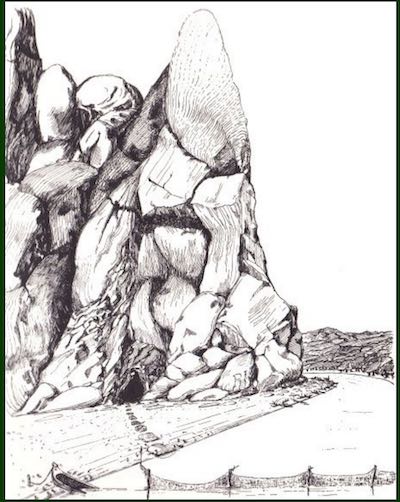
One night they sank through the shiny waterโ€”sank like stonesโ€”and, for the first time since he had known them, began to swim quickly. Kotick followed, and the pace astonished him, for he never dreamed that Sea Cow was anything of a swimmer. They headed for a cliff by the shoreโ€”a cliff that ran down into deep water, and plunged into a dark hole at the foot of it, twenty fathoms under the sea. It was a long, long swim, and Kotick badly wanted fresh air before he was out of the dark tunnel that they led him through.

โ€˜My wig!โ€™ he said, when he rose, gasping and puffing, into open water at the farther end. โ€˜It was a long dive, but it was worth it.โ€™

The sea cows had separated, and were browsing lazily along the edges of the finest beaches that Kotick had ever seen. There were long stretches of smooth-worn rock running for miles, exactly fitted to make seal-nurseries, and there were playgrounds of hard sand sloping inland behind them, and there were rollers for seals to dance in, and long grass to roll in, and sand-dunes to climb up and down; and, best of all, Kotick knew by the feel of the water, which never deceives a true Sea Catch, that no men had ever come there.

The first thing he did was to assure himself that the fishing was good, and then he swam along the beaches and counted up the delightful low sandy islands half hidden in the beautiful rolling fog. Away to the northward out to sea ran a line of bars and shoals and rocks that would never let a ship come within-six miles of the beach; and between the islands and the mainland was a stretch of deep water that ran up to the perpendicular cliffs, and somewhere below the cliffs. was the mouth of the tunnel.

โ€˜Itโ€™s Novastoshnah over again, but ten times better,โ€™ said Kotick. โ€˜Sea Cow must be wiser than I thought. Men canโ€™t come down the cliffs, even if there were any men; and the shoals to seaward would knock a ship to splinters. If any place in the sea is safe, this is it.โ€™

He began to think of the seal he had left behind him, but though he was in a hurry to go back to Novastoshnah, he thoroughly explored the new country, so that he would be able to answer all questions.

Then he dived and made sure of the mouth of the tunnel, and raced through to the southward. No one but a sea cow or a seal would have dreamed of there being such a place, and when he looked back at the cliffs even Kotick could hardly believe that he had been under them.

He was six days going home, though he was not swimming slowly; and when he hauled out just above Sea-Lionโ€™s Neck the first person he met was the seal who had been waiting for him, and she saw by the look in his eyes that he had found his island at last.

But the holluschickie and Sea Catch, his father, and all the other seals, laughed at him when he told them what he had discovered, and a young seal about his own age said: โ€˜This is all very well, Kotick, but you canโ€™t come from no one knows where and order us off like this. Remember weโ€™ve been fighting for our nurseries, and thatโ€™s a thing you never did. You preferred prowling about in the sea.โ€™

The other seals laughed at this, and the young seal began twisting his head from side to side. He had just married that year, and was making a great fuss about it.

โ€˜Iโ€™ve no nursery to fight for,โ€™ said Kotick. โ€˜I want only to show you all a place where you will be safe. Whatโ€™s the use of fighting?โ€™

โ€˜Oh, if youโ€™re trying to back out, of course Iโ€™ve no more to say,โ€™ said the young seal, with an ugly chuckle.

โ€˜Will you come with me if I win?โ€™ said Kotick; and a green light came into his eyes, for he was very angry at having to fight at all.

โ€˜Very good,โ€™ said the young seal carelessly. โ€˜If you win, Iโ€™ll come.โ€™

He had no time to change his mind, for Kotickโ€™s head darted out and his teeth sank in the blubber of the young sealโ€™s neck. Then he threw himself back on his haunches and hauled his enemy down the beach, shook him, and knocked him over. Then Kotick roared to the seals: โ€˜Iโ€™ve done my best for you these five seasons past. Iโ€™ve found you the island where youโ€™ll be safe, but unless your heads are dragged off your silly necks you wonโ€™t believe. Iโ€™m going to teach you now. Look out for yourselves!โ€™

Limmershin told me that never in his lifeโ€”and Limmershin sees ten thousand big seals fighting every yearโ€”never in all his little life did he see anything like Kotickโ€™s charge into the nurseries. He flung himself at the biggest sea-catch he could find, caught him by the throat, choked him and bumped him and banged him till he grunted for mercy, and then threw him aside and attacked the next. You see, Kotick had never fasted for four months as the big seals did every year, and his deep-sea swimming-trips kept him in perfect condition, and, best of all, he had never fought before. His curly white mane stood up with rage, and his eyes flamed, and his big dogteeth glistened, and he was splendid to look at.

Old Sea Catch, his father, saw him tearing past, hauling the grizzled old seals about as though they had been halibut, and upsetting the young bachelors in all directions; and Sea Catch gave one roar and shouted: โ€˜He may be a fool, but he is the best fighter on the Beaches. Donโ€™t tackle your father, my son! Heโ€™s with you!โ€™

Kotick roared in answer, and old Sea Catch waddled in, his moustache on end, blowing like a locomotive, while Matkah and the seal that was going to marry Kotick cowered down and admired their men-folk. It was a gorgeous fight, for the two fought as long as there was a seal that dared lift up his head, and then they paraded grandly up and down the beach side by side, bellowing.

At night, just as the Northern Lights were winking and flashing through the fog, Kotick climbed a bare rock and looked down on the scattered nurseries and the torn and bleeding seals. โ€˜Now,โ€™ he said, โ€˜Iโ€™ve taught you your lesson.โ€™

โ€˜My wig!โ€™ said old Sea Catch, boosting himself up stiffly, for he was fearfully mauled. โ€˜The Killer Whale himself could not have cut them up worse. Son, Iโ€™m proud of you, and whatโ€™s more, Iโ€™ll come with you to your islandโ€”if there is such a place.โ€™

โ€˜Here you, fat pigs of the sea! Who comes with me to the Sea Cowโ€™s tunnel? Answer, or I shall teach you again,โ€™ roared Kotick.

There was a murmur like the ripple of the tide all up and down the beaches. โ€˜We will come,โ€™ said thousands of tired voices. โ€˜We will follow Kotick, the White Seal.โ€™

Then Kotick dropped his head between his shoulders and shut his eyes proudly. He was not a white seal any more, but red from head to tail. All the same, he would have scorned to look at or touch one of his wounds.

A week later he and his army (nearly ten thousand holluschickie and old seals) went away north to the Sea Cowโ€™s tunnel, Kotick leading them, and the seals that stayed at Novastoshnah called them idiots. But next spring, when they all met off the fishing-banks of the Pacific, Kotickโ€™s seals told such tales of the new beaches beyond Sea Cowโ€™s tunnel that more and more seals left Novastoshnah.

Of course it was not all done at once, for the seals need a long time to turn things over in their minds, but year by year more seals went away from Novastoshnah, and Lukannon, and the other nurseries, to the quiet, sheltered beaches where Kotick sits all the summer through, getting bigger and fatter and stronger each year, while the holluschickie play round him, in that sea where no man comes.

Ham and the Porcupine


listen to the tale

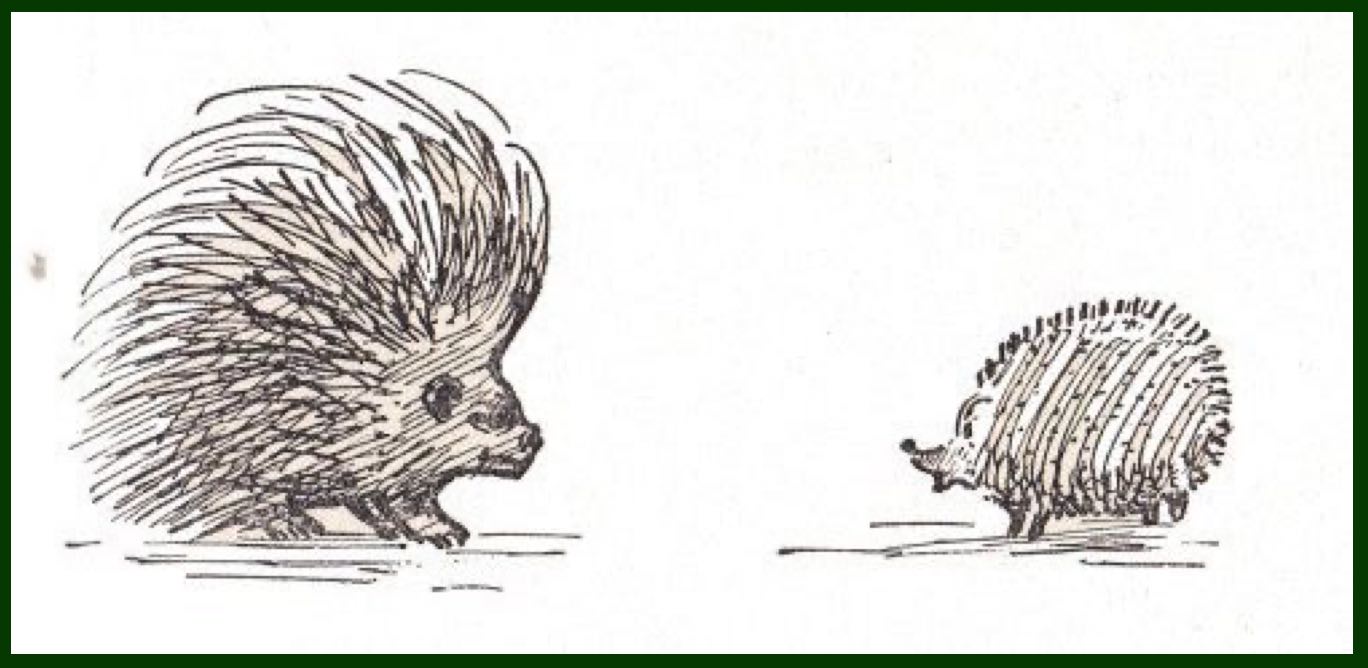
WHEN ALL the Animals lived in Big Nursery, before it was time to go into the Ark, Big Nurse had to brush their hair. She told them to stand still while she did it or it might be the worse for them. So they stood still. The Lion stood still and had his hair brushed into a splendid mane with a blob at the tip of his tail. The Horse stood still, and had his hair brushed into a beautiful mane and a noble tail. The Cow stood still and had her horns polished, too. The Bear stood still and got a Lick and a Promise. They all stood still, except one Animal, and he wouldn’t. He wiggled and kicked sideways at Big Nurse.

Big Nurse told him, over and over again, that he would not make anything by behaving so. But he said he wasn’t going to stand still for anyone, and he wanted his hair to grow all over him. So, at last, Big Nurse washed her hands of him and said: ‘On-your-own-head-be-it-and-all-over-you! ‘So, that Animal went away, and his hair grew and grewโ€”on his own head it was and all over himโ€”all the while that they were waiting to go into the Ark. And the more it grew, the longer, the harder, the harsher, and the pricklier it grew, till, at last, it was all long spines and jabby quills. On his own head it was and all over him, and particularly on his tail! So they called him Porcupine and stood him in the corner till the Ark was ready.

Then they all went into the Ark, two by two; but not one wanted to go in with Porcupine on account of his spines, except one small brother of his called Hedgehog who always stood still to have his hair brushed (he wore it short), and Porcupine hated him.

Their cabin was on the orlop-deckโ€”the lowestโ€”which was reserved for the Nocturnal Mammalia, such as Bats, Badgers, Lemurs, Bandi-coots and Myoptics at large. Noah’s second son, Ham, was in charge there, because he matched the decoration, being dark-complexioned but very wise.

When the lunch-gong sounded, Ham went down with a basketful of potatoes, carrots, small fruits, grapes, onions and green corn for their lunches.

The first Animal that he found was the small Hedgehog Brother, having the time of his life among the blackbeetles. He said to Ham, ‘I doubt if I would go near Porcupine this morning. The motion has upset him and he’s a little fretful.’

image

Ham said: ‘Dunno anything about that. My job is to feed ’em.’ So he went into Porcupine’s cabin, where Porcupine was taking up all the room in the world in his bunk, and his quills rattling like a loose window in a taxi.

Ham gave him three sweet potatoes, six inches of sugarcane, and two green corn-cobs. When he had finished, Ham said: ‘Don’t you ever say ‘thank-you’ for anything?’ ‘Yes,’ said Porcupine. ‘This is my way of saying it.’ And he swung round and slapped and swished with his tail sideways at Ham’s bare right leg and made it bleed from the ankle to the knee.

Ham hopped up on deck, with his foot in his hand, and found Father Noah at the wheel.

‘What do you want on the bridge at this hour of high noon?’ said Noah.

Ham said, ‘I want a large tin of Ararat biscuits.’

‘For what and what for?’ said Noah.

‘Because something on the orlop-deck thinks he can teach something about porcupines,’ said Ham. ‘I want to show him.’

‘Then why waste biscuits?’ said Noah.

‘Law!’ said Ham. ‘I only done ask for the largest lid offen the largest box of Ararat biscuits on the boat.’

‘Speak to your Mother,’ said Noah. ‘She issues the stores.’

So Ham’s Mother, Mrs. Noah, gave him the largest lid of the very largest box of Ararat biscuits in the Ark as well as some biscuits for himself; and Ham went down to the orlop-deck with the box-lid held low in his dark right hand, so that it covered his dark right leg from the knee to the ankle.

‘Here’s something I forgot,’ said Ham and he held out an Ararat biscuit to Porcupine, and Porcupine ate it quick.

‘Now say ‘Thank-you,’ ‘ said Ham.

‘I will,’ said Porcupine, and he whipped round, swish, with his wicked tail and hit the biscuit-tin. And that did him no good. ‘Try again,’ said Ham, and Porcupine swished and slapped with his tail harder than ever. ‘Try again,’ said Ham. This time the Porcupine swished so hard that his quill-ends jarred on his skin inside him, and some of the quills broke off short.

Then Ham sat down on the other bunk and said, ‘Listen! Just because a man looks a little sunburned and talks a little chuffy, don’t you think you can be fretful with him. I am Ham! The minute that this Dhow touches Mount Ararat, I shall be Emperor of Africa from the Bayuda Bend to the Bight of Benin, and from the Bight of Benin to Dar-es-Salam, and Dar-es-Salam to the Drakensberg, and from the Drakensberg to where the Two Seas meet round the same Cape. I shall be Sultan of Sultans, Paramount Chief of all Indunas, Medicine Men, and Rain-doctors, and specially of the Wunungiriโ€”the Porcupine Peopleโ€”who are waiting for you. You will belong to me! You will live in holes and burrows and old diggings all up and down Africa; and if I ever hear of you being fretful again I will tell my Wunungiri, and they will come down after you underground, and pull you out backwards. Iโ€”ammโ€”Hamm!

Porcupine was so frightened at this that he stopped rattling his quills under the bunk and lay quite still.

Then the small Hedgehog Brother who was under the bunk too, having the time of his life among the blackbeetles there, said: ‘This doesn’t look rosy for me. After all, I’m his brother in a way of speaking, and I suppose I shall have to go along with him underground, and I can’t dig for nuts!’

‘Not in the least,’ said Ham. ‘On his own head it was and all over him, just as Big Nurse said. But you stood still to have your hair brushed. Besides, you aren’t in my caravan. As soon as this old bugga-low (he meant the Ark) touches Ararat, I go South and East with my little lotโ€”Elephants and Lions and things – and Porcupigโ€”and scatter ’em over Africa. You’ll go North and West with one or other of my Brothers (I’ve forgotten which), and you’ll fetch up in a comfy little place called Englandโ€”all among gardens and box-borders and slugs, where people will be glad to see you. And you will be a lucky little fellow always.’

‘Thank you, Sir,’ said the small Hedgehog Brother. ‘But what about my living underground? That isn’t my line of country.’

‘Not the least need,’ said Ham. And he touched the small Hedgehog Brother with his foot, and Hedgehog curled upโ€”which he had never done before.

‘Now you’ll be able to pick up your own dry-leaf-bedding on your own prickles so as you can lie warm in a hedge from October till April if you like. Nobody will bother you except the gipsies; and you’ll be no treat to any dog.’

‘Thank you, Sir,’ said small Hedgehog Brother, and he uncurled himself and went after more blackbeetles.

And it all happened just as Ham said.

I don’t know how the keepers at the Zoo feed Porcupine but, from that day to this, every keeper that I have ever seen feed a porcupine in Africa, takes care to have the lid of a biscuit-box held low in front of his right leg so that Porcupine can’t get in a swish with his tail at it, after he has had his lunch.

Palaver done set! Go and have your hair brushed! image


some notes by Lisa Lewis image

Here is a PDF version of the story


The Tabu Tale

image


image

THE MOST IMPORTANT thing about Tegumai Bopsulai and his dear daughter, Taffimai Metallumai, were the Tabus of Tegumai, which were all Bopsulai.

Listen and attend, and remember, O Best Beloved; because we know about Tabus, you and I.

When Taffimai Metallumai (but you can still call her Taffy) went out into the woods hunting with Tegumai, she never kept still. She kept very unstill. She danced among dead leaves, she did. She snapped dry branches off, she did. She slid down banks and pits, she did quarries and pits of sand, she did. She splashed through swamps and bogs, she did; and she made a horrible noise! So all the animals that they huntedโ€”squirrels, beavers, otters, badgers, and deer, and the rabbitsโ€”knew when Taffy and her Daddy were coming, and ran away.

Then Taffy said, ‘I’m awfully sorry, Daddy, dear.’ Then Tegumai said, ‘What’s the use of being sorry? The squirrels have gone, and the beavers have dived, the deer have jumped, and the rabbits are deep in their buries. You ought to be beaten, O Daughter of Tegumai, and I would, too, if I didn’t happen to love you.’ Just then he saw a squirrel kinking and prinking round the trunk of an ash-tree, and he said, ‘H’sh! There’s our lunch, Taffy, if you’ll only keep quiet.’

Taffy said, ‘Where? Where? Show me! Show!’ She said it in a raspy-gaspy whisper that would have frightened a steam-cow, and she skittered about in the bracken, being a ‘citable child; and the squirrel flicked his tail and went off in large, free, loopy-legs to about the middle of Sussex before he ever stopped.

image

Tegumai was severely angry. He stood quite still, making up his mind whether it would be better to boil Taffy, or skin Taffy, or tattoo Taffy, or cut her hair, or send her to bed for one night without being kissed; and while he was thinking, the Head Chief of the Tribe of Tegumai came through the woods all in his eagle-feathers.

He was the Head Chief of the High and the Low and the Middle Medicine for the whole Tribe of Tegumai, and he and Taffy were rather friends.

He said to Tegumai, ‘What is the matter, O Chiefest of Bopsulai? You look angry.’

‘I am angry,’ said Tegumai, and he told the Head Chief all about Taffy’s very unstillness in the woods; and about the way she frightened the game; and about her falling into swamps because she would look behind her when she ran; and about her falling out of trees because she wouldn’t take good hold on both sides of her; and about her getting her legs all greeny with duckweed from ponds and places, and bringing it sploshing into the Cave. The Head Chief shook his head till the eagle-feathers and the little shells on his forehead rattled, and then he said, ‘Well, well! I’ll see about it later. I wanted to talk to you, O Tegumai, on serious business.’

‘Talk away, O Head Chief,’ said Tegumai, and they both sat down politely.

‘Observe and take notice, O Tegumai,’ said the Head Chief. ‘The Tribe of Tegumai have been fishing the Wagai river ever so long and ever so much too much. Consequence is, there’s hardly any carp of any size left in it, and even the little carps are going away. What do you think of putting the big Tribal Tabu on it, so as to stop every one fishing there for six months?’

‘That’s a good plan, O Head Chief,’ said Tegumai. ‘But what will the consequence be if any of our people break tabu?’

‘Consequence will be, O Tegumai,’ said the Head Chief, ‘that we will make them understand it with sticks and stinging-nettles and dobs of mud; and if that doesn’t teach them, we’ll draw fine, freehand Tribal patterns on their backs with the cutty edges of mussel-shells. Come along with me, O Tegumai, and we will proclaim the Tribal Tabu on the Wagai river.’

Then they went up to the Head Chief’s head house, where all the Tribal Magic of Tegumai belonged; and they brought out the Big Tribal Tabu-pole, made of wood, with the image of the Tribal Beaver of Tegumai and the other animals carved on top, and all the Tribal Tabu-marks carved underneath.

Then they called up the Tribe of Tegumai with the Big Tribal Horn that roars and blores, and the Middle Tribal Conch that squeaks and squawks, and the Little Tribal Drum that taps and raps.

They made a lovely noise, and Taffy was allowed to beat the Little Tribal Drum, because she was rather friends with the Head Chief.

When all the Tribe had come together in front of the Head Chief’s house, the Head Chief stood up and said and sang: ‘O Tribe of Tegumai! The Wagai river has been fished too much, and the carp-fish are getting frightened. Nobody must fish in the Wagai river for six months. It is tabu both sides and the middle; on all islands and mud-banks. It is tabu to bring a fishing-spear nearer than ten man-strides to the bank of the river. It is tabu, it is tabu, it is most specially tabu, O Tribe of Tegumai! It is tabu for this month and next month and next month and next month and next month and next month. Now go and put up the Tabu-pole by the river, and don’t let anybody pretend that they haven’t understood!’

image

This is a picture of the Tribal Totem Pole after it was put up on the banks of the Wagai river. That fat thing at the top is the Tribal Beaver of the Tribe of Tegumai. It is carved from lime-wood, and though you can’t see the nails, it is nailed on to the rest of the pole, which is all in one piece. Below the Beaver are four birdsโ€”two ducks, one of them looking at an egg, a sparrowโ€“bird, and a bird whose name I don’t know. Below them is a Rabbit, below the Rabbit a Weasel, below the Weasel a Fox or a Dog (I am not quite sure which), and below the Dog two Fishes.

On the other side of the pole is an Otter, a Badger, a Bison, and a Wild Horse. The rope that steadies the pole is looped round next to the Fishes. This shows that the Tabu is a Fish Tabu. If the Head Chief wanted to tabu the tribe killing Rabbits or Duck, he would have put the rope next to the Rabbit or the Duck carving; and so on with the other animals and birds.

The two black figures below the rope are meant for the Bad Man who didn’t keep Tabu, and so grew all knobby and uncomfy, and the Good Man who kept Tabu and grew fat and round. They are painted on the pole with a paint made from oakโ€“apples and poundedโ€“up pieces of iron. At the very bottom of the pole (but there was not room to put it in the picture) are six copper rings to show that the Tabu was to last for six months.

You will see that there is nobody at all in the woods and hills behind. That is because the Tabu is a Strong Tabu and nobody would break it.

image

Then the Tribe of Tegumai shouted, and put up the Tabu-pole by the banks of the Wagai river, and swiftly they ran down both banks (half the Tribe on one side and half on the other), and chased away all the small boys who hadn’t attended the meeting because they were looking for crayfish in the river; and then they all praised the Head Chief and Tegumai Bopsulai.

Tegumai went home after this, but Taffy stayed with the Head Chief, because they were rather friends. She was very much surprised. She had never seen a tabu put on anything before, and she said to the Head Chief, ‘What does Tabu mean azactly?’

The Head Chief said, ‘Tabu doesn’t mean anything till you break it, O Only Daughter of Tegumai; but when you break it, it means sticks and stinging-nettles and fine, freehand Tribal patterns drawn on your back with the cutty edges of mussel-shells.’

Then Taffy said, ‘Could I have a tabu of my ownโ€”a little small tabu to play with?’

Then the Head Chief said, ‘I’ll give you a little tabu of your own, just because you made up that picture-writing, which will one day grow into the ABC.’ (You remember how Taffy and Tegumai made up the Alphabet? That was why she and the Head Chief were rather friends.)

He took off one of his magic necklacesโ€”he had twenty-two of themโ€”and it was made of bits of pink coral, and he said, ‘If you put this necklace on anything that belongs to you your own self, no one can touch that thing until you take the necklace off. It will only work inside your own Cave; and if you have left anything of yours lying about where you shouldn’t, the tabu won’t work till you have put that thing back in its proper place.’

‘Thank you very much indeed,’ said Taffy. ‘Now, what d’you truly s’pose it will do to my Daddy?’

‘I’m not quite sure,’ said the Head Chief. ‘He may throw himself down on the floor and shout, or he may have cramps, or he may just flop, or he may take Three Sorrowful Steps and say sorrowful words, and then you can pull his hair three times if you like.’ ‘And what will it do to my Mummy?’ said Taffy. ‘There aren’t any tabus on people’s Mummies,’ said the Head Chief.

‘Why not?’ said Taffy.

‘Because if there were tabus on people’s Mummies, people’s Mummies could put tabus on breakfasts, and dinners, and teas, and that would be very bad for the Tribe. Long and long ago the Tribe decided not to have tabus on people’s Mummiesโ€”anywhereโ€”for anything.’

‘Well,’ said Taffy, ‘do you know if my Daddy has any tabus of his own that will work on meโ€”s’posin’ I broke a tabu by accident?’ ‘You don’t mean to say,’ said the Head Chief, ‘that your Daddy has never put any tabus on you yet?’

‘No,’ said Taffy; ‘he only says “Don’t!” and gets angry.’ ‘Ah! I suppose he thought you were a kiddy,’ said the Head Chief. ‘Now, if you show him that you’ve a real tabu of your own, I shouldn’t be surprised if he put several real tabus on you.’

‘Thank you,’ said Taffy; ‘but I have a little garden of my own outside the Cave, and if you don’t mind I should like you to make this tabu-necklace work so that if I hang it up on the wild roses in front of the garden, and people go inside, they won’t be able to come out until they have said they are sorry.’

‘Oh, certainly, certainly,’ said the Head Chief. ‘Of course you can tabu your very own garden.’

‘Thank you,’ said Taffy; ‘and now I will go home and see if this tabu truly works.’

When she got back to the Cave, it was nearly time for dinner; and when she came to the door, Teshumai Tewindrow, her dear Mummy, instead of saying, ‘Where have you been, Taffy?’ said, ‘O Daughter of Tegumai, come in and eat,’ same as if she had been a grown-up person. That was because she saw a tabu-necklace on Taffy’s neck.

Her Daddy was sitting in front of the fire waiting for dinner, and he said the very same thing, and Taffy felt most important.

She looked all round the Cave, to see that her own things (her private mendy-bag of otter-skin, with the shark’s teeth and the bone needles and the deer-sinew thread; her mud-shoes of birch-bark; her spear and her throwing-stick and her lunch-basket) were all in their proper places, and then she slipped off her tabu-necklace quite quickly and hung it over the handle of the little wooden water-bucket that she used to draw water with.

Then her Mummy said to Tegumai, her Daddy, quite accidental, ‘O Tegumai! Won’t you get us some fresh drinking-water for dinner?’

‘Certainly,’ said Tegumai, and he jumped up and lifted Taffy’s bucket with the tabu-necklace on it. Next minute he fell down flat on the floor and shouted; then he curled himself up and rolled round the cave; then he stood up and flopped several times.
‘My dear,’ said Teshumai Tewindrow, ‘it looks to me as if you had rather broken somebody’s tabu somehow. Does it hurt?’

‘Horribly,’ said Tegumai. He took Three Sorrowful Steps and put his head on one side, and shouted, ‘I broke tabu! I broke tabu! I broke tabu!’

‘Taffy, dear, that must be your tabu,’ said Teshumai Tewindrow. ‘You’d better pull his hair three times, or he will have to go on shouting till evening; and you know what Daddy is like when he once begins.’

Tegumai stooped down, and Taffy pulled his hair three times; and he wiped his face, and said, ‘My Tribal Word! That’s a dreadful strong tabu of yours, Taffy. Where did you get it from?’

‘The Head Chief gave it me. He told me you’d have cramps and flops if you broke it,’ said Taffy.

‘He was quite right. But he didn’t tell you anything about Sign Tabus, did he?’

‘No,’ said Taffy. ‘He said that if I showed you I had a real tabu of my own, you’d most likely put some real tabus on me.’

‘Quite right, my only daughter dear,’ said Tegumai. ‘I’ll give you some tabus that will simply amaze youโ€”Stinging-Nettle Tabus, Sign Tabus, Black and White Tabusโ€”dozens of tabus. Now attend to me. Do you know what this means?’

Tegumai skiffled his forefinger in the air snakyfashion. ‘That’s tabu on wriggling when you’re eating your dinner. It is an important tabu, and if you break it, you’ll have crampsโ€”same as I didโ€”or else I’ll have to tattoo you all over.’

Taffy sat quite still through dinner, and then Tegumai held up his right hand in front of him, the fingers close together. ‘That’s the Still Tabu, Taffy. Whenever I do that, you must stop as you are, whatever you are doing. If you are sewing, you must stop with the needle halfway through the deer-skin. If you’re walking, you stop on one foot. If you’re climbing, you stop on one branch. You don’t move until you see me go like this.’

Tegumai put up his right hand, and waved it in front of his face two or three times. ‘That’s the sign for Carry On. You can go on with whatever you are doing when you see me make that.’

‘Aren’t there any necklaces for that tabu?’ said Taffy.

‘Yes. There is a red-and-black necklace, of course, but how can I come tramping through the fern to give you a Still Tabu necklace every time I see a deer or a rabbit, and want you to be quiet?’ said Tegumai. ‘I thought you were a better hunter than that. Why, I might have to shoot an arrow over your head the minute after I had put Still Tabu on you.’
‘But how would I know what you were shooting at?’ said Taffy.

‘Watch my hand,’ said Tegumai. ‘You know the three little jumps a deer gives before he starts to run off – like this?’ He looped his finger three times in the air, and Taffy nodded. ‘When you see me do that, you’ll know we’ve found a deer. A little jiggle of the forefinger means a rabbit.’

‘Yes. Rabbits run like that,’ said Taffy, and jiggled her forefinger the same way.

‘Squirrel’s a long, climby-up twist in the air. Like this!’

‘Same as squirrels kinking round trees. I see,’ said Taffy.

‘Otter’s a long, smooth, straight wave in the airโ€”like this.’

‘Same as otters swimming in a pool. I see,’ said Taffy.

‘And beaver’s just as if I was smacking somebody with my open hand.’

‘Same as beavers’ tails smacking on the water when they are frightened. see.’

‘Those aren’t tabus. Those are just signs to show you what I am hunting. The Still Tabu is the thing you must watch, because it’s a big tabu.’

‘I can put the Still Tabu on, too,’ said Teshumai Tewindrow, who was sewing deer-skins together. ‘I can put it on you, Taffy, when you get too rowdy going to bed.’

‘What happens if I break it?’ said Taffy. ‘You can’t break a tabu except by accident.’ ‘But s’pose I did,’ said Taffy.

‘You’d lose your own tabu-necklace. You’d have to take it back to the Head Chief, and you’d just be called Taffy again, not Daughter of Tegumai. Or perhaps we’d change your name to Tabumai Skellumzulaiโ€”the Bad Thing who can’t keep a Tabuโ€”and very likely you wouldn’t be kissed for a day and a night.’

‘Umm!’ said Taffy. ‘I don’t think tabus are fun at all.’ ‘Well, take your tabu-necklace back to the Head Chief, and say you want to be a kiddy again, O Only Daughter of Tegumai!’ said her Daddy. ‘No,’ said Taffy. ‘Tell me more about tabus. Can’t I have some more of my very ownโ€”my very ownโ€”strong tabus that give people Tribal Fits?’

‘No,’ said her Daddy. ‘You aren’t old enough to be allowed to give people Tribal Fits. That pink necklace will do quite well for you.’

‘Then tell me more about tabus,’ said Taffy.

‘But I am sleepy, daughter dear. I’ll just put tabu on anyone talking to me till the sun gets behind that hill, and we’ll go out in the evening and see if we can catch rabbits.

Ask Mummy about the other tabus. It’s a great comfort that you are a tabu-girl, because now I shan’t have to tell you anything more than once.’

Taffy talked quietly to her Mummy till the sun was in the right place. Then she waked Tegumai, and they both got their hunting things ready and went out into the woods. But just as she passed her little garden outside the Cave, Taffy took off her tabu-necklace and hung it on a rose-bush. Her garden-border was only marked with white stones, but she called the Rose the real gate into it, and all the Tribe knew it.

‘Who do you s’pose you’ll catch?’ said Tegumai. ‘Wait and see till we come back,’ said Taffy. ‘The Head Chief said that anyone who breaks that tabu will have to stay in my garden till I let him out.’ They went along through the woods, and crossed the Wagai river on a fallen tree, and they climbed up to the top of a big bare hill where there were plenty of rabbits in the fern.

‘Remember you’re a tabu-girl now,’ said Tegumai, when Taffy began to skitter about and ask questions instead of hunting for rabbits; and he made the Still Tabu sign, and Taffy stopped as if she had been all turned into one solid stone. She was stooping to tie up a shoestring, and she stayed still with her hand on the string (We know that kind of tabu, don’t we, Best Beloved?) only she looked hard at her Daddy, which you always must do when the Still Tabu is on. Presently, when he had walked a long way off, he turned round and made the Carry On sign. So she walked forward quietly through the bracken, always looking at her Daddy, and a rabbit jumped up in front of her. She was just going to throw her stick, when she saw Tegumai make the Still Tabu sign, and she stopped with her mouth half open and her throwing-stick in her hand. The rabbit ran towards Tegumai, and Tegumai caught it. Then he came across the fern and kissed his daughter and said, ‘That is what I call a superior girldaughter. It’s some pleasure to hunt with you now, Taffy.’

A little while afterwards, a rabbit jumped up where Tegumai couldn’t see it, but Taffy could, and she knew it was coming towards her if Tegumai did not frighten it; so she held up her hand, made the Rabbit Sign (so as he should know she wasn’t in fun), and she put the Still Tabu on her own Daddy! She didโ€”indeed she did, Best Beloved!

Tegumai stopped with one foot half lifted to climb over an old tree-trunk. The rabbit ran past Taffy, and Taffy killed it with her throwing-stick; but she was so excited that she forgot to take off the Still Tabu for quite two minutes, and all that time Tegumai stood on one leg, not daring to put his other foot down. Then he came and kissed her and threw her up in the air, and put her on his shoulder and danced and said, ‘My Tribal Word and Testimony! This is what I call having a daughter that is a daughter, O Only Daughter of Tegumai!’ And Taffy was most tremenenssly and wonderhugely pleased.

It was almost dark when they went home. They had five rabbits and two squirrels, as well as a water-rat. Taffy wanted the water-rat’s skin for a purse. (People had to kill water-rats in those days because they couldn’t buy purses, but we know that water-rats are just as much tabu, these particular days, for you and me as anything else that is alive.)

‘I think I’ve kept you out a little too late,’ said Tegumai, when they were near home, ‘and Mummy won’t be pleased with us. Run home, Taffy! You can see the Cave-fire from here.’

Taffy ran along, and that very minute Tegumai heard something crackle in the bushes, and a big, lean, grey wolf jumped out and began to trot quietly after Taffy.

Now, all the Tegumai people hated wolves and killed them whenever they could, and Tegumai had never seen one so close to his Cave before.

He hurried after Taffy, but the wolf heard him, and jumped back into the bushes. Those wolves were afraid of grown-ups, but they used to try and catch the children of the Tribe. Taffy was swinging the water-rat and singing to herselfโ€”her Daddy had taken off all tabusโ€”so she didn’t notice anything.

There was a little meadow close to the Cave, and by the mouth of the Cave Taffy saw a tall man standing in her rose-garden, but it was too dark to make out properly.

‘I do believe my tabu-necklace has truly caught somebody,’ she said, and she was just running up to look when she heard her Daddy say, ‘Still, Taffy! Still Tabu till I take it off!’ She stopped where she wasโ€”the water-rat in one hand and the throwing-stick in the otherโ€”only turning her head towards her Daddy to be ready for the Carry On sign.

It was the longest Still Tabu she had had put upon her all that day. Tegumai had stepped back close to the wood and was holding his stone throwing-hatchet in one hand, and with the other he was making the Still Tabu sign.

Then she thought she saw something black creeping sideways at her across the grass. It came nearer and nearer, then it moved back a little and then it crawled closer.

Then she heard her Daddy’s stone throwing-hatchet whirr past her shoulder just like a partridge, and at the same time another hatchet whirred out from her rose garden; and there was a howl, and a big grey wolf lay kicking on the grass, quite dead.

Then Tegumai picked her up and kissed her seven times and said, ‘My Tribal Word and Tegumai Testimony, Taffy, but you are a daughter to be proud of. Did you know what it was?’

‘I’m not sure,’ said Taffy. ‘But I think I guessed it was a wolf. I knew you wouldn’t let it hurt me.’

‘Good girl,’ said Tegumai, and he stooped over the wolf and picked up both hatchets. ‘Why, here’s the Head Chief’s hatchet!’ he said, and he held up the Head Chief’s magic throwing-hatchet, with the big greenstone head.

‘Yes,’ said the Head Chief from inside Taffy’s rosegarden, ‘and I’d be very much obliged if you would bring it back to me. I came to call on you this afternoon, and accidentally I stepped into Taffy’s garden before I saw her tabu-necklace on the rose-tree. So, of course, I had to wait, till Taffy came back to let me out.’

image

This is the picture that the Head Chief made of Taffy keeping the Still Tabu. It is done in the Head-Chiefly style of the Tribe of Tegumai, and it is full of Tabu meanings and signs. The wolf is lying under what is meant to be a Tabu tree. He is made squarely because that was the Headยญ Chiefly way of drawing. All that wavy curly stuff underneath hiin is the Tabu way of drawing grass, and below the grass is a thing like a piece of stone wall, which is the Tabu way of drawing earth.

Taffy is always drawn in outlineโ€”quite white. You will see her over to the right, keeping the Still Tabu very hard. I do not know why they did not draw the water-rat that she was carrying, but I think it was be cause it wouldn’t look pretty in the picture.

Tegumai is standing over at the left, throwing his hatchet at the wolf. He is dressed in a cloak embroidered with the Sacred Beaver of the Tribe all turned into a pattern, to show that he belonged to the Tribe of Tegumai. He has a quiver with two arrows and a bow stuck into it, to show that he is hunting. He is making the Still Tabu sign with his left hand.

Up above in the right-hand corner you will see the Head Chief standing in Taffy’s garden, throwing his axe at the wolf. It is not a portrait of the Head Chief, but a sort of picture-writing of all the Head Chief there was. The square cap and the feathers behind show that it is a Head Chief, and the Sacred Beaver drawn on the edge of his cloak shows that he is the Head Chief of the Tegumais. There is no face, because the face of a Head Chief does not matter.

The Double-Headed Beaver right in the middle of Taffy’s garden shows that there is a Tabu on the garden; which is why the Head Chief couldn’t get out. The black door to the left is supposed to be the door into Taffy’s cave, and those step’things behind are hills and rocks drawn in the Tabu way. The curly things under the eight roses in pots are the Tabu way of drawing short grass and turf.

This is a picture that really ought to be coloured, because half the meaning is lost without the colours.

image

Then the Head Chief all in his feathers and shells took the Three Sorrowful Steps with his head on one side, and said, ‘I broke tabu! I broke tabu! I broke tabu!’ and bowed solemnly and statelily before Taffy, till his tall eagle-feathers nearly touched the ground, and he said and he sang, ‘O Daughter of Tegumai, I saw everything that happened. You are a true tabu-girl. I am very pleased at you. At first I wasn’t pleased, because I had to wait in your garden since six o’clock, and I know you only put tabu on your garden for fun.’

‘No, not fun,’ said Taffy. ‘I truly wanted to see if my tabu would catch anybody; but I didn’t know that a little tabu like mine would work on a big Head Chief like you, O Head Chief.’

‘I told you it worked. I gave it to you myself,’ said the Head Chief. ‘Of course it would work. But I don’t mind. I want to tell you, Taffy, my dear, that I wouldn’t have minded staying in your garden from twelve o’clock instead of only six o’clock to see how beautifully you kept that last Still Tabu that your Daddy put on you. I give you my Chiefly Word, Taffy, that a great many men in the Tribe wouldn’t have kept that tabu as you kept it, with that wolf crawling up to you across the grass.’

‘What are you going to do with the wolf-skin, O Head Chief?’ said Tegumai, because any animal that the Head Chief threw his hatchet at belonged to the Head Chief by the Tribal Custom of Tegumai.

‘I am going to give it to Taffy, of course, for a winter cloak, and I’ll make her a magic necklace of her very own out of the teeth and claws,’ said the Head Chief; ‘and I am going to have the story of Taffy and the Still Tabu painted on wood on the Tribal Tabu-Count, so that all the girl-daughters of the Tribe can see and know and remember and understand.’

Then they all three went into the Cave, and Teshumai Tewindrow gave them a most beautiful supper, and the Head Chief took off his eagle-feathers and all his necklaces; and when it was time for Taffy to go to bed in her own little cave, Tegumai and the Head Chief came in to say good-night, and they romped all round the cave, and dragged Taffy over the floor on a deer-skin (same as some people are dragged about on a hearth-rug), and they finished by throwing the otter-skin cushions about and knocking down a lot of old spears and fishing-rods that were hung on the walls. At last things grew so rowdy that Teshumai Tewindrow came in, and said, ‘Still! Still Tabu on every one of you! How do you ever expect that child to go to sleep?’ And they said the really good-night, and Taffy went to sleep.

After that, what happened? Oh, Taffy learned all the tabus just like some people we know. She learned the White Shark Tabu, which made her eat up her dinner instead of playing with it (and that goes with a green-and-white necklace, you know); she learned the Grown-Up Tabu, which prevented her from talking when Neolithic ladies came to call (and, you know, a blue-and-white necklace goes with that); she learned the Owl Tabu, which prevented her staring at strangers (and a black-and-blue necklace goes with that); she learned the Open Hand Tabu (and we know a pure white necklace goes with that), which prevented her snapping and snarling when people borrowed things that belonged to her; and she learned five other tabus.

But the chief thing she learned, and the one that she never broke, not even by accident, was the Still Tabu. That was why she was taken everywhere that her Daddy went.


some notes by Lisa Lewis image


Here is a PDF version of the story


All the illustrations were drawn by Rudyard Kipling himself!

The Butterfly that Stamped

image
listen to the story


image

THIS, O my Best Beloved, is a storyโ€”a new and a wonderful storyโ€”a story quite different from the other storiesโ€”a story about The Most Wise Sovereign Suleiman-bin-Daoudโ€”Solomon the Son of David.

There are three hundred and fifty-five stories about Suleiman-bin-Daoud; but this is not one of them. It is not the story of the Lapwing who found the Water; or the Hoopoe who shaded Suleiman-bin-Daoud from the heat. It is not the story of the Glass Pavement, or the Ruby with the Crooked Hole, or the Gold Bars of Balkis. It is the story of the Butterfly that Stamped.

Now attend all over again and listen!

Suleiman-bin-Daoud was wise. He understood what the beasts said, what the birds said, what the fishes said, and what the insects said. He understood what the rocks said deep under the earth when they bowed in towards each other and groaned; and he understood what the trees said when they rustled in the middle of the morning. He understood everything, from the bishop on the bench to the hyssop on the wall, and Balkis, his Head Queen, the Most Beautiful Queen Balkis, was nearly as wise as he was.

Suleiman-bin-Daoud was strong. Upon the third finger of the right hand he wore a ring. When he turned it once, Afrits and Djinns came out of the earth to do whatever he told them. When he turned it twice, Fairies came down from the sky to do whatever he told them; and when he turned it three times, the very great angel Azrael of the Sword came dressed as a water-carrier, and told him the news of the three worlds,โ€”Aboveโ€”Belowโ€”and Here.

And yet Suleiman-bin-Daoud was not proud. He very seldom showed off, and when he did he was sorry for it. Once he tried to feed all the animals in all the world in one day, but when the food was ready an Animal came out of the deep sea and ate it up in three mouthfuls.

Suleiman-bin-Daoud was very surprised and said, ‘O Animal, who are you?’ And the Animal said, ‘O King, live for ever! I am the smallest of thirty thousand brothers, and our home is at the bottom of the sea. We heard that you were going to feed all the animals in all the world, and my brothers sent me to ask when dinner would be ready.’ Suleiman-bin-Daoud was more surprised than ever and said, ‘O Animal, you have eaten all the dinner that I made ready for all the animals in the world.’ And the Animal said, ‘O King, live for ever, but do you really call that a dinner? Where I come from we each eat twice as much as that between meals.’

Then Suleiman-bin-Daoud fell flat on his face and said, ‘O Animal! I gave that dinner to show what a great and rich king I was, and not because I really wanted to be kind to the animals. Now I am ashamed, and it serves me right.’ Suleiman-bin-Daoud was a really truly wise man, Best Beloved. After that he never forgot that it was silly to show off; and now the real story part of my story begins.

image

This is the picture of the Animal that came out of the sea and ate up all the food that Suleiman-bin-Daoud had made ready for all the animals in all the world. He was really quite a nice Animal, and his Mummy was very fond of him and of his twenty-nine thousand nine hundred and ninety-nine other brothers that lived at the bottom of the sea.

You know that he was the smallest of them all, and so his name was Small Porgies. He ate up all those boxes and packets and bales and things that had been got ready for all the animals, without ever once taking off the lids or untying the strings, and it did not hurt him at all.

The sticky-up masts behind the boxes of food belong to Suleiman-bin-Daoud’s ships. They were busy bringing more food when Small Porgies came ashore. He did not eat the ships. They stopped un loading the foods and instantly sailed away to sea till Small Porgies had quite finished eating. You can see some of the ships beginning to sail away by Small Porgies’ shoulder. I have not drawn Sulei man-bin-Daoud, but he is just outside the picture, very much astonished. The bundle hanging from the mast of the ship in the corner is really a package of wet dates for parrots to eat. I don’t know the names of the ships. That is all there is in that picture. image

He married ever so many wives. He married nine hundred and ninety-nine wives, besides the Most Beautiful Balkis; and they all lived in a great golden palace in the middle of a lovely garden with fountains. He didn’t really want nine-hundred and ninety-nine wives, but in those days everybody married ever so many wives, and of course the King had to marry ever so many more just to show that he was the King.

Some of the wives were nice, but some were simply horrid, and the horrid ones quarrelled with the nice ones and made them horrid too, and then they would all quarrel with Suleiman-bin-Daoud, and that was horrid for him. But Balkis the Most Beautiful never quarrelled with Suleiman-bin-Daoud. She loved him too much. She sat in her rooms in the Golden Palace, or walked in the Palace garden, and was truly sorry for him.

Of course if he had chosen to turn his ring on his finger and call up the Djinns and the Afrits they would have magicked all those nine hundred and ninety-nine quarrelsome wives into white mules of the desert or greyhounds or pomegranate seeds; but Suleiman-bin-Daoud thought that that would be showing off. So, when they quarrelled too much, he only walked by himself in one part of the beautiful Palace gardens and wished he had never been born.

One day, when they had quarrelled for three weeksโ€”all nine hundred and ninety-nine wives togetherโ€”Suleiman-bin-Daoud went out for peace and quiet as usual; and among the orange trees he met Balkis the Most Beautiful, very sorrowful because Suleiman-bin-Daoud was so worried. And she said to him, ‘O my Lord and Light of my Eyes, turn the ring upon your finger and show these Queens of Egypt and Mesopotamia and Persia and China that you are the great and terrible King.’ But Suleiman-bin-Daoud shook his head and said, ‘O my Lady and Delight of my Life, remember the Animal that came out of the sea and made me ashamed before all the animals in all the world because I showed off. Now, if I showed off before these Queens of Persia and Egypt and Abyssinia and China, merely because they worry me, I might be made even more ashamed than I have been.’

And Balkis the Most Beautiful said, ‘O my Lord and Treasure of my Soul, what will you do?’

And Suleiman-bin-Daoud said, ‘O my Lady and Content of my Heart, I shall continue to endure my fate at the hands of these nine hundred and ninety-nine Queens who vex me with their continual quarrelling.’

So he went on between the lilies and the loquats and the roses and the cannas and the heavy-scented ginger-plants that grew in the garden, till he came to the great camphor-tree that was called the Camphor Tree of Suleiman-bin-Daoud. But Balkis hid among the tall irises and the spotted bamboos and the red lillies behind the camphor-tree, so as to be near her own true love, Suleiman-bin-Daoud.

Presently two Butterflies flew under the tree, quarrelling.

Suleiman-bin-Daoud heard one say to the other, ‘I wonder at your presumption in talking like this to me. Don’t you know that if I stamped with my foot all Suleiman-bin-Daoud’s Palace and this garden here would immediately vanish in a clap of thunder.’

Then Suleiman-bin-Daoud forgot his nine hundred and ninety-nine bothersome wives, and laughed, till the camphor-tree shook, at the Butterfly’s boast. And he held out his finger and said, ‘Little man, come here.’

The Butterfly was dreadfully frightened, but he managed to fly up to the hand of Suleiman-bin-Daoud, and clung there, fanning himself. Suleiman-bin-Daoud bent his head and whispered very softly, ‘Little man, you know that all your stamping wouldn’t bend one blade of grass. What made you tell that awful fib to your wife?โ€”for doubtless she is your wife.’

The Butterfly looked at Suleiman-bin-Daoud and saw the most wise King’s eye twinkle like stars on a frosty night, and he picked up his courage with both wings, and he put his head on one side and said, ‘O King, live for ever. She is my wife; and you know what wives are like.’

Suleiman-bin-Daoud smiled in his beard and said, ‘Yes, I know, little brother.’

‘One must keep them in order somehow,’ said the Butterfly, ‘and she has been quarrelling with me all the morning. I said that to quiet her.’

And Suleiman-bin-Daoud said, ‘May it quiet her. Go back to your wife, little brother, and let me hear what you say.’

Back flew the Butterfly to his wife, who was all of a twitter behind a leaf, and she said, ‘He heard you! Suleiman-bin-Daoud himself heard you!’

‘Heard me!’ said the Butterfly. ‘Of course he did. I meant him to hear me.’

‘And what did he say? Oh, what did he say?’

‘Well,’ said the Butterfly, fanning himself most importantly, ‘between you and me, my dearโ€”of course I don’t blame him, because his Palace must have cost a great deal and the oranges are just ripening,โ€”he asked me not to stamp, and I promised I wouldn’t.’

‘Gracious!’ said his wife, and sat quite quiet; but Suleiman-bin-Daoud laughed till the tears ran down his face at the impudence of the bad little Butterfly.

Balkis the Most Beautiful stood up behind the tree among the red lilies and smiled to herself, for she had heard all this talk. She thought, ‘If I am wise I can yet save my Lord from the persecutions of these quarrelsome Queens,’ and she held out her finger and whispered softly to the Butterfly’s Wife, ‘Little woman, come here.’ Up flew the Butterfly’s Wife, very frightened, and clung to Balkis’s white hand.

Balkis bent her beautiful head down and whispered, ‘Little woman, do you believe what your husband has just said?’

The Butterfly’s Wife looked at Balkis, and saw the most beautiful Queen’s eyes shining like deep pools with starlight on them, and she picked up her courage with both wings and said, ‘O Queen, be lovely for ever. You know what men-folk are like.’

And the Queen Balkis, the Wise Balkis of Sheba, put her hand to her lips to hide a smile and said, ‘Little sister, I know.’

‘They get angry,’ said the Butterfly’s Wife, fanning herself quickly, ‘over nothing at all, but we must humour them, O Queen. They never mean half they say. If it pleases my husband to believe that I believe he can make Suleiman-bin-Daoud’s Palace disappear by stamping his foot, I’m sure I don’t care. He’ll forget all about it to-morrow.’

‘Little sister,’ said Balkis, ‘you are quite right; but next time he begins to boast, take him at his word. Ask him to stamp, and see what will happen. We know what men-folk are like, don’t we? He’ll be very much ashamed.’

Away flew the Butterfly’s Wife to her husband, and in five minutes they were quarrelling worse than ever.

‘Remember!’ said the Butterfly. ‘Remember what I can do if I stamp my foot.’

‘I don’t believe you one little bit,’ said the Butterfly’s Wife. ‘I should very much like to see it done. Suppose you stamp now.’

‘I promised Suleiman-bin-Daoud that I wouldn’t,’ said the Butterfly, ‘and I don’t want to break my promise.’

‘It wouldn’t matter if you did,’ said his wife. ‘You couldn’t bend a blade of grass with your stamping. I dare you to do it,’ she said. ‘Stamp! Stamp! Stamp!’

Suleiman-bin-Daoud, sitting under the camphor-tree, heard every word of this, and he laughed as he had never laughed in his life before. He forgot all about his Queens; he forgot all about the Animal that came out of the sea; he forgot about showing off. He just laughed with joy, and Balkis, on the other side of the tree, smiled because her own true love was so joyful.

Presently the Butterfly, very hot and puffy, came whirling back under the shadow of the camphor-tree and said to Suleiman, ‘She wants me to stamp! She wants to see what will happen, O Suleiman-bin-Daoud! You know I can’t do it, and now she’ll never believe a word I say. She’ll laugh at me to the end of my days!’

‘No, little brother,’ said Suleiman-bin-Daoud, ‘she will never laugh at you again,’ and he turned the ring on his fingerโ€”just for the little Butterfly’s sake, not for the sake of showing off,โ€”and, lo and behold, four huge Djinns came out of the earth!

‘Slaves,’ said Suleiman-bin-Daoud, ‘when this gentleman on my finger’ (that was where the impudent Butterfly was sitting) ‘stamps his left front forefoot you will make my Palace and these gardens disappear in a clap of thunder. When he stamps again you will bring them back carefully.’

‘Now, little brother,’ he said, ‘go back to your wife and stamp all you’ve a mind to.’

Away flew the Butterfly to his wife, who was crying, ‘I dare you to do it! I dare you to do it! Stamp! Stamp now! Stamp!’ Balkis saw the four vast Djinns stoop down to the four corners of the gardens with the Palace in the middle, and she clapped her hands softly and said, ‘At last Suleiman-bin-Daoud will do for the sake of a Butterfly what he ought to have done long ago for his own sake, and the quarrelsome Queens will be frightened!’

Then the butterfly stamped. The Djinns jerked the Palace and the gardens a thousand miles into the air: there was a most awful thunder-clap, and everything grew inky-black. The Butterfly’s Wife fluttered about in the dark, crying, ‘Oh, I’ll be good! I’m so sorry I spoke. Only bring the gardens back, my dear darling husband, and I’ll never contradict again.’

image

This is the picture of the four gull-winged Djinns lifting up Suleiman-bin-Daoud’s Palace the very minute after the Butterfly had stamped. The Palace and the gardens and everything came up in one piece like a board, and they left a big hole in the ground all full of dust and smoke.

If you look in the corner, close to the thing that looks like a lion, you will see Suleiman-bin-Daoud with his magic stick and the two Butterflies behind him. The thing that looks like a lion is really a lion carved in stone, and the thing that looks like a milk-can is really a piece of a temple or a house or something. Suleiman-bin-Daoud stood there so as to be out of the way of the dust and the smoke when the Djinns lifted up the Palace. I donโ€™t know the Djinns’ names. They were servants of Suleiman-bin-Daoud’s magic ring, and they changed about every day. They were just common gull-winged Djinns.

The thing at the bottom is a picture of a very friendly Djinn called Akraig. He used to feed the little fishes in the sea three times a day, and his wings were made of pure copper. I put him in to show you what a nice Djinn is like. He didn’t help to lift the Palace. He was busy feeding little fishes in the Arabian Sea when it happened. When they took their walks abroad! image

The Butterfly was nearly as frightened as his wife, and Suleiman-bin-Daoud laughed so much that it was several minutes before he found breath enough to whisper to the Butterfly, ‘Stamp again, little brother. Give me back my Palace, most great magician.’

‘Yes, give him back his Palace,’ said the Butterfly’s Wife, still flying about in the dark like a moth. ‘Give him back his Palace, and don’t let’s have any more horrid magic.’

‘Well, my dear,’ said the Butterfly as bravely as he could, ‘you see what your nagging has led to. Of course it doesn’t make any difference to meโ€”I’m used to this kind of thingโ€”but as a favour to you and to Suleiman-bin-Daoud I don’t mind putting things right.’

So he stamped once more, and that instant the Djinns let down the Palace and the gardens, without even a bump. The sun shone on the dark-green orange leaves; the fountains played among the pink Egyptian lilies; the birds went on singing, and the Butterfly’s Wife lay on her side under the camphor-tree waggling her wings and panting, ‘Oh, I’ll be good! I’ll be good!’

Suleiman-bin-Daolld could hardly speak for laughing. He leaned back all weak and hiccoughy, and shook his finger at the Butterfly and said, ‘O great wizard, what is the sense of returning to me my Palace if at the same time you slay me with mirth!’

Then came a terrible noise, for all the nine hundred and ninety-nine Queens ran out of the Palace shrieking and shouting and calling for their babies. They hurried down the great marble steps below the fountain, one hundred abreast, and the Most Wise Balkis went statelily forward to meet them and said, ‘What is your trouble, O Queens?’

They stood on the marble steps one hundred abreast and shouted, ‘What is our trouble? We were living peacefully in our golden palace, as is our custom, when upon a sudden the Palace disappeared, and we were left sitting in a thick and noisome darkness; and it thundered, and Djinns and Afrits moved about in the darkness! That is our trouble, O Head Queen, and we are most extremely troubled on account of that trouble, for it was a troublesome trouble, unlike any trouble we have known.’

Then Balkis the Most Beautiful Queenโ€”Suleiman-bin-Daoud’s Very Best Belovedโ€”Queen that was of Sheba and Sable and the Rivers of the Gold of the Southโ€”from the Desert of Zinn to the Towers of Zimbabweโ€”Balkis, almost as wise as the Most Wise Suleiman-bin-Daoud himself, said, ‘It is nothing, O Queens! A Butterfly has made complaint against his wife because she quarrelled with him, and it has pleased our Lord Suleiman-bin-Daoud to teach her a lesson in low-speaking and humbleness, for that is counted a virtue among the wives of the butterflies.’

Then up and spoke an Egyptian Queenโ€”the daughter of a Pharoahโ€”and she said, ‘Our Palace cannot be plucked up by the roots like a leek for the sake of a little insect. No! Suleiman-bin-Daoud must be dead, and what we heard and saw was the earth thundering and darkening at the news.’

Then Balkis beckoned that bold Queen without looking at her, and said to her and to the others, ‘Come and see.’

They came down the marble steps, one hundred abreast, and beneath his camphor-tree, still weak with laughing, they saw the Most Wise King Suleiman-bin-Daoud rocking back and forth with a Butterfly on either hand, and they heard him say, ‘O wife of my brother in the air, remember after this, to please your husband in all things, lest he be provoked to stamp his foot yet again; for he has said that he is used to this magic, and he is most eminently a great magicianโ€”one who steals away the very Palace of Suleirnan-bin-Daoud himself. Go in peace, little folk!’ And he kissed them on the wings, and they flew away.

Then all the Queens except Balkisโ€”the Most Beautiful and Splendid Balkis, who stood apart smilingโ€”fell flat on their faces, for they said, ‘If these things are done when a Butterfly is displeased with his wife, what shall be done to us who have vexed our King with our loud-speaking and open quarrelling through many days?’

Then they put their veils over their heads, and they put their hands over their mouths, and they tiptoed back to the Palace most mousy-quiet.

Then Balkisโ€”The Most Beautiful and Excellent Balkisโ€”went forward through the red lilies into the shade of the camphor-tree and laid her hand upon Suleiman-bin-Daoud’s shoulder and said, ‘O my Lord and Treasure of my Soul, rejoice, for we have taught the Queens of Egypt and Ethiopia and Abyssinia and Persia and India and China with a great and a memorable teaching.’

And Suleiman-bin-Daoud, still looking after the Butterflies where they played in the sunlight, said, ‘O my Lady and Jewel of my Felicity, when did this happen? For I have been jesting with a Butterfly ever since I came into the garden.’ And he told Balkis what he had done.

Balkisโ€”The tender and Most Lovely Balkisโ€”said, ‘O my Lord and Regent of my Existence, I hid behind the camphor-tree and saw it all. It was I who told the Butterfly’s Wife to ask the Butterfly to stamp, because I hoped that for the sake of the jest my Lord would make some great magic and that the Queens would see it and be frightened.’ And she told him what the Queens had said and seen and thought.

Then Suleiman-bin-Daoud rose up from his seat under the camphor-tree, and stretched his arms and rejoiced and said, ‘O my Lady and Sweetener of my Days, know that if I had made a magic against my Queens for the sake of pride or anger, as I made that feast for all the animals, I should certainly have been put to shame. But by means of your wisdom I made the magic for the sake of a jest and for the sake of a little Butterfly, andโ€”beholdโ€”it has also delivered me from the vexations of my vexatious wives! Tell me, therefore, O my Lady and Heart of my Heart, how did you come to be so wise?’ And Balkis the Queen, beautiful and tall, looked up into Suleiman-bin-Daoud’s eyes and put her head a little on one side, just like the Butterfly, and said, ‘First, O my Lord, because I loved you; and secondly, O my Lord, because I know what women-folk are.’

Then they went up to the Palace and lived happily ever afterwards.

But wasn’t it clever of Balkis?


There was never a Queen like Balkis,
From here to the wide world’s end;
But Balkis tailed to a butterfly
As you would talk to a friend.

There was never a King like Solomon,
Not since the world began;
But Solomon talked to a butterfly
As a man would talk to a man.

She was Queen of Sabaeaโ€”
And he was Asia’s Lordโ€”
But they both of ’em talked to butterflies
When they took their walks abroad!

image


listen to the poem

Some notes by Lisa Lewisย 

Here isย a PDF version of the story


The black & white illustrations are by Rudyard Kipling himself, the coloured title picture was created by Joseph M. Gleeson in 1912.


The Cat that Walked by Himself

image
listen to the tale


image

HEAR and attend and listen; for this befell and behappened and became and was, O my Best Beloved, when the Tame animals were wild. The Dog was wild, and the Horse was wild, and the Cow was wild, and the Sheep was wild, and the Pig was wildโ€”as wild as wild could beโ€”and they walked in the Wet Wild Woods by their wild lones. But the wildest of all the wild animals was the Cat. He walked by himself, and all places were alike to him.

Of course the Man was wild too. He was dreadfully wild. He didn’t even begin to be tame till he met the Woman, and she told him that she did not like living in his wild ways. She picked out a nice dry Cave, instead of a heap of wet leaves, to lie down in; and she strewed clean sand on the floor; and she lit a nice fire of wood at the back of the Cave; and she hung a dried wild-horse skin, tail-down, across the opening of the Cave; and she said, ‘Wipe you feet, dear, when you come in, and now we’ll keep house.’

image

This is the picture of the Cave where the Man and the Woman lived first of all. It was really a very nice Cave, and much warmer than it looks. The Man had a canoe. It is on the edge of the river, being soaked in water to make it swell up.

The tattery-looking thing across the river is the Man ‘s salmon-net to catch salmon with. There are nice clean stones leading up from the river to the mouth of the Cave, so that the Man and the Woman could go down for water without getting sand between their toes.

The things like blackโ€“beetles far down the beach are really trunks of dead trees that floated down the river from the Wet Wild Woods on the other bank. The Man and the Woman used to drag them out and dry them and cut them up for firewood.

I haven’t drawn the horse-hide curtain at the mouth of the Cave, because the Woman has just taken it down to be cleaned. All those little smudges on the sand between the Cave and the river are the marks of the Woman’s feet and the Man’s feet.

The Man and the Woman are both inside the Cave eating their dinner. They went to another cosier Cave when the Baby came, because the Baby used to crawl down to the river and fall in, and the Dog had to pull him out. image

That night, Best Beloved, they ate wild sheep roasted on the hot stones, and flavoured with wild garlic and wild pepper; and wild duck stuffed with wild rice and wild fenugreek and wild coriander; and marrow-bones of wild oxen; and wild cherries, and wild grenadillas. Then the Man went to sleep in front of the fire ever so happy; but the Woman sat up, combing her hair. She took the bone of the shoulder of muttonโ€”the big fat blade-boneโ€”and she looked at the wonderful marks on it, and she threw more wood on the fire, and she made a Magic. She made the First Singing Magic in the world.

Out in the Wet Wild Woods all the wild animals gathered together where they could see the light of the fire a long way off, and they wondered what it meant.

Then Wild Horse stamped with his wild foot and said, ‘O my Friends and O my Enemies, why have the Man and the Woman made that great light in that great Cave, and what harm will it do us?’

Wild Dog lifted up his wild nose and smelled the smell of roast mutton, and said, ‘I will go up and see and look, and say; for I think it is good. Cat, come with me.’

‘Nenni!’ said the Cat. ‘I am the Cat who walks by himself, and all places are alike to me. I will not come.’

‘Then we can never be friends again,’ said Wild Dog, and he trotted off to the Cave. But when he had gone a little way the Cat said to himself, ‘All places are alike to me. Why should I not go too and see and look and come away at my own liking.’ So he slipped after Wild Dog softly, very softly, and hid himself where he could hear everything.

When Wild Dog reached the mouth of the Cave he lifted up the dried horse-skin with his nose and sniffed the beautiful smell of the roast mutton, and the Woman, looking at the blade-bone, heard him, and laughed, and said, ‘Here comes the first. Wild Thing out of the Wild Woods, what do you want?’

Wild Dog said, ‘O my Enemy and Wife of my Enemy, what is this that smells so good in the Wild Woods?’

Then the Woman picked up a roasted mutton-bone and threw it to Wild Dog, and said, ‘Wild Thing out of the Wild Woods, taste and try.’ Wild Dog gnawed the bone, and it was more delicious than anything he had ever tasted, and he said, ‘O my Enemy and Wife of my Enemy, give me another.’

The Woman said, ‘Wild Thing out of the Wild Woods, help my Man to hunt through the day and guard this Cave at night, and I will give you as many roast bones as you need.’

‘Ah!’ said the Cat, listening. ‘This is a very wise Woman, but she is not so wise as I am.’

Wild Dog crawled into the Cave and laid his head on the Woman’s lap, and said, ‘O my Friend and Wife of my Friend, I will help Your Man to hunt through the day, and at night I will guard your Cave.’

‘Ah!’ said the Cat, listening. ‘That is a very foolish Dog.’ And he went back through the Wet Wild Woods waving his wild tail, and walking by his wild lone. But he never told anybody.

When the Man waked up he said, ‘What is Wild Dog doing here?’ And the Woman said, ‘His name is not Wild Dog any more, but the First Friend, because he will be our friend for always and always and always. Take him with you when you go hunting.’

Next night the Woman cut great green armfuls of fresh grass from the water-meadows, and dried it before the fire, so that it smelt like new-mown hay, and she sat at the mouth of the Cave and plaited a halter out of horse-hide, and she looked at the shoulder of mutton-boneโ€”at the big broad blade-boneโ€”and she made a Magic. She made the Second Singing Magic in the world.

Out in the Wild Woods all the wild animals wondered what had happened to Wild Dog, and at last Wild Horse stamped with his foot and said, ‘I will go and see and say why Wild Dog has not returned. Cat, come with me.’

‘Nenni!’ said the Cat. ‘I am the Cat who walks by himself, and all places are alike to me. I will not come.’ But all the same he followed Wild Horse softly, very softly, and hid himself where he could hear everything.

When the Woman heard Wild Horse tripping and stumbling on his long mane, she laughed and said, ‘Here comes the second. Wild Thing out of the Wild Woods what do you want?’

Wild Horse said, ‘O my Enemy and Wife of my Enemy, where is Wild Dog?’

The Woman laughed, and picked up the blade-bone and looked at it, and said, ‘Wild Thing out of the Wild Woods, you did not come here for Wild Dog, but for the sake of this good grass.’

And Wild Horse, tripping and stumbling on his long mane, said, ‘That is true; give it me to eat.’

The Woman said, ‘Wild Thing out of the Wild Woods, bend your wild head and wear what I give you, and you shall eat the wonderful grass three times a day.’

‘Ah,’ said the Cat, listening, ‘this is a clever Woman, but she is not so clever as I am.’ Wild Horse bent his wild head, and the Woman slipped the plaited hide halter over it, and Wild Horse breathed on the Woman’s feet and said, ‘O my Mistress, and Wife of my Master, I will be your servant for the sake of the wonderful grass.’

‘Ah,’ said the Cat, listening, ‘that is a very foolish Horse.’ And he went back through the Wet Wild Woods, waving his wild tail and walking by his wild lone. But he never told anybody.

When the Man and the Dog came back from hunting, the Man said, ‘What is Wild Horse doing here?’ And the Woman said, ‘His name is not Wild Horse any more, but the First Servant, because he will carry us from place to place for always and always and always. Ride on his back when you go hunting.’

Next day, holding her wild head high that her wild horns should not catch in the wild trees, Wild Cow came up to the Cave, and the Cat followed, and hid himself just the same as before; and everything happened just the same as before; and the Cat said the same things as before, and when Wild Cow had promised to give her milk to the Woman every day in exchange for the wonderful grass, the Cat went back through the Wet Wild Woods waving his wild tail and walking by his wild lone, just the same as before. But he never told anybody. And when the Man and the Horse and the Dog came home from hunting and asked the same questions same as before, the Woman said, ‘Her name is not Wild Cow any more, but the Giver of Good Food. She will give us the warm white milk for always and always and always, and I will take care of her while you and the First Friend and the First Servant go hunting.’

Next day the Cat waited to see if any other Wild thing would go up to the Cave, but no one moved in the Wet Wild Woods, so the Cat walked there by himself; and he saw the Woman milking the Cow, and he saw the light of the fire in the Cave, and he smelt the smell of the warm white milk.

Cat said, ‘O my Enemy and Wife of my Enemy, where did Wild Cow go?’

The Woman laughed and said, ‘Wild Thing out of the Wild Woods, go back to the Woods again, for I have braided up my hair, and I have put away the magic blade-bone, and we have no more need of either friends or servants in our Cave.

Cat said, ‘I am not a friend, and I am not a servant. I am the Cat who walks by himself, and I wish to come into your cave.’

Woman said, ‘Then why did you not come with First Friend on the first night?’

Cat grew very angry and said, ‘Has Wild Dog told tales of me?’

Then the Woman laughed and said, ‘You are the Cat who walks by himself, and all places are alike to you. Your are neither a friend nor a servant. You have said it yourself. Go away and walk by yourself in all places alike.’

Then Cat pretended to be sorry and said, ‘Must I never come into the Cave? Must I never sit by the warm fire? Must I never drink the warm white milk? You are very wise and very beautiful. You should not be cruel even to a Cat.’

Woman said, ‘I knew I was wise, but I did not know I was beautiful. So I will make a bargain with you. If ever I say one word in your praise you may come into the Cave.’

‘And if you say two words in my praise?’ said the Cat.

‘I never shall,’ said the Woman, ‘but if I say two words in your praise, you may sit by the fire in the Cave.’

‘And if you say three words?’ said the Cat.

‘I never shall,’ said the Woman, ‘but if I say three words in your praise, you may drink the warm white milk three times a day for always and always and always.’

Then the Cat arched his back and said, ‘Now let the Curtain at the mouth of the Cave, and the Fire at the back of the Cave, and the Milk-pots that stand beside the Fire, remember what my Enemy and the Wife of my Enemy has said.’ And he went away through the Wet Wild Woods waving his wild tail and walking by his wild lone.

That night when the Man and the Horse and the Dog came home from hunting, the Woman did not tell them of the bargain that she had made with the Cat, because she was afraid that they might not like it.

Cat went far and far away and hid himself in the Wet Wild Woods by his wild lone for a long time till the Woman forgot all about him. Only the Batโ€”the little upside-down Batโ€”that hung inside the Cave, knew where Cat hid; and every evening Bat would fly to Cat with news of what was happening.

One evening Bat said, ‘There is a Baby in the Cave. He is new and pink and fat and small, and the Woman is very fond of him.’

‘Ah,’ said the Cat, listening, ‘but what is the Baby fond of?’

‘He is fond of things that are soft and tickle,’ said the Bat. ‘He is fond of warm things to hold in his arms when he goes to sleep. He is fond of being played with. He is fond of all those things.’

‘Ah,’ said the Cat, listening, ‘then my time has come.’

Next night Cat walked through the Wet Wild Woods and hid very near the Cave till morning-time, and Man and Dog and Horse went hunting. The Woman was busy cooking that morning, and the Baby cried and interrupted. So she carried him outside the Cave and gave him a handful of pebbles to play with. But still the Baby cried.

Then the Cat put out his paddy paw and patted the Baby on the cheek, and it cooed; and the Cat rubbed against its fat knees and tickled it under its fat chin with his tail. And the Baby laughed; and the Woman heard him and smiled.

Then the Batโ€”the little upside-down batโ€”that hung in the mouth of the Cave said, ‘O my Hostess and Wife of my Host and Mother of my Host’s Son, a Wild Thing from the Wild Woods is most beautifully playing with your Baby.’

‘A blessing on that Wild Thing whoever he may be,’ said the Woman, straightening her back, ‘for I was a busy woman this morning and he has done me a service.’

That very minute and second, Best Beloved, the dried horse-skin Curtain that was stretched tail-down at the mouth of the Cave fell downโ€”whoosh!โ€”because it remembered the bargain she had made with the Cat, and when the Woman went to pick it upโ€”lo and behold!โ€”the Cat was sitting quite comfy inside the Cave.

‘O my Enemy and Wife of my Enemy and Mother of my Enemy,’ said the Cat, ‘it is I: for you have spoken a word in my praise, and now I can sit within the Cave for always and always and always. But still I am the Cat who walks by himself, and all places are alike to me.’

The Woman was very angry, and shut her lips tight and took up her spinning-wheel and began to spin. But the Baby cried because the Cat had gone away, and the Woman could not hush it, for it struggled and kicked and grew black in the face.

‘O my Enemy and Wife of my Enemy and Mother of my Enemy,’ said the Cat, ‘take a strand of the wire that you are spinning and tie it to your spinning-whorl and drag it along the floor, and I will show you a magic that shall make your Baby laugh as loudly as he is now crying.’

‘I will do so,’ said the Woman, ‘because I am at my wits’ end; but I will not thank you for it.’

She tied the thread to the little clay spindle whorl and drew it across the floor, and the Cat ran after it and patted it with his paws and rolled head over heels, and tossed it backward over his shoulder and chased it between his hind-legs and pretended to lose it, and pounced down upon it again, till the Baby laughed as loudly as it had been crying, and scrambled after the Cat and frolicked all over the Cave till it grew tired and settled down to sleep with the Cat in its arms.

‘Now,’ said the Cat, ‘I will sing the Baby a song that shall keep him asleep for an hour. And he began to purr, loud and low, low and loud, till the Baby fell fast asleep. The Woman smiled as she looked down upon the two of them and said, ‘That was wonderfully done. No question but you are very clever, O Cat.’

That very minute and second, Best Beloved, the smoke of the fire at the back of the Cave came down in clouds from the roofโ€”puff!โ€”because it remembered the bargain she had made with the Cat, and when it had cleared awayโ€”lo and behold!โ€”the Cat was sitting quite comfy close to the fire.

‘O my Enemy and Wife of my Enemy and Mother of My Enemy,’ said the Cat, ‘it is I, for you have spoken a second word in my praise, and now I can sit by the warm fire at the back of the Cave for always and always and always. But still I am the Cat who walks by himself, and all places are alike to me.’

Then the Woman was very very angry, and let down her hair and put more wood on the fire and brought out the broad blade-bone of the shoulder of mutton and began to make a Magic that should prevent her from saying a third word in praise of the Cat. It was not a Singing Magic, Best Beloved, it was a Still Magic; and by and by the Cave grew so still that a little wee-wee mouse crept out of a corner and ran across the floor.

‘O my Enemy and Wife of my Enemy and Mother of my Enemy,’ said the Cat, ‘is that little mouse part of your magic?’

‘Ouh! Chee! No indeed!’ said the Woman, and she dropped the blade-bone and jumped upon the footstool in front of the fire and braided up her hair very quick for fear that the mouse should run up it.

‘Ah,’ said the Cat, watching, ‘then the mouse will do me no harm if I eat it?’

‘No,’ said the Woman, braiding up her hair, ‘eat it quickly and I will ever be grateful to you.’

Cat made one jump and caught the little mouse, and the Woman said, ‘A hundred thanks. Even the First Friend is not quick enough to catch little mice as you have done. You must be very wise.’

That very moment and second, O Best Beloved, the Milk-pot that stood by the fire cracked in two piecesโ€”ffft!โ€”because it remembered the bargain she had made with the Cat, and when the Woman jumped down from the footstoolโ€”lo and behold!โ€”the Cat was lapping up the warm white milk that lay in one of the broken pieces.

‘O my Enemy and Wife of my Enemy and Mother of my Enemy, said the Cat, ‘it is I; for you have spoken three words in my praise, and now I can drink the warm white milk three times a day for always and always and always. But still I am the Cat who walks by himself, and all places are alike to me.’

Then the Woman laughed and set the Cat a bowl of the warm white milk and said, ‘O Cat, you are as clever as a man, but remember that your bargain was not made with the Man or the Dog, and I do not know what they will do when they come home.’

‘What is that to me?’ said the Cat. ‘If I have my place in the Cave by the fire and my warm white milk three times a day I do not care what the Man or the Dog can do.’

That evening when the Man and the Dog came into the Cave, the Woman told them all the story of the bargain while the Cat sat by the fire and smiled. Then the Man said, ‘Yes, but he has not made a bargain with me or with all proper Men after me.’ Then he took off his two leather boots and he took up his little stone axe (that makes three) and he fetched a piece of wood and a hatchet (that is five altogether), and he set them out in a row and he said, ‘Now we will make our bargain. If you do not catch mice when you are in the Cave for always and always and always, I will throw these five things at you whenever I see you, and so shall all proper Men do after me.’

‘Ah,’ said the Woman, listening, ‘this is a very clever Cat, but he is not so clever as my Man.’

The Cat counted the five things (and they looked very knobby) and he said, ‘I will catch mice when I am in the Cave for always and always and always; but still I am the Cat who walks by himself, and all places are alike to me.’

‘Not when I am near,’ said the Man. ‘If you had not said that last I would have put all these things away for always and always and always; but I am now going to throw my two boots and my little stone axe (that makes three) at you whenever I meet you. And so shall all proper Men do after me!’

Then the Dog said, ‘Wait a minute. He has not made a bargain with me or with all proper Dogs after me.’ And he showed his teeth and said, ‘If you are not kind to the Baby while I am in the Cave for always and always and always, I will hunt you till I catch you, and when I catch you I will bite you. And so shall all proper Dogs do after me.’

‘Ah,’ said the Woman, listening, ‘this is a very clever Cat, but he is not so clever as the Dog.’

Cat counted the Dog’s teeth (and they looked very pointed) and he said, ‘I will be kind to the Baby while I am in the Cave, as long as he does not pull my tail too hard, for always and always and always. But still I am the Cat that walks by himself, and all places are alike to me.’

‘Not when I am near,’ said the Dog. ‘If you had not said that last I would have shut my mouth for always and always and always; but now I am going to hunt you up a tree whenever I meet you. And so shall all proper Dogs do after me.’

Then the Man threw his two boots and his little stone axe (that makes three) at the Cat, and the Cat ran out of the Cave and the Dog chased him up a tree; and from that day to this, Best Beloved, three proper Men out of five will always throw things at a Cat whenever they meet him, and all proper Dogs will chase him up a tree. But the Cat keeps his side of the bargain too. He will kill mice and he will be kind to Babies when he is in the house, just as long as they do not pull his tail too hard. But when he has done that, and between times, and when the moon gets up and night comes, he is the Cat that walks by himself, and all places are alike to him. Then he goes out to the Wet Wild Woods or up the Wet Wild Trees or on the Wet Wild Roofs, waving his wild tail and walking by his wild lone.

image

This is the picture of the Cat that Walked by Himself, walking by his wild Ione through the Wet Wild Woods and waving his wild tail. There is nothing else in the picture except some toadstools. They had to grow there because the woods were so wet. The lumpy thing on the low branch isn’t a bird. It is moss that grew there because the Wild Woods were so wet.

Underneath the truly picture is a picture of the cosy Cave that the Man and the Woman went to after the Baby came. It was their summer Cave, and they planted wheat in front of it. The Man is riding on the Horse to find the Cow and bring her back to the Cave to be milked. He is holding up his hand to call the Dog, who has swum across to the other side of the river, looking for rabbits.

image

PUSSY can sit by the fire and sing,
  Pussy can climb a tree,
Or play with a silly old cork and string
  To 'muse herself, not me.
But like Binkie my dog, because
  He knows how to behave;
So, Binkie's the same as the First Friend was,
  And I am the Man in the Cave.

Pussy will play man-Friday till
  It's time to wet her paw
And make her walk on the window-sill
  (For the footprint Crusoe saw);
Then she fluffles her tail and mews,
  And scratches and won't attend.
But Binkie will play whatever I choose,
  And he is my true First Friend!

Pussy will rub my knees with her head
  Pretending she loves me hard;
But the very minute I go to my bed
  Pussy runs out in the yard,
And there she stays till the morning-light;
  So I know it is only pretend;
But Binkie, he snores at my feet all night,
  And he is my Firstest Friend! 
image


some notes by Lisa Lewis

Here is a PDF version of the story


The black & white illustrations are by Rudyard Kipling himself, the coloured title picture was created by Joseph M. Gleeson in 1912.


The Crab that Played with the Sea

image


listen to the tale


image


BEFORE the High and Farโ€“Off Times, O my Best Beloved, came the Time of the Very Beginnings; and that was in the days when the Eldest Magician was getting Things ready. First he got the Earth ready; then he got the Sea ready; and then he told all the Animals that they could come out and play.


And the Animals said, ‘O Eldest Magician, what shall we play at?’ and he said, ‘I will show you’. He took the Elephantโ€”Allโ€“theโ€“Elephantโ€“thereโ€“wasโ€”and said, ‘Play at being an Elephant,’ and Allโ€“theโ€“Elephantโ€“thereโ€“was played. He took the Beaverโ€”Allโ€“theโ€“Beaverโ€“thereโ€“was and said, ‘Play at being a Beaver,’ and Allโ€“the Beaverโ€“thereโ€“was played. He took the Cowโ€”Allโ€“the Cowโ€“thereโ€“wasโ€”and said, ‘Play at being a Cow,’ and Allโ€“theโ€“Cowโ€“thereโ€“was played. He took the Turtleโ€”Allโ€“theโ€“Turtle thereโ€“was and said, ‘Play at being a Turtle,’ and Allโ€“theโ€“Turtleโ€“thereโ€“was played.


One by one he took all the beasts and birds and fishes and told them what to play at.


But towards evening, when people and things grow restless and tired, there came up the Man (With his own little girlโ€“daughter?)โ€”Yes, with his own best beloved little girlโ€“daughter sitting upon his shoulder, and he said, ‘What is this play, Eldest Magician?’ And the Eldest Magician said, ‘Ho, Son of Adam, this is the play of the Very Beginning; but you are too wise for this play.’ And the Man saluted and said, ‘Yes, I am too wise for this play; but see that you make all the Animals obedient to me.’


Now, while the two were talking together, Pau Amma the Crab, who was next in the game, scuttled off sideways and stepped into the sea, saying to himself, ‘I will play my play alone in the deep waters, and I will never be obedient to this son of Adam.’ Nobody saw him go away except the little girlโ€“daughter where she leaned on the Man’s shoulder. And the play went on till there were no more Animals left without orders; and the Eldest Magician wiped the fine dust off his hands and walked about the world to see how the Animals were playing.


image


This is a picture of Pau Amma the Crab running away while the Eldest Magician was talking to the Man and his Little Girl Daughter. The Eldest Magician is sitting on his magic throne, wrapped up in his Magic Cloud.

The three flowers in front of him are the three Magic Flowers. On the top of the hill you can see Allโ€“theโ€“Elephant โ€“thereโ€“was, and Allโ€“theโ€“Cowโ€“there โ€“was, and Allโ€“the โ€“Turtleโ€“thereโ€“was going off to play as the Eldest Magician told them. The Cow has a hump, because she was Allโ€“theโ€“Cowโ€“there โ€“was; so she had to have all there was for all the cows that were made afterwards. Under the hill there are Animals who have been taught the game they were to play.

You can see Allโ€“theโ€“Tigerโ€“thereโ€“was smiling at Allโ€“theโ€“Bonesโ€“thereโ€“were, and you can see Allโ€“theโ€“Elkโ€“thereโ€“was, and Allโ€“theโ€“Parrotโ€“thereโ€“was, and Allโ€“theโ€“Bunniesโ€“thereโ€“were on the hill. The other Animals are on the other side of the hill, so I haven’t drawn them. The little house up the hill is Allโ€“theโ€“ Houseโ€“thereโ€“was. The Eldest Magician made it to show the Man how to make houses when he wanted to. The Snake round that spiky hill is Allโ€“theโ€“Snakeโ€“thereโ€“was, and he is talking to Allโ€“theโ€“Monkeyโ€“thereโ€“was, and the Monkey is being rude to the Snake, and the Snake is being rude to the Monkey.

The Man is very busy talking to the Eldest Magician. The little Girl Daught er is looking at Pau Atnma as he runs away. That humpy thing in the water in front is Pau Amma. He wasn’t a common Crab in those days. He was a King Crab. That is why he looks different. The thing that looks like bricks that the Man is standing in is the Big Mizโ€“Maze. When the Man has done talking with the Eldest Magician he will walk in the Big Mizโ€“Maze, because he has to.

The mark on the stone under the Man’s foot is a magic mark; and down underneath I have drawn the three Magic Flowers all mixed up with the Magic Cloud. All this picture is Big Medicine and Strong Magic.

image


He went North, Best Beloved, and he found Allโ€“theโ€“Elephantโ€“thereโ€“was digging with his tusks and stamping with his feet in the nice new clean earth that had been made ready for him.


Kun?‘ said Allโ€“theโ€“Elephantโ€“thereโ€“was, meaning, ‘Is this right?’


Payah kun,’ said the Eldest Magician, meaning, ‘That is quite right’ and he breathed upon the great rocks and lumps of earth that Allโ€“theโ€“Elephantโ€“thereโ€“was had thrown up, and they became the great Himalayan Mountains, and you can look them out on the map.


He went East, and he found Allโ€“theโ€“Cow thereโ€“was feeding in the field that had been made ready for her, and she licked her tongue round a whole forest at a time, and swallowed it and sat down to chew her cud.


Kun?‘ said Allโ€“theโ€“Cowโ€“thereโ€“was.


Payah kun,’ said the Eldest Magician; and he breathed upon the bare patch where she had eaten, and upon the place where she had sat down, and one became the great Indian Desert, and the other became the Desert of Sahara, and you can look them out on the map. He went West, and he found Allโ€“theโ€“Beaverโ€“thereโ€“was making a beaverโ€“dam across the mouths of broad rivers that had been got ready for him.


Kun?‘ said Allโ€“theโ€“Beaverโ€“thereโ€“was.


Payah kun,’ said the Eldest Magician; and he breathed upon the fallen trees and the still water, and they became the Everglades in Florida, and you may look them out on the map.


Then he went South and found Allโ€“theโ€“Turtleโ€“thereโ€“was scratching with his flippers in the sand that had been got ready for him, and the sand and the rocks whirled through the air and fell far off into the sea.


Kun?‘ said Allโ€“theโ€“Turtleโ€“thereโ€“was.


Payah kun,’ said the Eldest Magician; and he breathed upon the sand and the rocks, where they had fallen in the sea, and they became the most beautiful islands of Borneo, Celebes, Sumatra, Java, and the rest of the Malay Archipelago, and you can look them out on the map!


By and by the Eldest Magician met the Man on the banks of the Perak river, and said, ‘Ho! Son of Adam, are all the Animals obedient to you?’


‘Yes,’ said the Man.


‘Is all the Earth obedient to you?’


‘Yes,’ said the Man.


‘Is all the Sea obedient to you?’


‘No,’ said the Man. ‘Once a day and once a night the Sea runs up the Perak river and drives the sweetโ€“water back into the forest, so that my house is made wet; once a day and once a night it runs down the river and draws all the water after it, so that there is nothing left but mud, and my canoe is upset. Is that the play you told it to play?’


‘No,’ said the Eldest Magician. ‘That is a new and a bad play.’


‘Look!’ said the Man, and as he spoke the great Sea came up the mouth of the Perak river, driving the river backwards till it overflowed all the dark forests for miles and miles, and flooded the Man’s house.


‘This is wrong. Launch your canoe and we will find out who is playing with the Sea,’ said the Eldest Magician. They stepped into the canoe; the little girlโ€“daughter came with them; and the Man took his krisโ€”a curving, wavy dagger with a blade like a flame,โ€”and they pushed out on the Perak river. Then the sea began to run back and back, and the canoe was sucked out of the mouth of the Perak river, past Selangor, past Malacca, past Singapore, out and out to the Island of Bingtang, as though it had been pulled by a string.


Then the Eldest Magician stood up and shouted, ‘Ho! beasts, birds, and fishes, that I took between my hands at the Very Beginning and taught the play that you should play, which one of you is playing with the Sea?’


Then all the beasts, birds, and fishes said together, ‘Eldest Magician, we play the plays that you taught us to playโ€”we and our children’s children. But not one of us plays with the Sea.’


Then the Moon rose big and full over the water, and the Eldest Magician said to the hunchbacked old man who sits in the Moon spinning a fishingโ€“line with which he hopes one day to catch the world, ‘Ho! Fisher of the Moon, are you playing with the Sea?’


‘No,’ said the Fisherman, ‘I am spinning a line with which I shall some day catch the world; but I do not play with the Sea.’ And he went on spinning his line.


Now there is also a Rat up in the Moon who always bites the old Fisherman’s line as fast as it is made, and the Eldest Magician said to him, ‘Ho! Rat of the Moon, are you playing with the Sea?’


And the Rat said, ‘I am too busy biting through the line that this old Fisherman is spinning. I do not play with the Sea.’ And he went on biting the line.


Then the little girlโ€“daughter put up her little soft brown arms with the beautiful white shell bracelets and said, ‘O Eldest Magician! when my father here talked to you at the Very Beginning, and I leaned upon his shoulder while the beasts were being taught their plays, one beast went away naughtily into the Sea before you had taught him his play.’


And the Eldest Magician said, ‘How wise are little children who see and are silent! What was the beast like?’


And the little girlโ€“daughter said, ‘He was round and he was flat; and his eyes grew upon stalks; and he walked sideways like this ; and he was covered with strong armour upon his back.’


And the Eldest Magician said, ‘How wise are little children who speak truth! Now I know where Pau Amma went. Give me the paddle!’


So he took the paddle; but there was no need to paddle, for the water flowed steadily past all the islands till they came to the place called Pusat Tasekโ€”the Heart of the Seaโ€”where the great hollow is that leads down to the heart of the world, and in that hollow grows the Wonderful Tree, Pauh Janggi, that bears the magic twin nuts. Then the Eldest Magician slid his arm up to the shoulder through the deep warm water, and under the roots of the Wonderful Tree he touched the broad back of Pau Amma the Crab. And Pau Amma settled down at the touch, and all the Sea rose up as water rises in a basin when you put your hand into it.


‘Ah!’ said the Eldest Magician. ‘Now I know who has been playing with the Sea;’ and he called out, ‘What are you doing, Pau Amma?’


And Pau Amma, deep down below, answered, ‘Once a day and once a night I go out to look for my food. Once a day and once a night I return. Leave me alone.’


Then the Eldest Magician said, ‘Listen, Pau Amma. When you go out from your cave the waters of the Sea pour down into Pusat Tasek, and all the beaches of all the islands are left bare, and the little fish die, and Raja Moyang Kaban, the King of the Elephants, his legs are made muddy. When you come back and sit in Pusat Tasek, the waters of the Sea rise, and half the little islands are drowned, and the Man’s house is flooded, and Raja Abdullah, the King of the Crocodiles, his mouth is filled with the salt water.


image


This is the picture of Pau Amma the Crab rising out of the sea as tall as the smoke of three volcanoes. I haven’ t drawn the three volcanoes, because Pau Amma was so big. Pau Amma is trying to make a Magic, but he is only a silly old King Crab, and so he can’t do anything. You can see he is all legs and claws and empty hollow shell.

The canoe is the canoe that the Man and the Girl Daughter and the Eldest Magician sailed from the Perak River in. The Sea is all black and bobbly, because Pau Amma has just risen up out of Pusat Tasek. Pusat Tasek is underneath, so I haven’t drawn it. The Man is waving his curvy krisโ€“knife at Pau Amma. The Little Girl Daughter is sitting quietly in the middle of the canoe. She knows she is quite safe with her Daddy. The Eldest Magician is standing up at the other end of the canoe beginn ing to make a Magic. He has left his magic throne on the beach, and he has taken off his clothes so as not to get wet, and he has left the Magic Cloud behind too, so as not to tip the boat over.

The thing that looks like another litle canoe outside the real canoe is called an outrigger. It is a piece of wood tied to sticks, and it prevents the canoe from being tipped over. The canoe is made out of one piece of wood, and there is a paddle at one end of it.

image


Then Pau Amma, deep down below, laughed and said, ‘I did not know I was so important. Henceforward I will go out seven times a day, and the waters shall never be still.’


And the Eldest Magician said, ‘I cannot make you play the play you were meant to play, Pau Amma, because you escaped me at the Very Beginning; but if you are not afraid, come up and we will talk about it.’


‘I am not afraid,’ said Pau Amma, and he rose to the top of the sea in the moonlight. There was nobody in the world so big as Pau Ammaโ€”for he was the King Crab of all Crabs. Not a common Crab, but a King Crab. One side of his great shell touched the beach at Sarawak; the other touched the beach at Pahang; and he was taller than the smoke of three volcanoes! As he rose up through the branches of the Wonderful Tree he tore off one of the great twin fruitsโ€”the magic double kernelled nuts that make people young,โ€” and the little girlโ€“daughter saw it bobbing alongside the canoe, and pulled it in and began to pick out the soft eyes of it with her little golden scissors.


‘Now,’ said the Magician, ‘make a Magic, Pau Amma, to show that you are really important.’


Pau Amma rolled his eyes and waved his legs, but he could only stir up the Sea, because, though he was a King Crab, he was nothing more than a Crab, and the Eldest Magician laughed.


‘You are not so important after all, Pau Amma,’ he said. ‘Now, let me try,’ and he made a Magic with his left handโ€”with just the little finger of his left handโ€”andโ€”lo and behold, Best Beloved, Pau Amma’s hard, blueโ€“greenโ€“black shell fell off him as a husk falls off a cocoaโ€“nut, and Pau Amma was left all softโ€”soft as the little crabs that you sometimes find on the beach, Best Beloved.


‘Indeed, you are very important,’ said the Eldest Magician. ‘Shall I ask the Man here to cut you with his kris? Shall I send for Raja Moyang Kaban, the King of the Elephants, to pierce you with his tusks, or shall I call Raja Abdullah, the King of the Crocodiles, to bite you?’


And Pau Amma said, ‘I am ashamed! Give me back my hard shell and let me go back to Pusat Tasek, and I will only stir out once a day and once a night to get my food.’ And the Eldest Magician said, ‘No, Pau Amma, I will not give you back your shell, for you will grow bigger and prouder and stronger, and perhaps you will forget your promise, and you will play with the Sea once more.’


Then Pau Amma said, ‘What shall I do? I am so big that I can only hide in Pusat Tasek, and if I go anywhere else, all soft as I am now, the sharks and the dogfish will eat me. And if I go to Pusat Tasek, all soft as I am now, though I may be safe, I can never stir out to get my food, and so I shall die.’ Then he waved his legs and lamented.


‘Listen, Pau Amma,’ said the Eldest Magician. ‘I cannot make you play the play you were meant to play, because you escaped me at the Very Beginning; but if you choose, I can make every stone and every hole and every bunch of weed in all the seas a safe Pusat Tasek for you and your children for always.’


Then Pau Amma said, ‘That is good, but I do not choose yet. Look! there is that Man who talked to you at the Very Beginning. If he had not taken up your attention I should not have grown tired of waiting and run away, and all this would never have happened. What will he do for me?’


And the Man said, ‘If you choose, I will make a Magic, so that both the deep water and the dry ground will be a home for you and your childrenโ€”so that you shall be able to hide both on the land and in the sea.’


And Pau Amma said, ‘I do not choose yet. Look! there is that girl who saw me running away at the Very Beginning. If she had spoken then, the Eldest Magician would have called me back, and all this would never have happened. What will she do for me?’


And the little girlโ€“daughter said, ‘This is a good nut that I am eating. If you choose, I will make a Magic and I will give you this pair of scissors, very sharp and strong, so that you and your children can eat cocoaโ€“nuts like this all day long when you come up from the Sea to the land; or you can dig a Pusat Tasek for yourself with the scissors that belong to you when there is no stone or hole near by; and when the earth is too hard, by the help of these same scissors you can run up a tree.’


And Pau Amma said, ‘I do not choose yet, for, all soft as I am, these gifts would not help me. Give me back my shell, O Eldest Magician, and then I will play your play.’


And the Eldest Magician said, ‘I will give it back, Pau Amma, for eleven months of the year; but on the twelfth month of every year it shall grow soft again, to remind you and all your children that I can make magics, and to keep you humble, Pau Amma; for I see that if you can run both under the water and on land, you will grow too bold; and if you can climb trees and crack nuts and dig holes with your scissors, you will grow too greedy, Pau Amma.’


Then Pau Amma thought a little and said, ‘I have made my choice. I will take all the gifts.’


Then the Eldest Magician made a Magic with the right hand, with all five fingers of his right hand, and lo and behold, Best Beloved, Pau Amma grew smaller and smaller and smaller, till at last there was only a little green crab swimming in the water alongside the canoe, crying in a very small voice, ‘Give me the scissors!’


And the girlโ€“daughter picked him up on the palm of her little brown hand, and sat him in the bottom of the canoe and gave him her scissors, and he waved them in his little arms, and opened them and shut them and snapped them, and said, ‘I can eat nuts. I can crack shells. I can dig holes. I can climb trees. I can breathe in the dry air, and I can find a safe Pusat Tasek under every stone. I did not know I was so important. Kun?‘ (Is this right?)


Payahโ€“kun,’ said the Eldest Magician, and he laughed and gave him his blessing; and little Pau Amma scuttled over the side of the canoe into the water; and he was so tiny that he could have hidden under the shadow of a dry leaf on land or of a dead shell at the bottom of the sea.


‘Was that well done?’ said the Eldest Magician.


‘Yes,’ said the Man. ‘But now we must go back to Perak, and that is a weary way to paddle. If we had waited till Pau Amma had gone out of Pusat Tasek and come home, the water would have carried us there by itself.’


‘You are lazy,’ said the Eldest Magician. ‘So your children shall be lazy. They shall be the laziest people in the world. They shall be called the Malazyโ€”the lazy people;’ and he held up his finger to the Moon and said, ‘O Fisherman, here is the Man too lazy to row home. Pull his canoe home with your line, Fisherman.’


‘No,’ said the Man. ‘If I am to be lazy all my days, let the Sea work for me twice a day for ever. That will save paddling.’


And the Eldest Magician laughed and said, ‘Payah kun‘ (That is right).


And the Rat of the Moon stopped biting the line; and the Fisherman let his line down till it touched the Sea, and he pulled the whole deep Sea along, past the Island of Bintang, past Singapore, past Malacca, past Selangor, till the canoe whirled into the mouth of the Perak River again. ‘Kun?‘ said the Fisherman of the Moon.


Payah kun,’ said the Eldest Magician. ‘See now that you pull the Sea twice a day and twice a night for ever, so that the Malazy fishermen may be saved paddling. But be careful not to do it too hard, or I shall make a magic on you as I did to Pau Amma.’


Then they all went up the Perak River and went to bed, Best Beloved.


Now listen and attend!


From that day to this the Moon has always pulled the sea up and down and made what we call the tides. Sometimes the Fisher of the Sea pulls a little too hard, and then we get spring tides; and sometimes he pulls a little too softly, and then we get what are called neapโ€“tides; but nearly always he is careful, because of the Eldest Magician.


And Pau Amma? You can see when you go to the beach, how all Pau Amma’s babies make little Pusat Taseks for themselves under every stone and bunch of weed on the sands; you can see them waving their little scissors; and in some parts of the world they truly live on the dry land and run up the palm trees and eat cocoaโ€“nuts, exactly as the girlโ€“daughter promised. But once a year all Pau Ammas must shake off their hard armour and be softโ€“to remind them of what the Eldest Magician could do. And so it isn’t fair to kill or hunt Pau Amma’s babies just because old Pau Amma was stupidly rude a very long time ago.


Oh yes! And Pau Amma’s babies hate being taken out of their little Pusat Taseks and brought home in pickleโ€“bottles. That is why they nip you with their scissors, and it serves you right!


China-going P. & O.'s
Pass Pau Amma's playground close,
And his Pusat Tasek lies
Near the track of most B.I.'s.
N.Y.K. and N.D.L.
Know Pau Amma's home as well
As the Fisher of the Sea knows
" Bens," M.M.'s and Rubattinos.
But (and this is rather queer)
A.T.L.'s can not come here;
O. and O. and D.O.A.
Must go round another way.
Orient, Anchor, Bibby, Hall,
Never go that way at all.
U.C.S. would have a fit
If it found itself on it.
And if " Beavers " took their cargoes
To Penang instead of Lagos,
Or a fat Shaw-Savill bore
Passengers to Singapore,
Or a White Star were to try a
Little trip to Sourabaya,
Or a B.S.A. went on
Past Natal to Cheribon,
Then great Mr. Lloyds would come
With a wire and drag them home
You'll know what my riddle means
When you've eaten mangosteens. 
image


some notes by Lisa Lewisimage


Here is a PDF version of the story


The black & white illustrations are by Rudyard Kipling himself, the coloured title picture was created by Joseph M. Gleeson in 1912.

How the Alphabet was Made

image

ย 


THE week after Taffimai Metallumai (we will still call her Taffy, Best Beloved) made that little mistake about her Daddy’s spear and the Strangerโ€“man and the pictureโ€“letter and all, she went carpโ€“fishing again with her Daddy. Her Mummy wanted her to stay at home and help hang up hides to dry on the big dryingโ€“poles outside their Neolithic Cave, but Taffy slipped away down to her Daddy quite early, and they fished. Presently she began to giggle, and her Daddy said, ‘Don’t be silly, child.’

‘But wasn’t it inciting!’ said Taffy. ‘Don’t you remember how the Head Chief puffed out his cheeks, and how funny the nice Strangerโ€“man looked with the mud in his hair?’

‘Well do I,’ said Tegumai. ‘I had to pay two deerskinsโ€”soft ones with fringesโ€”to the Strangerโ€“man for the things we did to him.’

‘We didn’t do anything,’ said Taffy. ‘It was Mummy and the other Neolithic ladiesโ€”and the mud.’

‘We won’t talk about that,’ said her Daddy, ‘Let’s have lunch.’

Taffy took a marrowโ€“bone and sat mousyโ€“quiet for ten whole minutes, while her Daddy scratched on pieces of birchโ€“bark with a shark’s tooth. Then she said, ‘Daddy, I’ve thinked of a secret surprise. You make a noiseโ€”any sort of noise.’

‘Ah!’ said Tegumai. ‘Will that do to begin with?’

‘Yes,’ said Taffy. ‘You look just like a carpโ€“fish with its mouth open. Say it again, please.’

‘Ah! ah! ah!’ said her Daddy. ‘Don’t be rude, my daughter.’

‘I’m not meaning rude, really and truly,’ said Taffy. ‘It’s part of my secretโ€“surpriseโ€“think. Do say ah, Daddy, and keep your mouth open at the end, and lend me that tooth. I’m going to draw a carpโ€“fish’s mouth wideโ€“open.’

‘What for?’ said her Daddy.

‘Don’t you see?’ said Taffy, scratching away on the bark. ‘That will be our little secret s’prise. When I draw a carpโ€“fish with his mouth open in the smoke at the back of our Caveโ€”if Mummy doesn’t mindโ€”it will remind you of that ahโ€“noise. Then we can play that it was me jumped out of the dark and s’prised you with that noiseโ€”same as I did in the beaverโ€“swamp last winter.’

‘Really?’ said her Daddy, in the voice that grownโ€“ups use when they are truly attending. ‘Go on, Taffy.’

‘Oh bother!’ she said. ‘I can’t draw all of a carpโ€“fish, but I can draw something that means a carpโ€“fish’s mouth. Don’t you know how they stand on their heads rooting in the mud? Well, here’s a pretence carpโ€“fish (we can play that the rest of him is drawn). Here’s just his mouth, and that means ah.’ And she drew this. (1.)

image

‘That’s not bad,’ said Tegumai, and scratched on his own piece of bark for himself; but you’ve forgotten the feeler that hangs across his mouth.’ ‘But I can’t draw, Daddy.’

‘You needn’t draw anything of him except just the opening of his mouth and the feeler across. Then we’ll know he’s a carpโ€“fish, ’cause the perches and trouts haven’t got feelers. Look here, Taffy.’ And he drew this. (2.)

image

‘Now I’ll copy it.’ said Taffy. ‘Will you understand this when you see it?’ And she drew this. (3.)

image

‘Perfectly,’ said her Daddy. ‘And I’ll be quite as s’prised when I see it anywhere, as if you had jumped out from behind a tree and said “Ah!” ‘

‘Now, make another noise,’ said Taffy, very proud.

‘Yah!’ said her Daddy, very loud.

‘H’m,’ said Taffy. ‘That’s a mixy noise. The end part is ahโ€“carpโ€“fishโ€“mouth; but what can we do about the front part? Yerโ€“yerโ€“yer and ah! Ya!’

‘It’s very like the carpโ€“fishโ€“mouth noise. Let’s draw another bit of the carpโ€“fish and join ’em,’ said her Daddy. He was quite incited too.

‘No. If they’re joined, I’ll forget. Draw it separate. Draw his tail. If he’s standing on his head the tail will come first. ‘Sides, I think I can draw tails easiest,’ said Taffy.

‘A good notion,’ said Tegumai. โ€œHere’s a carpโ€“fish tail for the yerโ€“noise.’ And he drew this. (4.)

image

‘I’ll try now,’ said Taffy. ”Member I can’t draw like you, Daddy. Will it do if I just draw the split part of the tail, and the stickyโ€“down line for where it joins?’ And she drew this. (5.)

image

Her Daddy nodded, and his eyes were shiny bright with ‘citement.

‘That’s beautiful,’ she said. ‘Now make another noise, Daddy.’

‘Oh!’ said her Daddy, very loud.

‘That’s quite easy,’ said Taffy. ‘You make your mouth all around like an egg or a stone. So an egg or a stone will do for that.’

‘You can’t always find eggs or stones. We’ll have to scratch a round something like one.’ And he drew this. (6.)

image

‘My gracious!’ said Taffy, ‘what a lot of noiseโ€“pictures we’ve made,โ€”carpโ€“mouth, carpโ€“tail, and egg! Now, make another noise, Daddy.’

‘Ssh!’ said her Daddy, and frowned to himself, but Taffy was too incited to notice.

‘That’s quite easy,’ she said, scratching on the bark.

‘Eh, what?’ said her Daddy. ‘I meant I was thinking, and didn’t want to be disturbed.’

‘It’s a noise just the same. It’s the noise a snake makes, Daddy, when it is thinking and doesn’t want to be disturbed. Let’s make the sshโ€“noise a snake. Will this do?’ And she drew this. (7.)

‘There,’ she said. ‘That’s another s’priseโ€“secret. When you draw a hissyโ€“snake by the door of your little backโ€“cave where you mend the spears, I’ll know you’re thinking hard; and I’ll come in most mousyโ€“quiet. And if you draw it on a tree by the river when you are fishing, I’ll know you want me to walk most most mousyโ€“quiet, so as not to shake the banks.’

‘Perfectly true,’ said Tegumai. And there’s more in this game than you think. Taffy, dear, I’ve a notion that your Daddy’s daughter has hit upon the finest thing that there ever was since the Tribe of Tegumai took to using shark’s teeth instead of flints for their spearโ€“heads. I believe we’ve found out the big secret of the world.’

‘Why?’ said Taffy, and her eyes shone too with incitement.

‘I’ll show,’ said her Daddy. ‘What’s water in the Tegumai language?’

‘Ya, of course, and it means river tooโ€”like Wagaiโ€“yaโ€”the Wagai river.’

‘What is bad water that gives you fever if you drink itโ€”black waterโ€”swampโ€“water?’

‘Yo, of course.’

‘Now look,’ said her Daddy. ‘S’pose you saw this scratched by the side of a pool in the beaverโ€“swamp?’ And he drew this. (8.)

‘Carpโ€“tail and round egg. Two noises mixed! Yo, bad water,’ said Taffy. ”Course I wouldn’t drink that water because I’d know you said it was bad.’

‘But I needn’t be near the water at all. I might be miles away, hunting, and stillโ€”โ€”’

‘And still it would be just the same as if you stood there and said, โ€œG’way, Taffy, or you’ll get fever.โ€ All that in a carpโ€“fishโ€“tail and a round egg! O Daddy, we must tell Mummy, quick!’ and Taffy danced all round him.

‘Not yet,’ said Tegumai; ‘not till we’ve gone a little further. Let’s see. Yo is bad water, but so is food cooked on the fire, isn’t it?’ And he drew this. (9.)

‘Yes. Snake and egg,’ said Taffy ‘So that means dinner’s ready. If you saw that scratched on a tree you’d know it was time to come to the Cave. So’d I.’

‘My Winkie!’ said Tegumai. ‘That’s true too. But wait a minute. I see a difficulty. So means โ€œcome and have dinner,โ€ but sho means the dryingโ€“poles where we hang our hides.’

‘Horrid old dryingโ€“poles!’ said Taffy. ‘I hate helping to hang heavy, hot, hairy hides on them. If you drew the snake and egg, and I thought it meant dinner, and I came in from the wood and found that it meant I was to help Mummy hang the two hides on the dryingโ€“poles, what would I do?’

‘You’d be cross. So’d Mummy. We must make a new picture for sho. We must draw a spotty snake that hisses shโ€“sh, and we’ll play that the plain snake only hisses ssss.’

‘I couldn’t be sure how to put in the spots,’ said Taffy. ‘And p’raps if you were in a hurry you might leave them out, and I’d think it was so when it was sho, and then Mummy would catch me just the same. No! I think we’d better draw a picture of the horrid high dryingโ€“poles their very selves, and make quite sure. I’ll put them in just after the hissyโ€“snake. Look!’ And she drew this. (10.)

image

‘P’raps that’s safest. It’s very like our dryingโ€“poles, anyhow,’ said her Daddy, laughing. ‘Now I’ll make a new noise with a snake and dryingโ€“pole sound in it. I’ll say shi. That’s Tegumai for spear, Taffy.’ And he laughed.

‘Don’t make fun of me,’ said Taffy, as she thought of her pictureโ€“letter and the mud in the Strangerโ€“man’s hair. ‘You draw it, Daddy.’

‘We won’t have beavers or hills this time, eh?’ said her Daddy, ‘I’ll just draw a straight line for my spear.’ and he drew this. (11.)

image

‘Even Mummy couldn’t mistake that for me being killed.’

‘Please don’t, Daddy. It makes me uncomfy. Do some more noises. We’re getting on beautifully.’

‘Erโ€“hm!’ said Tegumai, looking up. ‘We’ll say shu. That means sky.’

Taffy drew the snake and the dryingโ€“pole. Then she stopped. ‘We must make a new picture for that end sound, mustn’t we?’

‘Shuโ€“shuโ€“uโ€“uโ€“u!’ said her Daddy. ‘Why, it’s just like the roundโ€“eggโ€“sound made thin.’

‘Then s’pose we draw a thin round egg, and pretend it’s a frog that hasn’t eaten anything for years.’

‘Nโ€“no,’ said her Daddy. ‘If we drew that in a hurry we might mistake it for the round egg itself. Shuโ€“shuโ€“shu! ‘I tell you what we’ll do. We’ll open a little hole at the end of the round egg to show how the Oโ€“noise runs out all thin, oooโ€“ooโ€“oo. Like this.’ And he drew this. (12.)

image

‘Oh, that’s lovely ! Much better than a thin frog. Go on,’ said Taffy, using her shark’s tooth. Her Daddy went on drawing, and his hand shook with incitement. He went on till he had drawn this. (13.)

image

‘Don’t look up, Taffy,’ he said. ‘Try if you can make out what that means in the Tegumai language. If you can, we’ve found the Secret.’

‘Snakeโ€”poleโ€”brokenโ€”eggโ€”carpโ€”tail and carpโ€“mouth,’ said Taffy. ‘Shuโ€“ya. Skyโ€“water (rain).’ Just then a drop fell on her hand, for the day had clouded over. ‘Why, Daddy, it’s raining. Was that what you meant to tell me?’

‘Of course,’ said her Daddy. ‘And I told it you without saying a word, didn’t I?’

‘Well, I think I would have known it in a minute, but that raindrop made me quite sure. I’ll always remember now. Shuโ€“ya means rain, or โ€œit is going to rain.โ€ Why, Daddy!’ She gotup and danced round him. ‘S’pose you went out before I was awake, and drawed shuโ€“ya in the smoke on the wall, I’d know it was going to rain and I’d take my beaverโ€“skin hood. Wouldn’t Mummy be surprised?’

Tegumai got up and danced. (Daddies didn’t mind doing those things in those days.) ‘More than that! More than that!’ he said. ‘S’pose I wanted to tell you it wasn’t going to rain much and you must come down to the river, what would we draw? Say the words in Tegumaiโ€“talk first.’

‘Shuโ€“yaโ€“las, ya maru. (Skyโ€“water ending. River come to.) What a lot of new sounds! I don’t see how we can draw them.’

‘But I doโ€”but I do!’ said Tegumai. ‘Just attend a minute, Taffy, and we won’t do any more toโ€“day. We’ve got shuโ€“ya all right, haven’t we? But this las is a teaser. Laโ€“laโ€“la’ and he waved his sharkโ€“tooth.

‘There’s the hissyโ€“snake at the end and the carpโ€“mouth before the snakeโ€”asโ€“asโ€“as. We only want laโ€“la,’ said Taffy.

‘I know it, but we have to make laโ€“la. And we’re the first people in all the world who’ve ever tried to do it, Taffimai!’

‘Well,’ said Taffy, yawning, for she was rather tired. ‘Las means breaking or finishing as well as ending, doesn’t it?’

‘So it does,’ said Tegumai. ‘Toโ€“las means that there’s no water in the tank for Mummy to cook withโ€”just when I’m going hunting, too.’

‘And shiโ€“las means that your spear is broken. If I’d only thought of that instead of drawing silly beaver pictures for the Stranger!’

‘La! La! La!’ said Tegumai, waiving his stick and frowning. ‘Oh bother!’

‘I could have drawn shi quite easily,’ Taffy went on. ‘Then I’d have drawn your spear all brokenโ€”this way!’ And she drew. (14.)

image

‘The very thing,’ said Tegumai. ‘That’s la all over. It isn’t like any of the other marks either.’ And he drew this. (15.)

‘Now for ya. Oh, we’ve done that before. Now for maru. Mumโ€“mumโ€“mum. Mum shuts one’s mouth up, doesn’t it? We’ll draw a shut mouth like this.’ And he drew. (16.)

‘Then the carpโ€“mouth open. That makes Maโ€“maโ€“ma! But what about this rrrrrโ€“thing, Taffy?’

‘It sounds all rough and edgy, like your sharkโ€“tooth saw when you’re cutting out a plank for the canoe,’ said Taffy.

‘You mean all sharp at the edges, like this?’ said Tegumai. And he drew. (17.)

image

”Xactly,’ said Taffy. ‘But we don’t want all those teeth: only put two.’

‘I’ll only put in one,’ said Tegumai. ‘If this game of ours is going to be what I think it will, the easier we make our soundโ€“ pictures the better for everybody.’ And he drew. (18.)

image

‘Now, we’ve got it,’ said Tegumai, standing on one leg. ‘I’ll draw ’em all in a string like fish.’

‘Hadn’t we better put a little bit of stick or something between each word, so’s they won’t rub up against each other and jostle, same as if they were carps?’

‘Oh, I’ll leave a space for that,’ said her Daddy. And very incitedly he drew them all without stopping, on a big new bit of birchโ€“bark. (19.)

image

‘Shuโ€“yaโ€“las yaโ€“maru,’ said Taffy, reading it out sound by sound.

‘That’s enough for toโ€“day,’ said Tegumai. ‘Besides, you’re getting tired, Taffy. Never mind, dear. We’ll finish it all toโ€“ morrow, and then we’ll be remembered for years and years after the biggest trees you can see are all chopped up for firewood.’

So they went home, and all that evening Tegumai sat on one side of the fire and Taffy on the other, drawing ya’s and yo’s and shu’s and shi’s in the smoke on the wall and giggling together till her Mummy said, ‘Really, Tegumai, you’re worse than my Taffy.’

‘Please don’t mind,’ said Taffy. ‘It’s only our secretโ€“s’prise, Mummy dear, and we’ll tell you all about it the very minute it’s done; but please don’t ask me what it is now, or else I’ll have to tell.’

So her Mummy most carefully didn’t; and bright and early next morning Tegumai went down to the river to think about new sound pictures, and when Taffy got up she saw Yaโ€“las (water is ending or running out) chalked on the side of the big stone waterโ€“tank, outside the Cave.

‘Um,’ said Taffy. ‘These pictureโ€“sounds are rather a bother! Daddy’s just as good as come here himself and told me to get more water for Mummy to cook with.’ She went to the spring at the back of the house and filled the tank from a bark bucket, and then she ran down to the river and pulled her Daddy’s left earโ€”the one that belonged to her to pull when she was good.

‘Now come along and we’ll draw all the leftโ€“over soundโ€“pictures,’ said her Daddy, and they had a most inciting day of it, and a beautiful lunch in the middle, and two games of romps. When they came to T, Taffy said that as her name, and her Daddy’s, and her Mummy’s all began with that sound, they should draw a sort of family group of themselves holding hands. That was all very well to draw once or twice; but when it came to drawing it six or seven times, Taffy and Tegumai drew it scratchier and scratchier, till at last the Tโ€“sound was only a thin long Tegumai with his arms out to hold Taffy and Teshumai. You can see from these three pictures partly how it happened. (20, 21, 22.)

image

Many of the other pictures were much too beautiful to begin with, especially before lunch, but as they were drawn over and over again on birchโ€“bark, they became plainer and easier, till at last even Tegumai said he could find no fault with them. They turned the hissyโ€“snake the other way round for the Zโ€“sound, to show it was hissing backwards in a soft and gentle way (23); and they just made a twiddle for E, because it came into the pictures so often (24);

image

and they drew pictures of the sacred Beaver of the Tegumais for the Bโ€“sound (25, 26, 27, 28);

image

and because it was a nasty, nosy noise, they just drew noses for the Nโ€“sound, till they were tired (29); and they drew a picture of the big lakeโ€“pike’s mouth for the greedy Gaโ€“sound (30); and they drew the pike’s mouth again with a spear behind it for the scratchy, hurty Kaโ€“sound (31);

image

and they drew pictures of a little bit of the winding Wagai river for the nice windyโ€“windy Waโ€“sound (32, 33);

and so on and so forth and so following till they had done and drawn all the soundโ€“pictures that they wanted, and there was the Alphabet, all complete.

And after thousands and thousands and thousands of years, and after Hieroglyphics and Demotics, and Nilotics, and Cryptics, and Cufics, and Runics, and Dorics, and Ionics, and all sorts of other ricks and tricks (because the Woons, and the Neguses, and the Akhoonds, and the Repositories of Tradition would never leave a good thing alone when they saw it), the fine old easy, understandable Alphabetโ€”A, B, C, D, E, and the rest of ’emโ€”got back into its proper shape again for all Best Beloveds to learn when they are old enough.

But I remember Tegumai Bopsulai, and Taffimai Metallumai and Teshumai Tewindrow, her dear Mummy, and all the days gone by. And it was soโ€”just soโ€”a little time agoโ€”on the banks of the big Wagai!


ONE of the first things that Tegumai Bopsulai did after Taffy and he had made the Alphabet was to make a magic Alphabetโ€“necklace of all the letters, so that it could be put in the Temple of Tegumai and kept for ever and ever. All the Tribe of Tegumai brought their most precious beads and beautiful things, and Taffy and Tegumai spent five whole years getting the necklace in order. This is a picture of the magic Alphabetโ€“necklace. The string was made of the finest and strongest reindeerโ€“sinew, bound round with thin copper wire.


image

Beginning at the top, the first bead is an old silver one that belonged to the Head Priest of the Tribe of Tegumai; then came three black musselโ€“pearls; next is a clay bead (blue and gray); next a nubbly gold bead sent as a present by a tribe who got it from Africa (but it must have been Indian really); the next is a long flatโ€“sided glass bead from Africa (the Tribe of Tegumai took it in a fight); then come two clay beads (white and green), with dots on one, and dots and bands on the other; next are three rather chipped amber beads; then three clay beads (red and white), two with dots, and the big one in the middle with a toothed pattern. Then the letters begin, and between each letter is a little whitish clay bead with the letter repeated small. Here are the lettersโ€”

A is scratched an a toothโ€”an elkโ€“tusk I think.
B is the Sacred Beaver of Tegumai on a bit of old glory.
C is a pearly oysterโ€“shellโ€”inside front.
D must be a sort of mussel shellโ€”outside front.
E is a twist of silver wire.
F is broken, but what remains of it is a bit of stag’s horn.
G is painted black on a piece of wood. (The bead after G is a small shell, and not a clay bead. I don’t know why they did that.)
H is a kind of a big brown cowieโ€“shell.
I is the inside part of a long shell ground down by hand. (It took Tegumai three months to grind it down.)
J is a fish hook in motherโ€“ofโ€“pearl.
L is the broken spear in silver. (K aught to follow J of course, but the necklace was broken once and they mended it wrong.)
K is a thin slice of bone scratched and rubbed in black.
M is on a pale gray shell.
N is a piece of what is called porphyry with a nose scratched on it. (Tegumai spent five months polishing this stone.)
O is a piece of oysterโ€“shell with a hole in the middle.
P and Q are missing. They were lost, a long time ago, in a great war, and the tribe mended the necklace with the dried rattles of a rattlesnake, but no one ever found P and Q. That is how the saying began, โ€˜You must mind your P’s. and Q’s.’
R is, of course, just a shark’s tooth.
S is a little silver snake.
T is the end of a small bone, polished brown and shiny.
U is another piece of oysterโ€“shell.
W is a twisty piece of motherโ€“ofโ€“pearl that they found inside a big motherโ€“ofโ€“pearl shell, and sawed off with a wire dipped in sand and water. It took Taffy a month and a half to polish it and drill the holes.
X is silver wire joined in the middle with a raw garnet. (Taffy found the garnet.)
Y is the carp’s tail in ivory.
Z is a bellโ€“shaped piece of agate marked with Zโ€“shaped stripes. They made the Zโ€“snake out of one of the stripes by picking out the soft stone and rubbing in red sand and bee’sโ€“wax. Just in the mouth of the bell you see the clay bead repeating the Zโ€“letter.

These are all the letters.

The next bead is a small round greeny lump of copper ore; the next is a lump of rough turquoise; the next is a rough gold nugget (what they call waterโ€“gold); the next is a melonโ€“shaped clay bead (white with green spots). Then come four flat ivory pieces, with dots on them rather like dominoes; then come three stone beads, very badly worn; then two soft iron beads with rustโ€“holes at the edges (they must have been magic, because they look very common); and last is a very very old African bead, like glassโ€”blue, red, white, black, and yellow. Then comes the loop to slip over the big silver button at the other end, and that is all.

I have copied the necklace very carefully. It weighs one pound seven and a half ounces. ( … )


OF all the Tribe of Tegumai
       Who cut that figure, none remain,โ€”
On Merrow Down the cuckoos cryโ€”
       The silence and the sun remain.

But as the faithful years return
       And hearts unwounded sing again,
Comes Taffy dancing through the fern
       To lead the Surrey spring again.

Her brows are bound with brackenโ€“fronds,
       And golden elfโ€“locks fly above;
Her eyes are bright as diamonds
       And bluer than the skies above.

In mocassins and deerโ€“skin cloak,
       Unfearing, free and fair she flits,
And lights her little dampโ€“wood smoke
       To show her Daddy where she flits.

For farโ€”oh, very far behind,
       So far she cannot call to him,
Comes Tegumai alone to find
       The daughter that was all to him.
image

some notes by Lisa Lewis image

ย Here is a PDF version of the story


The black & white illustrations are by Rudyard Kipling himself, the coloured titled picture was created by Joseph M. Gleeson in 1912.