Piet

1 
 I do not love my Empire’s foes,
    Nor call ’em angels; still,
What is the sense of ’atin’ those
    ’Oom you are paid to kill?
So, barrin’ all that foreign lot
     Which only joined for spite,
Myself, I’d just as soon as not
    Respect the man I fight.

Ah there, Piet!—’is trousies to ’is knees,
’Is coat-tails lyin’ level in the bullet-sprinkled breeze;
’E does not lose ’is rifle an’ ’e does not lose ’is seat,
I’ve known a lot o’ people ride a dam’ sight worse than Piet.

2 
I’ve ’eard ’im cryin’ from the ground
   Like Abel’s blood of old,
An’ skirmished out to look, an’ found
   The beggar nearly cold.
I’ve waited on till ’e was dead
    (Which couldn’t ’elp ’im much),
But many grateful things ’e’s said
    To me for doin’ such.

Ah there, Piet! whose time ’as come to die,
’Is carcase past rebellion, but ’is eyes inquirin’ why.
Though dressed in stolen uniform with badge o’ rank complete,
I’ve known a lot o’ fellers go a dam’ sight worse than Piet.

3 
An’ when there wasn’t aught to do
   But camp and cattle-guards,
I’ve fought with ’im the ’ole day through
   At fifteen ’undred yards;
Long afternoons o’ lyin’ still,
   An’ ’earin’ as you lay
The bullets swish from ’ill to ’ill
   Like scythes among the ’ay.

Ah there, Piet!–be’ind ’is stony kop.
With ’is Boer bread an’ biltong, an’ ’is flask of awful Dop;
’Is Mauser for amusement an’ ’is pony for retreat,
I’ve known a lot o’ fellers shoot a dam’ sight worse than Piet.

4 
He’s shoved ’is rifle ’neath my nose
   Before I’d time to think,
An’ borrowed all my Sunday clo’es
   An’ sent me ’ome in pink;
An’ I ’ave crept (Lord, ’ow I’ve crept!)
   On ’ands an’ knees I’ve gone,
And spoored and floored and caught and kept
   An’ sent him to Ceylon!

Ah there, Piet!—you’ve sold me many a pup,
When week on week alternate it was you an’ me “’ands up!”
But though I never made you walk man-naked in the ’eat,
I’ve known a lot of fellows stalk a dam’ sight worse than Piet.

5 
From Plewman’s to Marabastad,
   From Ookiep to De Aar,
Me an’ my trusty friend ’ave ’ad,
   As you might say, a war;
But seein’ what both parties done
   Before ’e owned defeat,
I ain’t more proud of ’avin’ won,
   Than I am pleased with Piet.

Ah there, Piet!—picked up be’ind the drive!
The wonder wasn’t ’ow ’e fought, but ’ow ’e kep’ alive,
With nothin’ in ’is belly, on ’is back, or to ’is feet—
I’ve known a lot o’ men behave a dam’ sight worse than Piet.

6 
No more I’ll ’ear ’is rifle crack
   Along the block’ouse fence—
The beggar’s on the peaceful tack,
   Regardless of expense;
For countin’ what ’e eats an’ draws,
   An’ gifts an’ loans as well,
’E’s gettin’ ’alf the Earth, because
   ’E didn’t give us ’Ell!

Ah there, Piet! with your brand-new English plough,
Your gratis tents an’ cattle, an’ your most ungrateful frow,
You’ve made the British taxpayer rebuild your country seat—
I’ve known some pet battalions charge a dam’ sight less than Piet.

Choose another poem
Personal Responsibilities

1 
Nay, not 'mechanical' my Lord—
      A personal and private glow
Pervades us when our humble hoard
      Is 'cut' by twenty dibs or so.
Least of your subjects, store immense I 
Set monthly by Your Excellency.
2
For when I pay my little dues,
      I wonder where the money goes;
And read the papers for the news,
      Or write to ventilate my woes. 
Because I sink my money in
The firm of 'Queen and Dufferin'.
3
Oft in some ultra loyal mood
      I tender newly coined rupees; 
In case His Excellency should
      Befoul his gloves with dirt and grease.
By arts like these, I strive to win 
The friendship of Lord Dufferin.
4
But, when the red chaprassi brings—
      Magnificent in marge and line
A letter, hinting awful things,
      From some respected friend of mine,
Because my tax is overdue,
Then much, my Lord, I mourn for you.
5
My friend is kindest of the kind,
      I meet him oft—I know him well—
It ne'er would cross his courteous mind 
      To threaten me with dungeon cell.
Who drove him, therefore, into sin?
He answers sadly:—'Dufferin'.
6
And when some 'unearned increment' 
      Is added to my modest stipend—
Like Achan in the fateful tent
      So I—a neatly-worded lie penned—
Secrete my gold untaxed, and smile
With glee ungodly at my guile.
7
Now, I was nurtured in a creed
      That hates a lie and scorns a theft;
Who makes me traitor to my breed,
      Of truth and honour both bereft?
Who vulcanized my moral skin?—
 My business partner—Dufferin.
8
And when I pay that tax no more,
      And pass beyond the fires they kindle,
St Peter at the half-shut door
      Will tax me with my latest swindle. 
But I shall answer:—'Let me in! 
Refer the debt to Dufferin.'
9
And thus the Silver Chain hooks on 
      Our destinies diverse in tether;
And Frederick Temple Hamilton,
      And You and I, and they together,
Are linked in ties, occult, unreckoned, 
Of last year's Act, surnamed the Second.

Choose another poem

Philadelphia

If you're off to Philadelphia in the morning,
  You mustn't take my stories for a guide.
  There's little left, indeed, of the city you will read of,
  And all the folk I write about have died.
Now few will understand if you mention Talleyrand,
  Or remember what his cunning and his skill did;
  And the cabmen at the wharf do not know Count Zinzendorf,
  Nor the Church in Philadelphia he builded.

    It is gone, gone, gone with lost Atlantis,
    (Never say I didn't give you warning).      
    In Seventeen Ninety-three 'twas there for all to see,
    But it's not in Philadelphia this morning.

If you're off to Philadelphia in the morning,
  You mustn't go by anything I've said.
  Bob Bicknell's Southern Stages have been laid aside for ages,
  But the Limited will take you there instead.
Toby Hirte can't be seen at One Hundred and Eighteen
  North Second Street–no matter when you call;
  And I fear you'll search in vain for the wash-house down the lane
  Where Pharaoh played the fiddle at the ball.

    It is gone, gone, gone with Thebes the Golden,
    (Never say I didn't give you warning).
    In Seventeen Ninety-four 'twas a famous dancing floor–
    But it's not in Philadelphia this morning.

If you're off to Philadelphia in the morning,
  You must telegraph for rooms at some Hotel.
  You needn't try your luck at Epply's or "The Buck,"
  Though the Father of his Country liked them well.
It is not the slightest use to inquire for Adam Goos,
  Or to ask where Pastor Meder has removed–so
  You must treat as out of date the story I relate
  Of the Church in Philadelphia he loved so.

    He is gone, gone, gone with Martin Luther
    (Never say I didn't give you warning)
    In Seventeen Ninety-five he was, (rest his soul!) alive.
    But he's not in Philadelphia this morning.

If you're off to Philadelphia this morning,
  And wish to prove the truth of what I say,   
  I pledge my word you'll find the pleasant land behind
  Unaltered since Red Jacket rode that way.
Still the pine-woods scent the noon; still the catbird sings his tune;
  Still autumn sets the maple-forest blazing;
  Still the grape-vine through the dusk flings her soul-compelling musk;
  Still the fire-flies in the corn make night amazing!
     
    They are there, there, there with Earth immortal
    (Citizens, I give you friendly warning).           
    The things that truly last when men and times have passed,
    They are all in Pennsylvania this morning!

Choose another poem

Pharaoh and the Sergeant

1 
Said England unto Pharaoh, "I must make a man of you,
  That will stand upon his feet and play the game;
That will Maxim his oppressor as a Christian ought to do,"
  And she sent old Pharaoh Sergeant Whatsisname.
       It was not a Duke nor Earl, nor yet a Viscount—
          It was not a big brass General that came;
       But a man in khaki kit who could handle men a bit,
          With his bedding labelled Sergeant Whatisname. 
2 
Said England unto Pharaoh, "Though at present singing small,
  You shall hum a proper tune before it ends,"
And she introduced old Pharaoh to the Sergeant once for all,
  And left 'em in the desert making friends.
       It was not a Crystal Palace nor Cathedral;
          It was not a public-house of common fame;
       But a piece of red-hot sand, with a palm on either hand,
         And a little hut for Sergeant Whatsisname.
3 
Said England unto Pharaoh, "You've had miracles before,
  When Aaron struck your rivers into blood;
But if you watch the Sergeant he can show you something more.                                   '
      He's a charm for making riflemen from mud."
       It was neither Hindustani, French, nor Coptics;
          It was odds and ends and leavings of the same,
       Translated by a stick (which is really half the trick),
         And Pharaoh harked to Sergeant Whatsisname.
4 
(There were years that no one talked of; there were times of horrid doubt—
  There was faith and hope and whacking and despair—
While the Sergeant gave the Cautions and he combed old Pharaoh out,
  And England didn't seem to know nor care.
       That is England's awful way o' doing business—
         She would serve her God (or Gordon) just the same—
       For she thinks her Empire still is the Strand and Holborn Hill,
         And she didn't think of Sergeant Whatsisname.)
5 
Said England to the Sergeant, "You can let my people go!"
  (England used 'em cheap and nasty from the start),
And they entered 'em in battle on a most astonished foe—
   But the Sergeant he had hardened Pharaoh's heart.
       Which was broke, along of all the plagues of Egypt,
         Three thousand years before the Sergeant came
       And he mended it again in a little more than ten,
         Till Pharaoh fought like Sergeant Whatsisname.
6 
It was wicked bad campaigning (cheap and nasty from the first),
  There was heat and dust and coolie-work and sun,
There were vipers; flies, and sandstorms, there was cholera and thirst,
  But Pharaoh done the best he ever done.
       Down the desert, down the railway, down the river,
           Like Israelites from bondage so he came,
       'Tween the clouds o' dust and fire to the land of his desire,
         And his Moses, it was Sergeant Whatsisname!
7 
We are eating dirt in handfuls for to save our daily bread,
  Which we have to buy from those that hate us most,
And we must not raise the money where the Sergeant raised the dead,
  And it's wrong and bad and dangerous to boast.
        But he did it on the cheap and on the quiet,
         And he's not allowed to forward any claim—
       Though he drilled a black man white, though he made a mummy fight,
          He will still continue Sergeant Whatsisname—
       Private, Corporal, Colour-Sergeant, and Instructor—
         But the everlasting miracle's the same!

Choose another poem

Parturiunt Montes

'We learn from Simla that the members of the Financial
Committee have already assembled, and are pulling themselves
together for their struggle with the work which lies before them.
Statistics of a most intricate and searching nature have been demanded.
Of so elaborate a nature does the scrutiny promise to be, that a long
time must perforce elapse before the necessary tabular statements and
details can be prepared and placed in the hands of members; whilst the
sifting of so enormous a mass of information will necessitate
Herculean efforts on the part of the Committee'—Pioneer, April 20th.


Scene: The Simla Offices. F——E C——E discovered striking attitudes.

               CHORUS OF MEMBERS rolling up shirt-sleeves:

We are going to retrench! Yes! we're going to retrench,
In a rigid, revolutionary style;
From the Judge upon his Bench, on his costly cushioned Bench,
To the Babu and the Commissariat Byle!
(pp) (Especially the Babu and the Byle)

(ff) Let the fat Departments blench,
We are yearning to retrench
In a clip-and-cut, and skin-removing style!
And when office doors are shut, 
We will get to business, but
First we pull ourselves together and we smile.
Ah! Yah!  (They smile)
We must pull overselves together and must smile.


Barcarole Extatique by PRESIDENT, to official step-dance:

And I shall evolve a Report,
Shall write you a splendid Report;
And 'neath my direction, each para and section
Shall sparkle with jewels of thought!
Ye Gods! it must be a Report
To set all the others at naught:
An elephant-folio, phototype-oleo,
Guttenberg-Caxton Report!

Recitative; HON'BLE W.W. to music expressive of caution:

The Hills are full of little birds.
What need of compromising words?
We all know what we think—
Wherefore, I beg to move that we,
In sign of unanimity,
Do wink a pregnant wink.


PRESIDENT

I second the motion with pleasure.

2ND MEMBER

But I an amendment propose.
Let each man advance, in slow measure,
His thumb to the side of his nose.


Motion carried nem. con. C——E stand to order,
HON'BLE W.W. intones fortissimo through a paper trumpet:

Bring pens in sheaves and writing blocks in bales!
Pour out the ink-kegs into stable-pails!
Let blotting-pads in bushels strew the floor!
Produce your office-boxes by the score!
Pile on statistics till the tables creak,
(E——T and I can sift 'em in a week)
Each to his place! Draw out your cleanest pen,
Flourish it once, and—put it back again!
Drop down exhausted! Let the Public see
You're worth your salt! Now, taking time from me,
Wipe with one trembling hand a toil–worn brow,­
Then, all together, make an awful row!
Turn to the Plains! What ho there! Pipes and tabors!
Tell them about our Herculean labours.


FULL CHORUS OF C——E to accompaniment of clinking despatch–boxes:

We have fled the toils of tennis; we are saving you your pennies;
On the mountain where our den is, we are slaving all the day:
And we think it only fitting, you should know that we are sitting,
While a sinful world is flitting off to dinner, dance and play.
Laughing men and maids invite us where Mahasu woods delight us;
Notes for sylvan fêtes indite us, but we shun the gilded snare;
For we think upon our Duty, and are blind to Love and Beauty,
We despise the thought of chuti—scoff at exercise and air.

Adagio, con molt exp:

We're a wonderful Committee; we deserve your praise and pity,
Ke-ind Christian fellow-citizens we hope you'll take the hint.
We are dying of exertion, and the lack of all diversion;
And should value the insertion of these sentiments in print.


CHORUS FROM THE PLAINS OF THE STEAMING THOUSANDS

There is a way of putting things
Intrinsically great and grand,
That laughter and derision brings,
And wakes irreverence in the land.
The office Anglo-Indian
Is not a sentimental man.

He knows, forgive the fact, your pay,
Is some six times as much as his'n.
He works—at least eight hours a day,
Perspiring in a sultry prison.
Whereas, whate'er your labours be,
Your summer heat is seventy–three;

And he demands it as his due,
That you sit still and, if you can,
Produce, before the year is through,
A sober practicable plan.
How does our dear Sam Gerridge spout it?
'We works, but we don't 'owl about it.'


Choose another poem

Parting

The last five minutes were worth the price—
The lies and the petty shifts to get them—
They sent for the cab—by my advice
Not from the stand but the place where they let them.


Bonnetted, gloved and ready to start
My darling stands—and here we count
By each beat of heart against beating heart—
How much is slipped from the whole amount
Allotted yet—and what a reward
Shall come in the end to all our trouble
When the year flies over and she is restored—
Once, for ever to me her Lord
Who would pay for her sake his past pains double—

And a gorgeous web is spread before us,
Flashing in crimson & stiff with gold,
Before our life's dark days come o'er us,
Before we turn again to the cold—
Her lip leaves my lip, her hand my hold
And below in the streets comes the waking chorus
Of a world on its wheel in torment rolled:—

        'Love is no prize,
        Fame is a lie,
        Love's mysteries
        Are set to buy.
        Honour is dead,
        Truth is all told,
        Only a goodlihead    
        Resteth in gold—
        Masters make haste
        To gather in gold'—

Out on the doubt and the ghostly pain,
Let the world's lying in at the door—
Her lip is put to my lip again,
I hold her hand for a moment more
I have learnt my lesson, the truth is plain
Love is the only perfect gain—
The worst is done with—my night is o'er

               *     *     *

Darling be quick, or you'll miss the train.

Choose another poem

Pan in Vermont

1 
It's forty in the shade to-day the spouting eaves declare;
The boulders nose above the drift, the southern slopes are bare;
Hub-deep in slush Apollo’s car swings north along the Zodiac.
Good lack, the Spring is back, and Pan is on the road!
2
His house is Gee & Tellus’ Sons,—so goes his jest with men—
He sold us Zeus knows what last year; he’ll take us in again.
Disguised behind a livery-team, fur-coated, rubber-shod—
Yet Apis from the bull-pen lows—he knows his brother God!
3
Now down the lines of tasselled pines the yearning whispers wake—
Pithys of old thy love behold. Come in for Hermes’ sake!
How long since that so-Boston boot with reeling Maenads ran?
Numen adest! Let be the rest. Pipe and we pay, O Pan.
4
(What though his phlox and hollyhocks ere half a month demised?
What though his ampelopsis clambered not as advertised?
Though every seed was guaranteed and every standard true—
Forget, forgive they did not live! Believe, and buy anew!)
5
Now o’er a careless knee he flings the painted page abroad—
Such bloom hath never eye beheld this side the Eden Sword;
Such fruit Pomona marks her own, yea, Liber oversees
That we may reach (one dollar each) the Lost Hesperides!
6
Serene, assenting, unabashed, he writes our orders down:—
Blue Asphodel on all our paths–a few true bays for crown—
Uncankered bud, immortal flower, and leaves that never fall—
Apples of Gold, of Youth, of Health—and—thank you, Pan, that’s all.
7
He’s off along the drifted pent to catch the Windsor train,
And swindle every citizen from Keene to Lake Champlain;
But where his goat’s-hoof cut the crust—beloved, look below—
He’s left us (I’ll forgive him all) the may-flower ’neath her snow!

Choose another poem

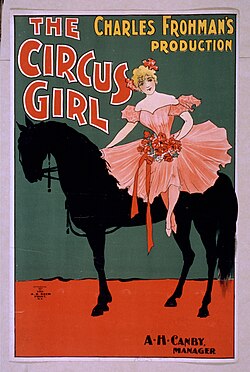
Overheard

So the day dragged through,
And the afternoon brought the spangles, 
  The sawdust smell, the tights,
  The flickering, flashing lights,
  The smile to acknowledge the cheer 
As the rider skips and jangles
  The bells. Ye gods!—'twas queer 
How the young equestriennes flew.

A programme relished, I lay 
  Back in my seat to gaze
On·the faces around, to hear what folk say,
While the orchestra rattled and roared,
  Murdering popular lays—
It was hot, too, and I felt bored.

Then a voice from behind, a rustling of dress, 
  The step of a man, a silence to settle,
  A babble of children (how they push,
These little ones, making your coat in a mess), 
A silence to settle, and after a gush
  Of small talk, I sat and waited,
  Shutting my eyes till the stream abated. 
'Twas a tale of trouble, told in a rush.

Who was the speaker? I turned to see— 
  A sharp little saucy face,
No whit abashed, gazing at me 
With bead-eyes, curiously,
  With a petulant child's grimace,
As I shifted, moving her feet
  From the chair where they'd taken root, 
  For the time at least; then again
I listened. Fast and fleet
  She poured out the queer little words 
to her friend—
  (A sort of an overgrown brute).
  I heard it out to the end—
      A story of pain.
      Here you have it, in fine 
      (Her words, not mine):
      'Tried for luck in London—
                                                  Voila tout! 
      Failed, lost money, undone; 
      Took to the streets for a life.
                                                  Entre nous, 
      It's a terrible uphill strife,
      Like all professions—too filled. 
      And now I'm in lodgings hard by, 
      Au quatrième, up in the sky.
      Visit me by and by,
  They're furnished, but oh—so cold, 
                                                  So cold!'

There the queer little voice was stilled; 
      She moved to a further chair
      And left me sitting there
      To think on the story told— 
      Not to me, but to her friend—
Of a life that had only one end, 
      And for burden, 'Oh, so cold!'

Have you ever seen on the face 
      Of a child a sort of despair, 
      A comical, hopeless air,
When a toy won't work, or a doll won't cry, 
Or a cart runs awkwardly?
      Well, I saw it there
      As she moved to a further chair. 
She'd broken some toy she had— 
Or, was it a life gone bad? 

[Well I moved just then  
      And among the crowds of men 
      I lost them She with her tale 
(Carelessly told indeed) 
Of means to supply a need 
      For bread 
      Till she's dead 
She has my prayers if they're any avail.]


Note: the final stanza above was not included
in the published version of the poem, but included
in an undated version sent to Edith Macdonald; 
        see Andrew Rutherford p. 93. 

Choose another poem

Outsong in the Jungle

BALOO  

For the sake of him who showed
One wise Frog the Jungle-Road,
Keep the Law the Man-Pack make
For thy blind old Baloo's sake!
Clean or tainted, hot or stale,
Hold it as it were the Trail,
Through the day and through the night,
Questing neither left nor right.
For the sake of him who loves
Thee beyond all else that moves,
When thy Pack would make thee pain,
Say: "Tabaqui sings again."
When thy Pack would work thee ill,
Say: "Shere Khan is yet to kill."
When the knife is drawn to slay,
Keep the Law and go thy way.
(Root and honey, palm and spathe,
Guard a cub from harm and scathe!)
Wood and Water, Wind and Tree,
Jungle-Favour go with thee!
                    
KAA  

Anger is the egg of Fear–
Only lidless eyes see clear.
Cobra-poison none may leech–
Even so with Cobra-speech.
Open talk shall call to thee
Strength, whose mate is Courtesy.
Send no lunge beyond thy length.
Lend no rotten bough thy strength.
Gauge thy gape with buck or goat,
Lest thine eye should choke thy throat.
After gorging, wouldst thou sleep?
Look thy den be hid and deep,
Lest a wrong, by thee forgot,
Draw thy killer to the spot.
East and West and North and South,
Wash thy hide and close thy mouth.
(Pit and rift and blue pool-brim,
Middle-Jungle follow him!)
Wood and Water, Wind and Tree,
Jungle-Favour go with thee!
                  
BAGHEERA  

In the cage my life began;
Well I know the worth of Man.
By the Broken Lock that freed–
Man-cub, ware the Man-cub's breed!
Scenting-dew or starlight pale,
Choose no tangled tree-cat trail.
Pack or council, hunt or den,
Cry no truce with Jackal-Men.
Feed them silence when they say:
"Come with us an easy way."
Feed them silence when they seek
Help of thine to hurt the weak.
Make no bandar's boast of skill;
Hold thy peace above the kill.
Let nor call nor song nor sign
Turn thee from thy hunting-line.
(Morning mist or twilight clear,
Serve him, Wardens of the Deer!)
Wood and Water, Wind and Tree,
Jungle-Favour go with thee!
                   
THE THREE  
On the trail that thou must tread
 To the threshold of our dread,
 Where the Flower blossoms red;
 Through the nights when thou shalt lie
 Prisoned from our Mother-sky,
 Hearing us, thy loves, go by;
 In the dawns when thou shalt wake
 To the toil thou canst not break,
 Heartsick for the Jungle's sake;
 Wood and Water, Wind and Tree,
 Wisdom, Strength, and Courtesy,
 Jungle-Favour go with thee!

Choose another poem

Our Lady of the Snows

1 
A Nation spoke to a Nation,
  A Queen sent word to a Throne:
“Daughter am I in my mother’s house,
  But mistress in my own.
The gates are mine to open,
  As the gates are mine to close,
And I set my house in order,”
  Said our Lady of the Snows. 
2 
“Neither with laughter nor weeping,
  Fear or the child’s amaze—
Soberly under the White Man’s law
   My white men go their ways.
Not for the Gentiles’ clamour—
   Insult or threat of blows—
Bow we the knee to Baal,”
  Said our Lady of the Snows. 
3 
“My speech is clean and single,
  I talk of common things—
Words of the wharf and the market-place
  And the ware the merchant brings:
Favour to those I favour,
  But a stumbling-block to my foes.
Many there be that hate us,”
  Said our Lady of the Snows. 
4 
“I called my chiefs to council
   In the din of a troubled year;
For the sake of a sign ye would not see,
  And a word ye would not hear.
This is our message and answer;
  This is the path we chose:
For we be also a people,”
  Said our Lady of the Snows. 
5 
“Carry the word to my sisters—
  To the Queens of the East and the South.
I have proven faith in the Heritage
  By more than the word of the mouth.
They that are wise may follow
  Ere the world’s war-trumpet blows,
But I—I am first in the battle,”
  Said our Lady of the Snows. 
6 
A Nation spoke to a Nation
  A Throne sent word to a Throne:
“Daughter am I in my mother’s house
  But mistress in my own.
The gates are mine to open,
  As the gates are mine to close,
And I abide by my Mother’s House,”
  Said our Lady of the Snows.

Choose another poem