Watches of the Night

[a short tale]

THIS began in a practical joke; but it has gone far enough now, and is getting serious.

Platte, the Subaltern, being poor, had a Waterbury watch and a plain leather guard.

The Colonel had a Waterbury watch also, and, for guard, the lip-strap of a curb-chain. Lipstraps make the best watch-guards. They are strong and short. Between a lip-strap and an ordinary leather-guard there is no great difference ; between one Waterbury watch and another none at all. Every one in the Station knew the Colonel’s lip-strap. He was not a horsy man, but he liked people to believe he had been one once ; and he wove fantastic stories of the hunting-bridle to which this particular lip-strap had belonged. Otherwise he was painfully religious.

Platte and the Colonel were dressing at the Club—both late for their engagements, and both in a hurry. That was Kismet. The two watches were on a shelf below the looking-glass—guards hanging down. That was carelessness. Platte changed first, snatched a watch, looked in the glass, settled his tie, and ran. Forty seconds later the Colonel did exactly the same thing, each man taking the other’s watch.

You may have noticed that many religious people are deeply suspicious. They seem—for purely religious purposes, of course—to know more about iniquity than the Unregenerate. Perhaps they were specially bad before they became converted! At any rate, in the imputation of things evil, and in putting the worst construction on things innocent, a certain type of good people may be trusted to surpass all others. The Colonel and his Wife were of that type. But the Colonel’s Wife was the worst. She manufactured the Station scandal, and—talked to her ayah. Nothing more need be said. The Colonel’s Wife broke up the Laplaces’ home. The Colonel’s Wife stopped the Ferris-Haughtrey engagement. The Colonel’s Wife induced young Buxton to keep his wife down in the Plains through the first year of the marriage. Wherefore little Mrs. Buxton died, and the baby with her. These things will be remembered against the Colonel’s Wife so long as there is a regiment in the country.

But to come back to the Colonel and Platte. They went their several ways from the dressingroom. The Colonel dined with two Chaplains, while Platte went to a bachelor party, and whist to follow.

Mark how things happen! If Platte’s groom had put the new saddle-pad on the mare, the butts of the territs would not have worked through the worn leather and the old pad into the mare’s withers, when she was coming home at two o’clock in the morning. She would not have reared, bolted, fallen into a ditch, upset the cart, and sent Platte flying over an aloe-hedge on to Mrs. Larkyn’s well-kept lawn; and this tale would never have been written. But the mare did all these things, and while Platte was rolling over and over on the turf, like a shot rabbit, the watch and guard flew from his waistcoat—as an Infantry Major’s sword hops out of the scabbard when they are firing a feu-de-joie—and rolled and rolled in the moonlight, till it stopped under a window.

Platte stuffed his handkerchief under the pad, put the cart straight, and went home.

Mark again how Kismet works! This would not arrive once in a hundred years. Towards the end of his dinner with the two Chaplains, the Colonel let out his waistcoat and leaned over the table to look at some Mission Reports. The bar of the watch-guard worked through the buttonhole, and the watch—Platte’s watch—slid quietly on to the carpet; where the bearer found it next morning and kept it.

Then the Colonel went home to the wife of his bosom; but the driver of the carriage was drunk and lost his way. So the Colonel returned at an unseemly hour and his excuses were not accepted. If the Colonel’s Wife had been an ordinary vessel of wrath appointed for destruction, she would have known that when a man stays away on purpose, a his excuse is always sound and original. The very baldness of the Colonel’s explanation proved its truth.

See once more the workings of Kismet. The Colonel’s watch which came with Platte hurriedly on to Mrs. Larkyn’s lawn, chose to stop just under Mrs. Larkyn’s window, where she saw it early in the morning, recognised it, and picked it up. She had heard the crash of Platte’s cart at two o’clock that morning, and his voice calling the mare names. She knew Platte and liked him. That day she showed him the watch and heard his story. He put his head on one side, winked and said, ‘How disgusting! Shocking old man! With his religious training, too! I should send the watch to the Colonel’s Wife and ask for explanations.’

Mrs. Larkyn thought for a minute of the Laplaces—whom she had known when Laplace and his wife believed in each other—and answered, ‘I will send it. I think it will do her good. But, remember, we must never tell her the truth.’

Platte guessed that his own watch was in the Colonel’s possession, and thought that the return of the lip-strapped Waterbury with a soothing note from Mrs. Larkyn would merely create a small trouble for a few minutes. Mrs. Larkyn knew better. She knew that any poison dropped would find good holding-ground in the heart of the Colonel’s Wife.

The packet, and a note containing a few remarks on the Colonel’s calling-hours, were sent over to the Colonel’s Wife, who wept in her own room and took counsel with herself.

If there was one woman under Heaven whom the Colonel’s Wife hated with holy fervour, it was Mrs. Larkyn. Mrs. Larkyn was a frivolous lady, and called the Colonel’s Wife ‘old cat.’ The Colonel’s Wife said that somebody in Revelation was remarkably like Mrs. Larkyn. She mentioned other Scripture people as well: from the Old Testament. But the Colonel’s Wife was the only person who cared or dared to say anything against Mrs. Larkyn. Every one else accepted her as an amusing, honest little body. Wherefore, to believe that her husband had been shedding watches under that ‘Thing’s’ window at ungodly hours, coupled with the fact of his late arrival on the previous night, was . . .

At this point she rose up and sought her husband. He denied everything except the ownership of the watch. She besought him, for his Soul’s sake to speak the truth. He denied afresh, with two bad words. Then a stony silence held the Colonel’s Wife, while a man could draw his breath five times.

The speech that followed is no affair of mine or yours. It was made up of wifely and womanly jealousy; knowledge of old age and sunk cheeks; deep mistrust born of the text that says even little babies’ hearts are as bad as they make them; rancorous hatred of Mrs. Larkyn, and the tenets of the creed of the Colonel’s Wife’s upbringing.

Over and above all was the damning lipstrapped Waterbury, ticking away in the palm of her shaking, withered hand. At that hour, I think, the Colonel’s Wife realised a little of the restless suspicion she had injected into old Laplace’s mind, a little of poor Miss Haughtrey’s misery, and some of the canker that ate into Buxton’s heart as he watched his wife dying before his eyes. The Colonel stammered and tried to explain. Then he remembered that his watch had disappeared; and the mystery grew greater. The Colonel’s Wife talked and prayed by turns till she was tired, and went away to devise means for chastening the stubborn heart of her husband. Which, translated, means, in our slang, ‘tailtwisting.’

Being deeply impressed with the doctrine of Original Sin, she could not believe in the face of appearances. She knew too much, and jumped to the wildest conclusions.

But it was good for her. It spoilt her life, as she had spoilt the life of the Laplaces. She had lost her faith in the Colonel, and—here the creed-suspicion came in—he might, she argued, have erred many times, before a merciful Providence, at the hands of so unworthy an instrument as Mrs. Larkyn, had established his guilt. He was a bad, wicked, gray-haired profligate. This may sound too sudden a revulsion for a long-wedded wife; but it is a venerable fact that, if a man or woman makes a practice of, and takes a delight in, believing and spreading evil of people indifferent to him or her, he or she will end in believing evil of folk very near and dear. You may think, also, that the mere incident of the watch was too small and trivial to raise this misunderstanding. It is another aged fact that, in life as well as racing, all the worst accidents happen at little ditches and cutdown fences. In the same way, you sometimes see a woman who would have made a Joan of Arc in another century and climate, threshing herself to pieces over all the mean worry of housekeeping. But that is another story.

Her belief only made the Colonel’s Wife more wretched, because it insisted so strongly on the villainy of men. Remembering what she had done, it was pleasant to watch her unhappiness, and the penny-farthing attempts she made to hide it from the Station. But the Station knew and laughed heartlessly; for they had heard the story of the watch, with much dramatic gesture, from Mrs. Larkyn’s lips.

Once or twice Platte said to Mrs. Larkyn, seeing that the Colonel had not cleared himself, ‘This thing has gone far enough. I move we tell the Colonel’s Wife how it happened.’ Mrs. Larkyn shut her lips and shook her head, and vowed that the Colonel’s Wife must bear her punishment as best she could. Now Mrs. Larkyn was a frivolous woman, in whom none would have suspected deep hate. So Platte took no action, and came to believe gradually, from the Colonel’s silence, that the Colonel must have run off the line somewhere that night, and, therefore, preferred to stand sentence on the lesser count of rambling into other people’s compounds out of calling-hours. Platte forgot about the watch business after a while, and moved down-country with his regiment. Mrs. Larkyn went home when her husband’s tour of Indian service expired. She never forgot.

But Platte was quite right when he said that the joke had gone too far. The mistrust and the tragedy of it—which we outsiders cannot see and do not believe in—are killing the Colonel’s Wife, and are making the Colonel wretched. If either of them read this story, they can depend upon its being a fairly true account of the case, and can kiss and make friends.

Shakespeare alludes to the pleasure of watching an Engineer being shelled by his own Battery. Now this shows that poets should not write about what they do not understand. Any one could have told him that Sappers and Gunners are perfectly different branches of the Service. But, if you correct the sentence, and substitute Gunner for Sapper, the moral comes just the same.

Something of Myself – V

THEN down to Bombay where my ayah, so old but so unaltered, met me with blessings and tears; and then to London to be married in January ’92 in the thick of an influenza epidemic, when the undertakers had run out of black horses and the dead had to be content with brown ones. The living were mostly abed. (We did not know then that this epidemic was the first warning that the plague—forgotten for generations—was on the move out of Manchuria.)All of which touched me as much as it would any other young man under like circumstances. My concern was to get out of the pest-house as soon as might be. For was I not a person of substance? Had I not several—more than two at least—thousand pounds in Fixed Deposits? Had not my own Bank’s Manager himself suggested that I might invest some of my ‘capital’ in, say, indigo? But I preferred to invest once more in Cook’s tickets—for two—on a voyage round the world. It was all arranged beyond any chance of failure.

So we were married in the church with the pencil-pointed steeple at Langham Place—Gosse, Henry James, and my cousin Ambrose Poynter being all the congregation present—and we parted at the church door to the scandal of the Beadle, my wife to administer medicine to her mother, and I to a wedding breakfast with Ambrose Poynter; after which, on returning to collect my wife, I saw, pinned down by weights on the rainy pavement as was the custom of those untroubled days, a newspaper poster announcing my marriage, which made me feel uncomfortable and defenceless.

And a few days afterwards we were on our magic carpet which was to take us round the earth, beginning with Canada deep in snow. Among our wedding gifts was a generous silver flask filled with whisky, but of incontinent habit. It leaked in the valise where it lay with flannel shirts. And it scented the entire Pullman from end to end ere we arrived at the cause. But by that time all our fellow-passengers were pitying that poor girl who had linked her life to this shameless inebriate. Thus in a false atmosphere all of our innocent own, we came to Vancouver, where with an eye to the future and for proof of wealth we bought, or thought we had, twenty acres of a wilderness called North Vancouver, now part of the City. But there was a catch in the thing, as we found many years later when, after paying taxes on it for ever so long, we discovered it belonged to some one else. All the consolation we got then from the smiling people of Vancouver was; ‘You bought that from Steve, did you? Ah-ah, Steve! You hadn’t ought to ha’ bought from Steve. No! Not from Steve.’ And thus did, the good Steve cure us of speculating in real estate.

Then to Yokohama, where we were treated with all the kindliness in the world by a man and his wife on whom we had no shadow of any claim. They made us more than welcome in their house, and saw to it that we should see Japan in wistaria and peony time. Here an earthquake (prophetic as it turned out) overtook us one hot break of dawn, and we fled out into the garden, where a tall cryptomeria waggled its insane head back and forth with an ‘I told you so’ expression; though not a breath was stirring. A little later I went to the Yokohama branch of my Bank on a wet forenoon to draw some of my solid wealth. Said the Manager to me: ‘Why not take more? It will be just as easy.’ I answered that I did not care to have too much cash at one time in my careless keeping, but that when I had looked over my accounts I might come again in the afternoon. I did so; but in that little space my Bank, the notice on its shut door explained, had suspended payment. (Yes, I should have done better to have invested my ‘capital’ as its London Manager had hinted.)

I returned with my news to my bride of three months and a child to be born. Except for what I had drawn that morning—the Manager had sailed as near to the wind as loyalty permitted—and the unexpended Cook vouchers, and our personal possessions in our trunks, we had nothing whatever. There was an instant Committee of Ways and Means, which advanced our understanding of each other more than a cycle of solvent matrimony. Retreat—flight, if you like—was indicated. What would Cook return for the tickets, not including the price of lost dreams? ‘Every pound you’ve paid, of course,’ said Cook of Yokohama. ‘These things are all luck and—here’s your refund.’

Back again, then, across the cold North Pacific, through Canada on the heels of the melting snows, and to the outskirts of a little New England town where my wife’s paternal grandfather (a French man) had made his home and estate many years before. The country was large-boned, mountainous, wooded, and divided into farms of from fifty to two hundred barren acres. Roads, sketched in dirt, connected white, clap-boarded farm-houses, where the older members of the families made shift to hold down the eating mortgages. The younger folk had gone elsewhere. There were many abandoned houses too; some decaying where they stood; others already reduced to a stone chimney-stack or mere green dimples still held by an undefeated lilac-bush. On one small farm was a building known as the Bliss Cottage, generally inhabited by a hired man. It was of one storey and a half; seventeen feet high to the roof-tree; seventeen feet deep and, including the kitchen and wood-shed, twenty-seven feet wide over all. Its water-supply was a single half-inch lead pipe connecting with a spring in the neighbourhood. But it was habitable, and it stood over a deep if dampish cellar. Its rent was ten dollars or two pounds a month.

We took it. We furnished it with a simplicity that fore-ran the hire-purchase system. We bought, second or third hand, a huge, hot-air stove which we installed in the cellar. We cut generous holes in our thin floors for its eightinch tin pipes (why we were not burned in our beds each week of the winter I never can understand) and we were extraordinarily and self-centredly content.

As the New England summer flamed into autumn I piled cut spruce boughs all round the draughty cottage sill, and helped to put up a tiny roofless verandah along one side of it for future needs. When winter shut down and sleigh-bells rang all over the white world that tucked us in, we counted ourselves secure. Sometimes we had a servant. Sometimes she would find the solitude too much for her and flee without warning, one even leaving her trunk. This troubled us not at all. There are always two sides to a plate, and the cleaning of frying- and saucepans is as little a mystery as the making of comfortable beds. When our lead pipe froze, we would slip on our coon-skin coats and thaw it out with a lighted candle. There was no space in the attic bedroom for a cradle, so we decided that a trunk-tray would be just as good. We envied no one—not even when skunks wandered into our cellar and, knowing the nature of the beasts, we immobilised ourselves till it should please them to depart.

But our neighbours saw no humour in our proceedings. Here was a stranger of an unloved race, currently reported to ‘make as much as a hundred dollars out of a ten-cent bottle of ink,’ and who had ‘pieces in the papers’ about him, who had married a ‘Balestier girl.’ Did not her grandmother still live on the Balestier place, where ‘old Balestier’ instead of farming had built a large house, and there had dined late in special raiment, and drunk red wines after the custom of the French instead of decent whisky? And behold this Britisher, under pretext of having lost money, had settled his wife down ‘right among her own folk’ in the Bliss Cottage. It was not seemly on the face of it; so they watched as secretively as the New England or English peasant can, and what toleration they extended to the ‘Britisher’ was solely for the sake of ‘the Balestier girl.’

But we had received the first shock of our young lives at the first crisis in them. The Committee of Ways and Means passed a resolution, never rescinded, that henceforth, at any price, it must own its collective self.

As money came in from the sale of books and tales, the first use we made of it was to buy back Departmental Ditties, Plain Tales, and the six paperbacked books that I had sold to get me funds for leaving India in ’89. They cost something, but, owning them, the Bliss Cottage breathed more comfortably.

Not till much later did we realise the terrible things that ‘folks thought of your doin’s.’ From their point of view they were right. Also, they were practical as the following will show.

One day a stranger drove up to the Bliss Cottage. The palaver opened thus:—

‘Kiplin’, ain’t ye?’

That was admitted.

‘Write, don’t ye?’

That seemed accurate. (Long pause.)

‘Thet bein’ so, you’ve got to live to please folk, hain’t ye?’

That indeed was the raw truth. He sat rigid in the buggy and went on.

‘Thet bein’ so, you’ve got to please to live, I reckon?’

It was true. (I thought of my Adjutant of Volunteers at Lahore.)

‘Puttin’ it thet way,’ he pursued, ‘we’ll ’low thet, by and by, ye can’t please. Sickness—accident—any darn thing. Then—what’s liable to happen ye—both of ye?’

I began to see, and he to fumble in his breast pocket.

‘Thet’s where Life Insurance comes in. Naow, I represent,’ etc. etc. It was beautiful salesmanship. The Company was reputable, and I effected my first American Insurance, Leuconoë agreeing with Horace to trust the future as little as possible.

Other visitors were not so tactful. Reporters came from papers in Boston, which I presume believed itself to be civilised, and demanded interviews. I told them I had nothing to say. ‘If ye hevn’t, guess we’ll make ye say something.’ So they went away and lied copiously, their orders being to ‘get the story.’ This was new to me at the time; but the Press had not got into its full free stride of later years.

My workroom in the Bliss Cottage was seven feet by eight, and from December to April the snow lay level with its window-sill. It chanced that I had written a tale about Indian Forestry work which included a boy who had been brought up by wolves. In the stillness, and suspense, of the winter of ’92 some memory of the Masonic Lions of my childhood’s magazine, and a phrase in Haggard’s Nada the Lily, combined with the echo of this tale. After blocking out the main idea in my head, the pen took charge, and I watched it begin to write stories about Mowgli and animals, which later grew into the Jungle Books .

Once launched there seemed no particular reason to stop, but I had learned to distinguish between the peremptory motions of my Daemon, and the ‘carry-over’ or induced electricity, which comes of what you might call mere ‘frictional’ writing. Two tales, I remember, I threw away and was better pleased with the remainder. More to the point, my Father thought well of the workmanship.

My first child and daughter was born in three foot of snow on the night of December 29th, 1892. Her Mother’s birthday being the 31st and mine the 30th of the same month, we congratulated her on her sense of the fitness of things, and she throve in her trunk-tray in the sunshine on the little plank verandah. Her birth brought me into contact with the best friend I made in New England—Dr. Conland.

It seemed that the Bliss Cottage might be getting a little congested, so, in the following spring, the Committee of Ways and Means ‘considered a field and bought it’—as much as ten whole acres—on a rocky hillside looking across a huge valley to Wantastiquet, the wooded mountain across the Connecticut river.

That summer there came out of Quebec Jean Pigeon with nine other habitants who put up a wooden shed for their own accommodation in what seemed twenty minutes, and then set to work to build us a house which we called ‘Naulakha.’ Ninety feet was the length of it and thirty the width, on a high foundation of solid mortared rocks which gave us an airy and a skunk-proof basement. The rest was wood, shingled, roof and sides, with dull green hand-split shingles, and the windows were lavish and wide. Lavish too was the long open attic, as I realised when too late. Pigeon asked me whether I would have it finished in ash or cherry. Ignorant that I was, I chose ash, and so missed a stretch of perhaps the most satisfying interior wood that is grown. Those were opulent days, when timber was nothing regarded, and the best of cabinet-work could be had for little money.

Next, we laid out a long drive to the road. This needed dynamite to soften its grades and a most mellow plumber brought up many sticks of it all rattling about under his buggy-seat among the tamping-rods. We dived, like woodchucks, into the nearest deepest hole. Next, needing water, we sunk a five-inch shaft three hundred foot into the New England granite, which nowhere was less than three, though some say thirty, thousand foot thick. Over that we set a windmill, which gave us not enough water and moaned and squeaked o’ nights. So we knocked out its lowest bolts, hitched on two yoke of bullocks, and overthrew it, as it might have been the Vendôme Column; thus spiritually recouping ourselves for at least half the cost of erection. A low-power atmospheric pump, which it was my disgustful duty to oil, was its successor. These experiences gave us both a life-long taste for playing with timber, stone, concrete and such delightful things.

Horses were an integral part of our lives, for the Bliss Cottage was three miles from the little town, and half a mile from the house in building. Our permanent servitor was a big, philosophical black called Marcus Aurelius, who waited in the buggy as cars wait to-day, and when weary of standing up would carefully lie down and go to sleep between his shafts. After we had finished with him, we tied his reins short and sent him in charge of the buggy alone down the road to his stable-door, where he resumed his slumbers till some one came to undress him and put him to bed. There was a small mob of other horses about the landscape, including a meek old stallion with a permanently lame leg, who passed the evening of his days in a horse-power machine which cut wood for us.

I tried to give something of the fun and flavour of those days in a story called ‘A Walking Delegate’ where all the characters are from horse-life.

The wife’s passion, I discovered, was driving trotters. It chanced that our first winter in ‘Naulakha’ she went to look at the new patent safety heating-stove, which blew flame in her face and burnt it severely. She recovered slowly, and Dr. Conland suggested that she needed a tonic. I had been in treaty for a couple of young, sealbrown, full brother and sister Morgans, good for a three-mile clip, and, on Conland’s hint, concluded the deal. When I told the wife, she thought it would console her to try them and, that same afternoon, leaving one eye free of the bandages, she did so in three foot of snow and a failing light, while I suffered beside her. But Nip and Tuck were perfect roadsters and the ‘tonic’ succeeded. After that they took us all over the large countryside.

It would be hard to exaggerate the loneliness and sterility of life on the farms. The land was denuding itself of its accustomed inhabitants, and their places had not yet been taken by the wreckage of Eastern Europe or the wealthy city folk who later bought ‘pleasure farms.’ What might have become characters, powers and attributes perverted themselves in that desolation as cankered trees throw out branches akimbo, and strange faiths and cruelties, born of solitude to the edge of insanity, flourished like lichen on sick bark.

One day-long excursion up the flanks of Wantastiquet, our guardian mountain across the river, brought us to a farm-house where we were welcomed by the usual wild-eyed, flat-fronted woman of the place. Looking over sweeps of emptiness, we saw our ‘Naulakha’ riding on its hillside like a little boat on the flank of a far wave. Said the woman, fiercely; ‘Be you the new lights ’crost the valley yonder? Ye don’t know what a comfort they’ve been to me this winter. Ye aren’t ever goin’ to shroud ’em up—or be ye?’ So, as long as we lived there, that broad side of ‘Naulakha’ which looked her-ward was always nakedly lit.

In the little town where we shopped there was another atmosphere. Vermont was by tradition a ‘Dry’ State. For that reason, one found in almost every office the water-bottle and thick tooth-glass displayed openly, and in discreet cupboards or drawers the whisky bottle. Business was conducted and concluded with gulps of raw spirit, followed by a pledget of ice-cold water. Then, both parties chewed cloves, but whether to defeat the Law, which no one ever regarded, or to deceive their women-folk, of whom they went in great fear (they were mostly educated up to College age by spinsters), I do not know.

But a promising scheme for a Country Club had to be abandoned because many men who would by right belong to it could not be trusted with a full whisky bottle. On the farms, of course, men drank cider, of various strengths, and sometimes achieved almost maniacal forms of drunkenness. The whole business seemed to me as unwholesomely furtive and false as many aspects of American life at that time.

Administratively, there was unlimited and meticulous legality, with a multiplication of semi-judicial offices and titles; but of law-abidingness, or of any conception of what that implied, not a trace. Very little in business, transportation, or distribution, that I had to deal with, was sure, punctual, accurate, or organised. But this they neither knew nor would have believed though angels affirmed it. Ethnologically, immigrants were coming into the States at about a million head a year. They supplied the cheap—almost slave—labour, lacking which all wheels would have stopped, and they were handled with a callousness that horrified me. The Irish had passed out of the market into ‘politics’ which suited their instincts of secrecy, plunder, and anonymous denunciation. The Italians were still at work, laying down trams, but were moving up, via small shops and curious activities, to the dominant position which they now occupy in well-organised society. The German, who had preceded even the Irish, counted himself a full-blooded American, and looked down gutturally on what he called ‘foreign trash.’ Somewhere in the background, though he did not know it, was the ‘representative’ American, who traced his blood through three or four generations and who, controlling nothing and affecting less, protested that the accepted lawlessness of life was not ‘representative’ of his country, whose moral, aesthetic, and literary champion he had appointed himself. He said too, almost automatically, that all foreign elements could and would soon be ‘assimilated’ into ‘good Americans.’ And not a soul cared what he said or how he said it! They were making or losing money.

The political background of the land was monotonous. When the people looked, which was seldom, outside their own borders, England was still the dark and dreadful enemy to be feared and guarded against. The Irish, whose other creed is Hate; the history books in the Schools; the Orators; the eminent Senators; and above all the Press; saw to that. Now John Hay, one of the very few American Ambassadors to England with two sides to their heads, had his summer house a few hours north by rail from us. On a visit to him, we discussed the matter. His explanation was convincing. I quote the words which stayed textually in my memory. ‘America’s hatred of England is the hoop round the forty-four (as they were then) staves of the Union.’ He said it was the only standard possible to apply to an enormously variegated population. ‘So—when a man comes up out of the sea, we say to him; “See that big bully over there in the East? He’s England! Hate him, and you’re a good American.”’

On the principle, ‘if you can’t keep a love affair going, start a row,’ this is reasonable. At any rate the belief lifted on occasion the overwhelming vacuity of the national life into some contact with imponderable externals.

But how thoroughly the doctrine was exploited I did not realise till we visited Washington in ’95, where I met Theodore Roosevelt, then UnderSecretary (I never caught the name of the Upper) to the U.S. Navy. I liked him from the first and largely believed in him. He would come to our hotel, and thank God in a loud voice that he had not one drop of British blood in him; his ancestry being Dutch, and his creed conforming-Dopper, I think it is called. Naturally I told him nice tales about his Uncles and Aunts in South Africa—only I called them Ooms and Tanties—who esteemed themselves the sole lawful Dutch under the canopy and dismissed Roosevelt’s stock for ‘Verdomder Hollanders.’ Then he became really eloquent, and we would go off to the Zoo together, where he talked about grizzlies that he had met. It was laid on him, at that time, to furnish his land with an adequate Navy; the existing collection of unrelated types and casual purchases being worn out. I asked him how he proposed to get it, for the American people did not love taxation. ‘Out of you,’ was the disarming reply. And so—to some extent—it was. The obedient and instructed Press explained how England—treacherous and jealous as ever—only waited round the corner to descend on the unprotected coasts of Liberty, and to that end was preparing, etc. etc. etc. (This in ’95 when England had more than enough hay on her own trident to keep her busy!) But the trick worked, and all the Orators and Senators gave tongue, like the Hannibal Chollops that they were. I remember the wife of a Senator who, apart from his politics, was very largely civilised, invited me to drop into the Senate and listen to her spouse ’twisting the Lion’s tail.’ It seemed an odd sort of refreshment to offer a visitor. I could not go, but I read his speech. [At the present time (autumn ’35) I have also read with interest the apology offered by an American Secretary of State to Nazi Germany for unfavourable comments on that land by a New York Police Court Judge.] But those were great and spacious and friendly days in Washington which—politics apart—Allah had not altogether deprived of a sense of humour; and the food was a thing to dream of.

Through Roosevelt I met Professor Langley of the Smithsonian, an old man who had designed a model aeroplane driven—for petrol had not yet arrived—by a miniature flash-boiler engine, a marvel of delicate craftsmanship. It flew on trial over two hundred yards, and drowned itself in the waters of the Potomac, which was cause of great mirth and humour to the Press of his country. Langley took it coolly enough and said to me that, though he would never live till then, I should see the aeroplane established.

The Smithsonian, specially on the ethnological side, was a pleasant place to browse in. Every nation, like every individual, walks in a vain show—else it could not live with itself—but I never got over the wonder of a people who, having extirpated the aboriginals of their continent more completely than any modern race had ever done, honestly believed that they were a godly little New England community, setting examples to brutal mankind. This wonder I used to explain to Theodore Roosevelt, who made the glass cases of Indian relics shake with his rebuttals.

The next time I met him was in England, not long after his country had acquired the Philippines, and he—like an elderly lady with one babe—yearned to advise England on colonial administration. His views were sound enough, for his subject was Egypt as it was beginning to be then, and his text ‘Govern or get out.’ He consulted several people as to how far he could go. I assured him that the English would take anything from him, but were racially immune to advice.

I never met him again, but we corresponded through the years when he ‘jumped’ Panama from a brother-President there whom he described as ‘Pithecanthropoid,’ and also during the War, in the course of which I met two of his delightful sons. My own idea of him was that he was a much bigger man than his people understood or, at that time, knew how to use, and that he and they might have been better off had he been born twenty years later.

Meantime, our lives went on at the Bliss Cottage and, so soon as it was built, at ‘Naulakha.’ To the former one day came Sam McClure, credited with being the original of Stevenson’s Pinkerton in The Wrecker, but himself, far more original. He had been everything from a pedlar to a tintype photographer along the highways, and had held intact his genius and simplicity. He entered, alight with the notion for a new Magazine to be called ‘McClure’s.’ I think the talk lasted some twelve—or it may have been seventeen—hours, before the notion was fully hatched out. He, like Roosevelt, was in advance of his age, for he looked rather straightly at practices and impostures which were in the course of being sanctified because they paid. People called it ‘muck-raking’ at the time, and it seemed to do no sort of good. I liked and admired McClure more than a little, for he was one of the few with whom three and a half words serve for a sentence, and as clean and straight as spring water. Nor did I like him less when he made a sporting offer to take all my output for the next few years at what looked like fancy rates. But the Committee of Ways and Means decided that futures were not to be dealt in. (I here earnestly commend to the attention of the ambitious young a text in the thirty-third chapter of Ecclesiasticus which runs; ‘As long as thou livest and hast breath in thee, give not thyself over to any.’)

To ‘Naulakha,’ on a wet day, came from Scribner’s of New York a large young man called Frank Doubleday, with a proposal, among other things, for a complete edition of my then works. One accepts or refuses things that really matter on personal and illogical grounds. We took to that young man at sight, and he and his wife became of our closest friends. In due time, when he was building up what turned into the great firm of Doubleday, Page & Co., and later Doubleday, Doran & Co., I handed over the American side of my business to him. Whereby I escaped many distractions for the rest of my life. Thanks to the large and intended gaps in the American Copyright law, much could be done by the enterprising not only to steal, which was natural, but to add to and interpolate and embellish the thefts with stuff I had never written. At first this annoyed me, but later I laughed; and Frank Doubleday chased the pirates up with cheaper and cheaper editions, so that their thefts became less profitable. There was no more pretence to morality in these gentlemen than in their brethren, the bootleggers of later years. As a pillar of the Copyright League (even he could not see the humour of it) once said, when I tried to bring him to book for a more than usually flagrant trespass ‘We thought there was money in it, so we did it.’ It was, you see, his religion. By and large I should say that American pirates have made say half as many dollars out of my stuff as I am occasionally charged with having ‘made’ out of the legitimate market in that country.

Into this queer life the Father came to see how we fared, and we two went wandering into Quebec where, the temperature being 95 and all the world dressed all over after the convention of those days, the Father was much amazed. Then we visited at Boston his old friend, Charles Eliot Norton of Harvard, whose daughters I had known at The Grange in my boyhood and since. They were Brahmins of the Boston Brahmins, living delightfully, but Norton himself, full of forebodings as to the future of his land’s soul, felt the established earth sliding under him, as horses feel coming earth-tremors.

He told us a tale of old days in New England. He and another Professor, wandering round the country in a buggy and discussing high and moral matters, halted at the farm of an elderly farmer well known to them, who, in the usual silence of New England; set about getting the horse a bucket of water. The two men in the buggy went on with their discussion, in the course of which one of them said; ‘Well, according to Montaigne,’ and gave a quotation. Voice from the horse’s head, where the farmer was holding the bucket ‘’Tweren’t Montaigne said that. ’Twere Mon-tes-ki-ew.’ And ’twas.

That, said Norton, was in the middle or late ’seventies. We two wandered about the back of Shady Hill in a buggy, but nothing of that amazing kind befell us. And Norton spoke of Emerson and Wendell Holmes and Longfellow and the Alcotts and other influences of the past as we returned to his library, and he browsed aloud among his books; for he was a scholar among scholars.

But what struck me, and he owned to something of the same feeling, was the apparent waste and ineffectiveness, in the face of the foreign inrush, of all the indigenous effort of the past generation. It was then that I first began to wonder whether Abraham Lincoln had not killed rather too many autochthonous ‘Americans’ in the Civil War, for the benefit of their hastily imported Continental supplanters. This is black heresy, but I have since met men and women who have breathed it. The weakest of the old-type immigrants had been sifted and salted by the long sailing-voyage of those days. But steam began in the later ’sixties and early ’seventies, when human cargoes could be delivered with all their imperfections and infections in a fortnight or so. And one million more-or-less acclimatised Americans had been killed.

Somehow or other, between ’92 and ’96 we managed to pay two flying visits to England, where my people were retired and lived in Wiltshire; and we learned to loathe the cold North Atlantic more and more. On one trip our steamer came almost atop of a whale, who submerged just in time to clear us, and looked up into my face with an unforgettable little eye the size of a bullock’s. Eminent Masters R.L.S. will remember what William Dent Pitman saw of ‘haughty and indefinable’ in the hairdresser’s waxen model. When I was illustrating the Just So Stories, I remembered and strove after that eye.

We went once or twice to Gloucester, Mass., on a summer visit, when I attended the annual Memorial Service to the men drowned or lost in the cod-fishing schooners fleet. Gloucester was then the metropolis of that industry.

Now our Dr. Conland had served in that fleet when he was young. One thing leading to another, as happens in this world, I embarked on a little book which was called Captains Courageous. My part was the writing; his the details. This book took us (he rejoicing to escape from the dread respectability of our little town) to the shore-front, and the old T-wharf of Boston Harbour, and to queer meals in sailors’ eating-houses, where he renewed his youth among ex-shipmates or their kin. We assisted hospitable tug-masters to help haul three- and four-stick schooners of Pocahontas coal all round the harbour; we boarded every craft that looked as if she might be useful, and we delighted ourselves to the limit of delight. Charts we got—old and new—and the crude implements of navigation such as they used off the Banks, and a battered boat-compass, still a treasure with me. (Also, by pure luck, I had sight of the first sickening uprush and vomit of iridescent coal-dusted water into the hold of a ship, a crippled iron hulk, sinking at her moorings.) And Conland took large cod and the appropriate knives with which they are prepared for the hold, and demonstrated anatomically and surgically so that I could make no mistake about treating them in print. Old tales, too, he dug up, and the lists of dead and gone schooners whom he had loved, and I revelled in profligate abundance of detail—not necessarily for publication but for the joy of it. And he sent me—may he be forgiven!—out on a pollock-fisher, which is ten times fouler than any cod-schooner, and I was immortally sick, even though they tried to revive me with a fragment of unfresh pollock.

As though this were not enough, when, at the end of my tale, I desired that some of my characters should pass from San Francisco to New York in record time, and wrote to a railway magnate of my acquaintance asking what he himself would do, that most excellent man sent a fully worked-out time-table, with watering halts, changes of engine, mileage, track conditions and climates, so that a corpse could not have gone wrong in the schedule. My characters arrived triumphantly; and, then, a real live railway magnate was so moved after reading the book that he called out his engines and called out his men, hitched up his own private car, and set himself to beat my time on paper over the identical route, and succeeded. Yet the book was not all reporterage. I wanted to see if I could catch and hold something of a rather beautiful localised American atmosphere that was already beginning to fade. Thanks to Conland I came near this.

A million—or it may have been only forty—years later, a Super-film Magnate was in treaty with me for the film rights of this book. At the end of the sitting, my Daemon led me to ask if it were proposed to introduce much ‘sex appeal’ into the great work. ‘Why, certainly,’ said he. Now a happily married lady cod-fish lays about three million eggs at one confinement. I told him as much. He said; ‘Is that so?’ And went on about ‘ideals.’. . . Conland had been long since dead, but I prayed that wherever he was, he might have heard.

And so, in this unreal life, indoors and out, four years passed, and a good deal of verse and prose saw the light. Better than all, I had known a corner of the United States as a householder, which is the only way of getting at a country. Tourists may carry away impressions, but it is the seasonal detail of small things and doings (such as putting up fly-screens and stove-pipes, buying yeast-cakes and being lectured by your neighbours) that bite in the lines of mental pictures. They were an interesting folk, but behind their desperate activities lay always, it seemed to me, immense and unacknowledged boredom—the deadweight of material things passionately worked up into Gods, that only bored their worshippers more and worse and longer. The intellectual influences of their Continental immigrants were to come later. At this time they were still more or less connected with the English tradition and schools, and the Semitic strain had not yet been uplifted in a too-much-at-ease Zion. So far as I was concerned, I felt the atmosphere was to some extent hostile. The idea seemed to be that I was ‘making money’ out of America—witness the new house and the horses—and was not sufficiently grateful for my privileges. My visits to England and the talk there persuaded me that the English scene might be shifting to some new developments, which would be worth watching. A meeting of the Committee of Ways and Means came to the conclusion that ‘Naulakha,’ desirable as it was, meant only ‘a house’ and not ‘The House’ of our dreams. So we loosed hold and, with another small daughter, born in the early spring snows and beautifully tanned in a sumptuous upper verandah, we took ship for England, after clearing up all our accounts. As Emerson wrote:—

Wilt thou seal up the avenues of ill?
Pay every debt as if God wrote the bill.

The spring of ’96 saw us in Torquay, where we found a house for our heads that seemed almost too good to be true. It was large and bright, with big rooms each and all open to the sun, the grounds embellished with great trees and the warm land dipping southerly to the clean sea under the Marychurch cliffs. It had been inhabited for thirty years by three old maids. We took it hopefully. Then we made two notable discoveries. Everybody was learning to ride things called ‘bicycles.’ In Torquay there was a circular cinder-track where, at stated hours, men and women rode solemnly round and round on them. Tailors supplied special costumes for this sport. Some one—I think it was Sam McClure from America—had given us a tandem bicycle, whose double steering-bars made good dependence for continuous domestic quarrel. On this devil’s toast-rack we took exercise, each believing that the other liked it. We even rode it through the idle, empty lanes, and would pass or overtake without upset several carts in several hours. But, one fortunate day, it skidded, and decanted us on to the roadmetal. Almost before we had risen from our knees, we made mutual confession of our common loathing of wheels, pushed the Hell-Spider home by hand, and rode it no more.

The other revelation came in the shape of a growing depression which enveloped us both—a gathering blackness of mind and sorrow of the heart, that each put down to the new, soft climate and, without telling the other, fought against for long weeks. It was the Feng-shui—the Spirit of the house itself—that darkened the sunshine and fell upon us every time we entered, checking the very words on our lips.

A talk about a doubtful cistern brought another mutual confession. ‘But I thought you liked the place?’ ‘But I made sure you did,’ was the burden of our litanies. Using the cistern for a stalking-horse, we paid forfeit and fled. More than thirty years later on a motor-trip we ventured down the steep little road to that house, and met, almost unchanged, the gardener and his wife in the large, open, sunny stable-yard, and, quite unchanged, the same brooding Spirit of deep, deep Despondency within the open, lit rooms.

But while we were at Torquay there came to me the idea of beginning some tracts or parables on the education of the young. These, for reasons honestly beyond my control, turned themselves into a series of tales called Stalky & Co. My very dear Headmaster, Cormell Price, who had now turned into ‘Uncle Crom’ or just ‘Crommy,’ paid a visit at the time and we discussed school things generally. He said, with the chuckle that I had reason to know, that my tracts would be some time before they came to their own. On their appearance they were regarded as irreverent, not true to life, and rather ‘brutal.’ This led me to wonder, not for the first time, at which end of their carcasses grown men keep their school memories.

Talking things over with ‘Crommy,’ I reviled him for the badness and scantiness of our food at Westward Ho! To which he replied; ‘We-el! For one thing, we were all as poor as church mice. Can you remember any one who had as much as a bob a week pocket money? I can’t. For an other, a boy who is always hungry is more interested in his belly than in anything else.’ (In the Boer War I learned that the virtue in a battalion living on what is known as ‘Two and a half’—Army biscuits—a day is severe.) Speaking of sickness and epidemics, which were unknown to us, he said; ‘I expect you were healthy because you lived in the open almost as much as Dartmoor ponies.’ Stalky & Co. became the illegitimate ancestor of several stories of school-life whose heroes lived through experiences mercifully denied to me. It is still read (’35) and I maintain it is a truly valuable collection of tracts.

Our flight from Torquay ended almost by instinct at Rottingdean where the beloved Aunt and Uncle had their holiday house, and where I had spent my very last days before sailing for India fourteen years back. In 1882 there had been but one daily bus from Brighton, which took forty minutes; and when a stranger appeared on the village green the native young would stick out their tongues at him. The Downs poured almost direct into the one village street and lay out eastward unbroken to Russia Hill above Newhaven. It was little altered in ’96. My cousin, Stanley Baldwin, had married the eldest daughter of the Ridsdales out of The Dene—the big house that flanked one side of the green. My Uncle’s ‘North End House’ commanded the other, and a third house opposite the church was waiting to be taken according to the decrees of Fate. The Baldwin marriage, then, made us free of the joyous young brotherhood and sisterhood of The Dene, and its friends.
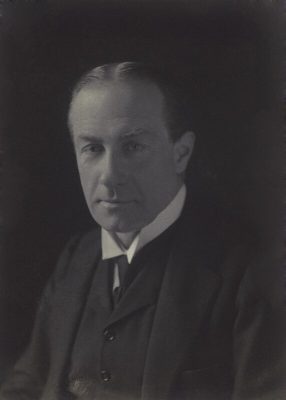
Stanley Baldwin by Walter Stoneman bromide print, 1920 NPG x66736 © National Portrait Gallery, London • NPG

Stanley Baldwin by Walter Stoneman bromide print, 1920 NPG x66736
© National Portrait Gallery, London • NPG

The Aunt and the Uncle had said to us; ‘Let the child that is coming to you be born in our house,’ and had effaced themselves till my son John arrived on a warm August night of ’97, under what seemed every good omen. Meantime, we had rented by direct interposition of Fate that third house opposite the church on the green. It stood in a sort of little island behind flint walls which we then thought were high enough, and almost beneath some big ilex trees. It was small, none too well built, but cheap, and so suited us who still remembered a little affair at Yokohama. Then there grew up great happiness between ‘The Dene,’ ‘North End House,’ and ‘The Elms.’ One could throw a cricket-ball from any one house to the other, but, beyond turning out at 2 A.M. to help a silly foxhound puppy who had stuck in a drain, I do not remember any violent alarms and excursions other than packing farmcarts filled with mixed babies—Stanley Baldwin’s and ours—and despatching them into the safe clean heart of the motherly Downs for jam-smeared picnics. Those Downs moved me to write some verses called ‘Sussex.’ To-day, from Rottingdean to Newhaven is almost fully developed suburb, of great horror.

When the Burne-Jones’ returned to their own ‘North End House,’ all was more than well. My Uncle’s world was naturally not mine, but his heart and brain were large enough to take in any universe, and in the matter of doing one’s own work in one’s own way he had no doubts. His golden laugh, his delight in small things, and the perpetual war of practical jokes that waged between us, was refreshment after working hours. And when we cousins, Phil, his son, Stanley Baldwin and I, went to the beach and came back with descriptions of fat bathers, he would draw them, indescribably swag-bellied, wallowing in the surf. Those were exceedingly good days, and one’s work came easily and fully.

Now even in the Bliss Cottage I had a vague notion of an Irish boy, born in India and mixed up with native life. I went as far as to make him the son of a private in an Irish Battalion, and christened him ‘Kim of the ‘Rishti’—short, that is, for Irish. This done, I felt like Mr. Micawber that I had as good as paid that I.O.U. on the future, and went after other things for some years.

In the meantime my people had left India for good, and were established in a small stone house near Tisbury, Wilts. It possessed a neat little stone-walled stable with a shed or two, all perfectly designed for clay and plaster of Paris works, which are not desired indoors. Later, the Father put up a tin tabernacle which he had thatched, and there disposed his drawing portfolios, big photo and architectural books, gravers, modelling-tools, paints, siccatives, varnishes, and the hundred other don’t-you-touch-’ems that every right-minded man who works with his hands naturally collects. (These matters are detailed because they all come into the story.)

Within short walk of him lay Fonthill, the great house of Alfred Morrison, millionaire and collector of all manner of beautiful things, his wife contenting herself with mere precious and sub-precious stones. And my Father was free of all these treasures, and many others in such houses as Clouds, where the Wyndhams lived, a few miles away. I think that both he and my Mother were happy in their English years, for they knew exactly what they did not want; and I knew that when I came over to see them I had no need to sing; ‘Backward, turn backward, O Time, in your flight.’

In a gloomy, windy autumn Kim came back to me with insistence, and I took it to be smoked over with my Father. Under our united tobaccos it grew like the Djinn released from the brass bottle, and the more we explored its possibilities the more opulence of detail did we discover. I do not know what proportion of an iceberg is below water-line, but Kim as it finally appeared was about one-tenth of what the first lavish specification called for.

As to its form there was but one possible to the author, who said that what was good enough for Cervantes was good enough for him. To whom the Mother; ‘Don’t you stand in your wool-boots hiding behind Cervantes with me! You know you couldn’t make a plot to save your soul.’

So I went home much fortified and Kim took care of himself. The only trouble was to keep him within bounds. Between us, we knew every step, sight, and smell on his casual road, as well as all the persons he met. Once only, as I remember, did I have to bother the India Office, where there are four acres of books and documents in the basements, for a certain work on Indian magic which I always sincerely regret that I could not steal. They fuss about receipts there.

At ‘The Elms,’ Rottingdean, the sou’-wester raged day and night, till the silly windows jiggled their wedges loose. (Which was why the Committee vowed never to have a house of their own with up-and-down windows. Cf. Charles Reade on that subject.) But I was quite unconcerned. I had my Eastern sunlight and if I wanted more I could get it at ‘The Gables,’ Tisbury. At last I reported Kim finished. ‘Did it stop, or you? ‘the Father asked. And when I told him that it was It, he said; ‘Then it oughtn’t to be too bad.’

He would take no sort of credit for any of his suggestions, memories or confirmations—not even for that single touch of the low-driving sunlight which makes luminous every detail in the picture of the Grand Trunk Road at eventide. The Himalayas I painted all by myself, as the children say. So also the picture of the Lahore Museum of which I had once been Deputy Curator for six weeks—unpaid but immensely important. And there was a half-chapter of the Lama sitting down in the blue-green shadows at the foot of a glacier, telling Kim stories out of the Jatakas, which was truly beautiful but, as my old Classics master would have said, ‘otiose,’ and it was removed almost with tears.

But the crown of the fun came when (in 1902) was issued an illustrated edition of my works, and the Father attended to Kim. He had the notion of making low-relief plaques and photographing them afterwards. Here it was needful to catch the local photographer, who, till then, had specialised in privates of the Line with plastered hair and skin-tight uniforms, and to lead him up the strenuous path of photographing dead things so that they might show a little life. The man was a bit bewildered at first, but he had a teacher of teachers, and so grew to understand. The incidental muck-heaps in the stable-yard were quite noticeable, though a loyal housemaid fought them broom-and-bucket, and Mother allowed messy half-born ‘sketches’ to be dumped by our careless hands on sofas and chairs. Naturally when he got his final proofs he was sure that ‘it all ought to be done again from the beginning,’ which was rather how I felt about the letterpress, but, if it be possible, he and I will do that in a better world, and on a scale to amaze Archangels.

There is one picture that I remember of him in the tin tabernacle, hunting big photos of Indian architecture for some utterly trivial detail in a corner of some plaque. He looked up as I came in and, rubbing his beard and carrying on his own thought, quoted; ‘If you get simple beauty and naught else, You get about the best thing God invents.’ It is the greatest of my many blessings that I was given grace to know them at the time, instead of having them brought to my remorseful notice too late.

I expect that is why I am perhaps a little impatient over the Higher Cannibalism as practised to-day.

And so much for Kim which has stood up for thirty-five years. There was a good deal of beauty in it, and not a little wisdom; the best in both sorts being owed to my Father.

A great, but frightening, honour came to me when I was thirty-three (1897) and was elected to the Athenaeum under Rule Two, which provides for admitting distinguished persons without ballot. I took counsel with Burne-Jones as to what to do. ‘I don’t dine there often,’ said he. ‘It frightens me rather, but we’ll tackle it together.’ And on a night appointed we went to that meal. So far as I recall we were the only people in that big dining-room, for in those days the Athenaeum, till one got to know it, was rather like a cathedral between services. But at any rate I had dined there, and hung my hat on Peg 33. (I have shifted it since.) Before long I realised that if one wanted to know anything from forging an anchor to forging antiquities one would find the world’s ultimate expert in the matter at lunch. I managed to be taken into a delightful window-table, pre-empted by an old General, who had begun life as a Middy in the Crimea before he entered the Guards. In his later years he was a fearless yachtsman, as well as several other things, and he dealt faithfully with me when I made technical errors in any tale of mine that interested him. I grew very fond of him, and of four or five others who used that table.

One afternoon, I remember, Parsons of the Turbinia asked if I would care to see a diamond burned. The demonstration took place in a room crammed with wires and electric cells (I forget what their aggregate voltage was) and all went well for a while. The diamond’s tip bubbled like cauliflower au gratin. Then there was a flash and a crash, and we were on the floor in darkness. But, as Parsons said, that was not the diamond’s fault.

Among other pillars of the dear, dingy, old downstairs billiard-room was Hercules Read, of the British Museum on the Eastern Antiquities side. Externally, he was very handsome, but his professional soul was black, even for that of a Curator—and my Father had been a Curator. (Note. It is entirely right that the English should mistrust and disregard all the Arts and most of the Sciences, for on that indifference rests their moral grandeur, but their starvation in their estimates is sometimes too marked.)

At this present age I do not lunch very often at the Athenaeum, where it has struck me that the bulk of the members are scandalously young, whether elected under Rule Two or by ballot of their fellow-infants. Nor do I relish persons of forty calling me ‘Sir.’

My life made me grossly dependent on Clubs for my spiritual comfort. Three English ones, the Athenaeum, Carlton, and Beefsteak, met my wants, but the Beefsteak gave me most. Our company there was unpredictable, and one could say what one pleased at the moment without being taken at the foot of the letter. Sometimes one would draw a full house of five different professions, from the Bench to the Dramatic Buccaneer. Otherwhiles, three of a kind, chance-stranded in town, would drift into long, leisurely talk that ranged half earth over, and separate well pleased with themselves and their table-companions. And once, when I feared that I might have to dine alone, there entered a member whom I had never seen before, and have never met since, full of bird-preservation. By the time we parted what I did not know about bird sanctuaries was scarcely worth knowing. But it was best when of a sudden some one or something plunged us all in what you might call a general ‘rag,’ each man’s tongue guarding his own head.

There is no race so dowered as the English with the gift of talking real, rich, allusive, cut-in-and-out ‘skittles.’ Americans are too much anecdotards; the French too much orators for this light-handed game, and neither race delivers itself so unreservedly to mirth as we do.

When I lived in Villiers Street, I picked up with the shore-end of a select fishing-club, which met in a tobacconist’s back-parlour. They were mostly small tradesmen, keen on roach, dace and such, but they too had that gift, as I expect their forebears had in Addison’s time.

The late Doctor Johnson once observed that ‘we shall receive no letters in the grave.’ I am perfectly sure, though Boswell never set it down, that he lamented the lack of Clubs in that same place.

The Marrèd Drives of Windsor

Preface


It is to be observed of this play that, though its plan is irregular, it has been made instrumental to the production of many discriminate characters who deliver themselves with candour and propriety, as they approach towards, or recede from, the operations of Justice. The juxtaposition of Hamlet and Falstaff may be questioned by the learned or the delicate, but the conjectural critic of an author neither systematic nor consequential can affirm that those same forces of natural genius, which expatiate in splendour and passion, demand for their refreshment and sanity an abruptness of release and a lawlessness of invention, proportioned to precedent constrictions. He only who hath never toiled in the anfractuous mines of Philosophy or Letters, nor subdued himself to the ignoble needs of the Stage, will dispute the proposition.

There is a tradition that this play was composed after a drinking bout. I would prefer to credit that it owed its birth to some such concatenation of circumstances as 1 have adumbrated. The more so since, amid much that is ill-considered, or even depraved, our author has assigned to the crafty and careless Falstaff an awful, if fleeting, visitation of self-knowledge. Let us now be told no more of the illegitimacy of this play.


ACT I


Argument, FALSTAFF, NYM, POINS, BARDOLPH and FLUELLEN having accompanied PRINCE HENRY in a motor drive through the city of London, their car breaks down, and FALSTAFF returns to the Boar’s Head Tavern in Eastcheap, where he is, followed by the PRINCE and FLUELLEN.

Enter FALSTAFF, habited as a motorist

Here’s all at an end between us, or I’ll never taste sack again. Prince or no Prince, I’ll not ride with him to Coventry on the hinder parts of a carbonadoed stink, not though he call her all the car in Christendom. Sack! Sack! Sack!

HOSTESS. I spied her out of the lattice. A’ fizzled and a’ groaned and a’ shook from the bones out, Sir John, and a’ ran on her own impulsidges back and forth o’ Chepe, and I knew that there was but one way to it when I saw them fighting at the handles. She died of a taking of pure wind on the heart, and they be about her body now with tongs. A marvellous searching perfume, Sir John!

FALSTAFF. He hath called me ribs; he hath called me tallow. There is no name in the extremer oiliness of comparisons which I have not borne meekly. But to go masked at midday; to wrap my belly in an horse-hide cloak of ten thousand buttons till I looked like a mushroomed dunghill; to be smoked over burnt oils; to be enseamed, moreover, with intolerable greases; and thus scented, thus habited, thus vizarded, to leap out-for I leaped, mark you . . . Another cup of sack! But there’s vengeance for my case! These eyes have seen the Lord’s Anointed on his knees in Chepe, foining with the key of Shrewsbury Castle, which Poins had bent to the very crook of Nym’s theftuous elbow, to wake the dumb devil in the guts of her. “Sweet Hal,” said I, “are all horses sold out of England, that thou must kneel before the lieges to any petrol-piddling turnspit?” Then he, Poins, and Bardolph whose nose blanched with sheer envy of her bodywork, begged a shoulder of me to thrust her into some alley, the street being full of Ephesians of the old church. Whereat I . . .

Enter PRINCE and FLUELLEN

PRINCE. Whereat thou, hearing her once or twice tenderly
backfire—

FALSTAFF. Heaven forgive thee, Hal! She thundered and lightened a full half-hour, so that Jove Himself could not have bettered the instruction. There’s a pit beneath her now, which she blew out of thy father’s highway the while I watched, where Sackerson could stand to six dogs.

PRINCE. Hearing, I say, her gentle outcry against Poins’ mishandling, thou didst flee up Chepe, calling upon the Sheriff’s Watch for a red flag.

FALSTAFF. I? Call me Jack if I were not jack to each of her wheels in turn till I am stamped like a butter-pat with the imprint of her underpinnings. I seek a red flag?

PRINCE. Ay, roaring like a bull.

FALSTAFF. Groans, Hal, groans such as Atlas heaved. But she overbore me at. the last. Why hast thou left her?—Faugh, that a King’s son should ever reek like a smutty-wicked lamp upon the wrong side of the morning!

PRINCE. There was Bardolph in the buckbasket behind, nosing fearfully overside like a full-wattled turkey-poult from Norfolk. There was Poins upon his belly beneath her, thrice steeped in pure plumbago, most despairfully clanking of chains like the devil in Brug’s Hall window; and there were some four thousand ’prentices at her tail, crying, “What ho!” and that she bumped. Methought ’twas no place for my father’s son.

FALSTAFF. Take any man’s horses and hale her to bed! The laws of England are at thy commandment, that the Heir should not be made a common stink in the nostrils of the lieges.

PRINCE. She’d not stir for all Apollo’s team—not though Phæton himself, drunk with nectar, lashed ’em stark mad. Poor Phæton!

HOSTESS. A’ was a King’s son, was a’ not, and came to’s end by keeping of bad company?

FALSTAFF. No more than a little horseflesh. I tell thee, Hal, this England of ours has never looked up since the nobles fell to puking over oil-buckets by the side of leather-jerkined Walloons.

PRINCE. He that drives me now is French as our princely cousin.

FALSTAFF. Dumain? Hang him for a pestilent, poke-eyed, chicken-chopping, hump-backed, leather-hatted, muffle-gloved ape! He hath been fined as often as he hath broken down; and that is at every tavern ’twixt here and York. Dumain! He’s the most notorious widow-maker on the Windsor road. His mother was a corn-cutter at Ypres, and his father a barber at Rouen, by which beastly conjunction he rightly draws every infirmity that damns him in his trade. Item: He cuts corners niggardly and upon the wrong side. Item: He’ll look behind him after a likely wench in the hottest press of Holborn, though he skid into the kennel for it. Item: He depends upon his brake to save him at need—a death-bed repentance, Hal, as hath been proved ere this, since grace is uncertain. Item: He is too proud to clean the body of her, but leaves the care of that which should be the very cote-armour of his mechanic knighthood to an unheedful ostler. Thus, at last, he comes to overlook even the oiling; and so it falls that she’s where she must be, and not where thou wouldst have her. Ay, laugh if thou wilt, Hal, but a round worthy knight need not fire himself through three baronies in eight hours to know the very essence of the petrol that fumes him. Domain will one day clutch thee into Hell upon the first speed.

PRINCE. Strange that clear knowledge should so long outlive mere nerve! I’ll dub Domain knight when I come to the throne, if he be not hanged first for murder on the highway. ’Twill save the state a pension.

FALSTAFF. So the lean vice goes ever before the solid virtue, (Confused noise without.) What riot’s afoot now?

FLUELLEN. Riots, look you, by my vizaments, make one noise, but murders another. There’s riots in Monmouth; but, by my vizaments, look you, there’s murders in Chepe. Pabes and old ’oomen—they howl so tamnably.

FALSTAFF. Rebellion rather! Half London’s calling on thy name, Hal, and half on thy father’s. Well, if it be successful, forget not who was promised the reversion of the Chief Justice-ship. Ha! Unquestioned rebellion, if broken crowns signify aught.

Enter HERALDS (wounded)

Most gracious lord, the car that bore thy state,
Too long neglected and adjudged acold,
Hath, without warning or advertisement,
Risen refreshed from her supposed stand
In unattended revolution.

PRINCE. This it is to be a King’s son! That a pitiful twelve horse touring-car cannot jar off her brakes but they must rehearse it me in damnable heroics. Your pleasure, gentlemen?

HERALDS. The blood upon our boltered brow attests
’Twas Bardolph’s art that waked her, whereat she
Skipped thunderously before our mazèd eyes,
Drew out o’er several lieges (all with God!),
Battered a house or so to lathes, and now
Fumes on her side in Holborn. Please you, come!

PRINCE. Anon! Seek each a physician according to his needs and revenues. I’ll be with you anon. (To FALSTAFF.) The third in three weeks! These whoreson German clockcases no sooner dint honest English paving-stone than they incontinent lay their entrails on the street. Five hundred and seventy pounds! I’ll out and pawn the Duchy!

HERALDS. The Lord Chief Justice waits thy princely will,
In thy dread father’s Court at Westminster.

FALSTAFF. A Star Chamber matter, Hal—a Star Chamber
matter! Glasses, Doll! We’ll drink to his deliverance.

HERALDS. You, too, Sir John, as party to those broils
And breakings-forth, in like attainder stand
For judgment: wherein fail not at your peril!

FALSTAFF. I do remember now to have had some dealings with this same Chief Justice. An old feeble man, drawn abroad in a cart by horses. We must enlighten—enlighten him, Hal. (Exeunt.)


ACT II


Argument. PRINCE HENRY, POINS, FLUELLEN, NYM, and SIR JOHN FALSTAFF (BARDOLPH having escaped) are charged, on DOGBERRY’S evidence, before the LORD CHIEF JUSTICE at Westminster, with exceeding the speed-limit and leaving their car unattended in the street. PORTIA defends them. JUSTICE SHALLOW has been accommodated with a seat on the Bench.

PRINCE. Where’s our red rear-lamp? Where’s Bardolph?

POINS. Shining over Southwark if he be not puffed out by now. He ran when the watch came. The Chief Justice looks sourly. Is any appointed to speak for us, Hal?

PRINCE. Thy notorious innocence, my known virtue, and if these fail, Sir John’s big belly. I have fed my father’s exchequer here twice since Easter.

CH. JUSTICE. Intemperate, rash, and ill-advisèd men—
Yoke-fellows at unsavoury enterprise—
Harry, and you, Sir John, stand forth for sentence!

FLUELLEN. Put—put there is no indictments discharged upon us yet. To pronounce sentences, look you, pefore the indictments is discharged is ropperies and oppressions.

NYM. Ay, that’s the humour of it. When they cry Budget we must cry mum.

FALSTAFF. Cram the Welsh flannel down his own throat, or we are imprisoned after the fine. I know the Chief Justice is sick of me.

SHALLOW (to CH. JUSTICE). My lord, my lord, if you suffer yon fat knight to talk, he’ll cozen the teeth out of your lord-ship’s head, while his serving-man steals the steeped crust you’d mumble to. I lent him a thousand pounds, my lord.

FALSTAFF. I deny it not. For the which I promised thee advancement. And art thou not now visibly next the Chief justice himself?

SHALLOW. Not on my merits, Sir John. I sit here simple of courtesy as visiting-justice. I’d do as much for my lord if he came to Gloucestershire, ’faith!

FALSTAFF. Shallow! Shallow! I say I gave thee occasion and opportunity to rise. Promotion is in thy hands. (To CH. JUSTICE.) Have a care, my lord! He fingers his dagger already.

SHALLOW. My dagger? My ink-horn, la! I’ll sit further off. I told you how he’d talk, my lord. But I’ll sit further off. My dagger, ’faith!

CH. JUSTICE. Sir John! Sir John! The licence of inveterate humour overstretched rends like an outworn garment—with like shame to the enduer. Answer me roundly, what defence make you to the charge you have run through Chepe at ten leagues the hour?

FALSTAFF. Roundly, my lord, my shape—my evident shape.

CH. JUSTICE. But ’tis so charged, and will be so witnessed.

DOGBERRY. Yes, and by one that hath a stopped watch and everything forsworn about him. Write it down fifteen leagues, my lord.

PRINCE (to CH. JUSTICE). We knights of the road have ever been fair quarry for your knights of the post to bind to, but this passes endurance. We left our car, my lord, extinct and combust in the kennel, while we sought an engineer to hoist her. In which stay she would have continued, but for the prying vulgar who found on her some handle to their curiosity, which, doubtless, they turned. For in such a car as this——

CH. JUSTICE. In such a car as this
The enfranchised ’prentices of London quash
Our harmless babes and necessary wives
At morning to the sound of Sabbath bells
Through panicked Huntingdon.

PORTIA. In such a car as this,
Slides young Desire athwart the mountain-tops,
Drinking the airs that part him from his dear
’Twixt Berwick and Glamorgan.

CH. JUSTICE. In such a car as this,
The lecherous Israelite to Brighthelmstone
Convoys his Jessica.

PORTIA. In such a car as this,
The lean chirurgeon burns the midnight oil
Impetuous over England. Where his lamp
Strikes pale the hedgerow, all the affrighted fays,
Their misty revels in the dew divulged,
Flee to the coney’s burrow, or divide
His antre with the squirrel—whom that ministrant
Marks not, his eyes being bent to thrid the dark,
Indifferent beneath the morning star,
To the poor cot that summoned him, and the life—
Some hour-old, mother-naked life, scarce held
By the drowsy midwife but it yarks and squeaks
Batlike, and batlike, would to the void again.
This he forbids, and yet not he, whose art,
His car unaiding, else had ne’er o’erleaped
The largess of a county in an hour.

SHALLOW. Neat, faith, la! For how a brace of twins now, the far side Cotsall, of a snowy night, my lord?

FALSTAFF. A pregnant wit. Which of thy misdeeds, Hal, hath raised this angel to help us? I’ll ask Doll.

PRINCE. Peace, dunghill, peace! She was never of Doll’s company.

PORTIA. And I charge you, my lord, if ever need,
Extreme and urgent need, hath visited you,
Or, in the unprobeable decree of Time,
May visit and masterfully constrain, think well
Ere your abhorrence of new enginery
Seal up the avenues of mercy here!

CH. JUSTICE. I sealed no avenues. They sealed the King’s
(Albeit it was called Northumberland)
With hellish engines drawn across the street
In an opposed and desperate barrier
Unto the lieges’ progress.

PORTIA. Not by their will, nor their intent, my lord!
It was a passing humour of the car
Gusty incontinence which, overlooked,
As unregard oft cows pretension,
May well not chance again.

CH. JUSTICE. But if it chance?

PORTIA. If the deep-brooding vault of Heaven retain
Memory and record of miracle
Vouchsafed, like this your prayed-for mercy, once,
And, in default of quail, rain from her gate
Heaven’s sweetest choristers—then it may fall,
But not till then!

FLUELLEN. Put—put—look you, she is telling the old shentlemans to wait till the sky shall rain larks! It is open contempts of Courts!

NYM. Ay, there’s humours in them all. But I think the old man’s humour is sweeter.

CH. JUSTICE. Yet, bating miracle, how if mercy breed
Not gratitude, but livelier insolence,
And through my softened verdict after years
Grow bold to break the law? How if our England—
Loverly, temperate, the midmost close of peace—
Dissolve in smoke and oils along the green,
Till sickened memory conceive no minute
Unharried, unpollutable, unhooted?
If I loose these, what do I loose on England?

PORTIA. Too late! Too late! That babe is viable!
The hour we dread o’ertops us while we wonder,
Not asking sufferance, but imposing change,
Most multitudinously. Hark, it sings i’ the wind!

ARIEL (invisible) sings:
Where the car slips there slip I—
In a sunbeam’s path I lie!
There I crouch while crowds do cry,
After somersaults muddily!
Where I lie, where I lie, shall I live now
Under the bonnet that bangs on my brow?

FALSTAFF (to PRINCE). The Chief Justice is mazed by the fairies. He hath great motions towards virtue. He’ll let us go.

CH. JUSTICE. Ourselves have snuffed some savour of these changes,
And more our horses who, poor winkered fools,
Hearing their dooms outstrip them, cast aside
And pole the all-shattered house-fronts.

We ourselves,
Of purpose to repair to Westminster,
Infirmity and age consenting, signalled
From her hot lair an horseless chariot
Which, in the recorded twelfth part of an hour,
Bore our inviolate ermines half a league.
It is, and woe it is, the chill refuge,
The lean, unenvied privilege of Age,
To meet new changes with old courtesy,
Not as averting change but sparing souls
Worn weak, and bodies extenuate with the years
That heed nor never heeded! Set them free.
What has been was, and what will be, must be!

ACT III


Argument. A room in the Boar’s Head Tavern set for a banquet
to celebrate the discharge of the motorists from the King’s
justice. Enter
PRINCE HENRY with PORTIA and several others. Also FALSTAFF drunk.

FALSTAFF. “When that I had and a little tinny car—
With a heigh-ho, the wind and the screen—”
Empty the radiator!

HOSTESS. Sir John, there’s one without says he’s your twin brother.

FALSTAFF. I’ll be the wise child. Have him in! (Enter HAMLET drunk.) Ha! ’Begot a night’s ride the cooler side o’ the blanket! But if I be knight,. he’s Blood-Royal. (To PRINCE HENRY) Here’s thy meat, Hal. I stay by our commons.

PRINCE. Lions know lions, tho’ they pride apart,
And Princes Princes. (To HAMLET) For these, my companions
Rejoicingly from Justice, your pardon, Brother,
And, if it so far please, your title.

HAMLET. Prince. Hamlet of Denmark. Your pardon too. ’Tis the Rhenish . . . But conceive, sirrah, how it comes about ’neath the unjust stars, that by a few ink-spirts and frail pretences of the plays, a bald-paced ostler to Pegasus conjures life into such as we. In which continuance, mark you, we live and inextinguishably shake spheres: he having left the globe—how long? But I’ll go find my double.

PRINCE. Rumour wrongs not the Danes. They drink too deep.
He is full proof. (To HAMLET) Welcome, distracted Sir.
We have a foolish feast in hand, whereat,
Wine and our near escapes making familiar,
You shall be richer by a score of brothers
Before the score is paid. Seek and make merry.
(To NYM) When the fat gentleman stumbles, lay him against the arras, head highest. There’s a crown waiting.

NYM. For him—not me. That’s an old humour.

PRINCE (to PORTIA). ‘Lovely lady,
To whom we go in bondage, first, of beauty,
And next of golden advocacy, snatching
Us from deservèd Bridewells,—name thy fee.

PORTIA. I here confess I never owned a car;
Never, in all my life, have driven car;
And, touching any uses of a car,
From airiest hearsays were my pleadings drawn.
Therefore, I ask no guerdon but a car,
To experience on the heels of phantasy.

PRINCE. A car? A car?

PORTIA. I said even so—one car.

HAMLET (to FALSTAFF). Women have dread affections, for their spirit,
Out-plumbing ours, their easier sympathies
Frame both the passion and the appurtenance;
Else they go mad.

FALSTAFF. True! Doll’s a she-kite of the same feather. But moulting—moulting!

PRINCE (to PORTIA). Nay, entertain conjecture of a time
When, horses fed to hounds, the thrice-stuffed streets
Ring, reek and rumble with opprobrious wains
Inveterately unheedful. Straw between
Their bulks the rash and pillioned amorists
Whose so mis-timed embracernents on the wood
Sling hose and cap to inquest.

BEATRICE. Signor Prince, spare thyself a dry mouth and us drier discourse. The world moves, for all man’s owlings, and we women in the va’ward.

NYM. That’s the new humour. To over-run the law and the lieges and say “I am a maid!”

BENEDICK. To have at a man sideways out of a blind lane, and if he give natural vent on some broken head, arm, or running board, her husband or lover must challenge him as though he were Claudio.

BEATRICE. That, Signor Benedick, shall never be. For when I drive you shall stay at home.

SHYLOCK. I have a bond! I have a bond in my office,
Whose virtue is—for every pound of flesh,
Or drop of blood, on such mistakings drawn,
Or push of market-bestial—being signed
(And some poor ducats paid) assures the holder
’Gainst every act and charge of law or leech.

PORTIA. We made sweet composition long ago,
Shylock and I. He pays upon such bonds,
As, in mine office, I can well avouch;
Having prepared the like for Jessica
Whose paths are wayward. Let them see it, Jew.

(SHYLOCK shows the company a Third Party Risks Policy. HAMLET and FALSTAFF talk apart.)

FALSTAFF (to HAMLET). Unconfined truth! Cowards natural, both of us, with each some huddled deliverance of jest or philosophy to piece out the skirts of ’voided occasion. ’You drive?

HAMLET. For action to be taken on the instant? I’d liever . . . ! But, oh, God—I have no choice, being what I am and informed of myself past endurance.

FALSTAFF. I have some same cause. How, now, of drink and lechery to drown self-knowledge?

HAMLET. ’Serves me not. There’s a mad woman whom I drowned floats in my every cup, like borage. But I am not brave.

FALSTAFF. Women in liquor! Double damnation and half satisfaction. Think you, Ham, that he who made us twins knew his work?

HAMLET. I set no limit, being born of that soul—
One spark in all its hells. Flesh, canst thou tremble?

FALSTAFF. I am too young to ’scape the cold fit o’ mornings.

HAMLET. Shake to thy core, contemplating what vasts
Unlawful, and what darkness, whereto ours
Is the sun’s targe, had he adventured down
(Holding the poised brain ice) till he arraigned
A murderess, a Moor, a mad King—me!
For ensample of all uttermosts of woe
Man bears or shall be designate to suffer
Inly or of the Gods!

FALSTAFF.True enough. But the sack’s here, and I have ’scaped Justice an hour. What a plague does the Jew with his papers?

PRINCE (taking Insurance Policy from SHYLOCK).
Thus furnished, and with knowledge of the wealth
Behind the bond, are all my doubts resolved.
My fears? (To PORTIA) Fair lady, warn me of thy comings
When that car rolls its fifty roystering steeds
Which is our instant, grateful, deadly gift!

SIR A. AGUECHEEK. There’s simply no back-alley left in Illyria now where a man may let’s liquor out of him, but he must stand ready to leap into either hedge.

PRINCE. To-morrow be his own klaxon. Till he call,
Put cars away, and revel comrades all!

FESTE. When all about the joiners thrive—
And coffins quick as man can saw;—
When learning lady-owners drive,
And beaks sit brooding on the Law;
When roasting cabs hiss on the grass,
Then lightly brays the headlong ass:—
Where to? To Hell!” Oh, word of fear,
Unpleasing to the charioteer!

A Book of Words – VIII

IT occurs to me that the reputation to which your Chairman alludes was achieved not by doing anything in particular, but by writing stories—telling tales if you like—about things which other men have done. They say in the Navy, I believe, that a man is often influenced throughout the whole of has career by the events of his first commission. The circumstances of my early training happened to throw me among disciplined men of action—men who belonged to one or other of the Indian Services—men who were therefore accustomed to act under orders, and to live under authority, as the good of their Service required.My business being to write, I wrote about them and their lives. I did not realise, then, what I realised later, that the men who belong to the Services—disciplined men of action, living under authority—constitute a very small portion of our world, and do not attract much of its attention or its interest. I did not realise then that where men of all ranks work together for aims and objects which are not for their own personal advantage, there arises among them a spirit, a tradition, and an unwritten law, which it is not very easy for the world at large to understand, or to sympathise with.

For instance, I belonged then to a Service where the unwritten law was that if you gave a man twice as much work to do in a day as he could do, he would do it; but if you only gave him as much as he could do, he wouldn’t do half of it. This in itself made me sympathise with the tradition of other Services who have the same unwritten law, and with the spirit which underlies every service on land and sea—specially on the Sea.

But as you yourselves know well, Gentlemen, the spirit of the Navy is too old, too varied, and too subtle, to be adequately interpreted by any outsider, no matter how keen his interest, or how deep his affection. He may paint a more or less truthful picture of externals; he may utter faithfully all that has been given him to say, but the essential soul of the machine—the spirit that makes the Service—will, and must, always elude him. How can it well be otherwise? The life out of which this spirit is born has always been a life more lonely, more apart than any life there is. The forces that mould that life have been forces beyond man’s control; the men who live that life do not, as a rule, discuss the risks that they face every day in the execution of their duty, any more than they talk of that immense and final risk which they are preparing themselves to face at the Day of Armageddon. Even if they did, the world would not believe—would not understand.

So the Navy has been as a rule both inarticulate and unfashionable. Till very recently—till just the other day in fact—when a fleet disappeared under the skyline, it went out into empty space—absolute isolation—with no means visible or invisible of communicating with the shore. It is of course different since Marconi came in, but the tradition of the Navy’s aloofness and separation from the tax-payer world at large still remains.

It is not altogether a bad tradition, d’you think? The Navy represents the man at the wheel in our ship of state, and speaking as a tax-payer, the less the passengers, that is the tax-payers, talk to or about the man at the wheel, the better it will be for all aboard the ship.

Isn’t it possible that the very thoroughness with which the Navy has protected the nation in the past may constitute a source of weakness both for the Navy and the nation? We have been safe for so long, and during all these generations have been so free to follow our own devices, that we tax-payers as a body to-day are utterly ignorant of the facts and the forces on which England depends for her existence. But instead of leaving the Navy alone, as our ancestors did, some of us are now trying to think. And thinking is a highly dangerous performance for amateurs. Some of us are like the monkeys in Brazil. We have sat so long upon the branch that we honestly think we can saw it off and still sit where we were. Some of us think that the Navy does not much matter one way or the other; some of us honestly regard it as a brutal and bloodthirsty anachronism, which if it can’t be openly abolished, ought to be secretly crippled as soon as possible. Such views are not shocking or surprising. After four generations of peace and party politics they are inevitable; but the passengers holding these views need not be encouraged to talk too much to the man at the wheel.

There remain now a few—comparatively very few—of us tax-payers who take an interest in the Navy; but here again our immense ignorance, our utter divorce from the actualities of the Navy or any other Service, handicaps us. Some of us honestly think that navies depend altogether on guns, armour, and machinery, and if we have these better or worse than anyone else, we are mathematically better or worse than anyone else. The battle of Tsu-shima—in the Sea of Japan—has rather upset the calculations; but you know how they are worked out. Multiply the calibre of a ship’s primary armament by the thickness of her average plating in millimetres; add the indicated horse-power of the forward bilge-pumps, and divide it by the temperature of the cordite magazines. Then reduce the result to decimals and point out that what the country needs is more Incredibles or Insupportables, or whatever the latest fancy pattern of war-canoe happens to be. Now nobody wants to undervalue machinery, but surely, Gentlemen, guns and machinery and armour are only ironmongery after all. They may be the best ironmongery in the world, and we must have them, but if talking, and arguing, and recriminating, and taking sides about them is going to react unfavourably on the men who have to handle the guns and sleep behind the armour, and run the machinery, why then, the less talk we have on Service matters outside the Service, the better all round. Silence is what we want.

Isn’t the morale of a Service a thousandfold more important than its material? Can’t we scratch up a fleet of Impossibles or Undockables in a few years for a few millions; but hasn’t it taken thirty generations to develop the spirit of the Navy? And is anything except that spirit going to save the nation in the dark days ahead of us?

I don’t know what has happened since the days of Trafalgar to make us think otherwise. The Navy may bulk larger on paper—or in the papers—than it did in Nelson’s time, but it is more separated from the life of the nation than it was then—for the simple reason that it is more specialised and scientific. In peace it exists under conditions which it takes years of training to understand; in war it will be subjected to mental and physical strains three days of which would make the mere sea-fight of Trafalgar a pleasant change and rest. We have no data to guide us for the future, but in judging by our thousand-year-old past, we can believe, and thank God for it, that whatever man may do, or neglect to do, the spirit of the Navy, which is man-made, but which no body of men can kill, will rise to meet and overcome every burden and every disability that may be imposed upon it—from without or within.

A Book of Words – XVIII

I ASK your forgiveness if I speak in English to acknowledge the very great and signal honour you have bestowed upon me, an Englishman.

Your Rector has delivered a eulogium of my work which would demand more than all that quality of imagination he attributes to me, could I convince myself that the half of it were deserved. But far be it from me to qualify any ruling of the Sorbonne, domus magistrorum pauperrima. So I will not confess (what must be evident to my literary confreres here) how much in my art I have learned and applied both consciously and unconsciously from the masters of that art in your country. It is an influence to which I was submitted almost from my childhood when, as a boy of twelve, I first made acquaintance with a France that was renewing herself after the FrancoPrussian War. It was an influence that strengthened itself again and again in my youth and through my manhood, as one saw and, at last, began to comprehend a little, what the genius and the existence of France signified in a world that moved without fear, since it was without knowledge, towards the catastrophe predicted by the unregarded prophets of ’70.

And when that catastrophe arrived, mankind beheld with what passion of virtue and faith in her women and men France moved to confront it; with what endurance she supported—with what hardihood she overcame—her triple burden of butchery, torture, and devastation; and with what ingrained sanity she set herself to repair her inconceivable losses with almost inconceivable labour.

These are not qualities born full-grown in any nation, nor produced by sudden pressure of necessity, however terrible. Their genesis lies in the national past. They are built up through multiplied experiences and agonies. They are tempered alike in the fires of war and the little daily fires of a million small hearths. They are reflected, also, step by step, through the generations, in the literature of the land whose instincts have developed them and whose sure defences they are.

It is for that reason, Masters, Doctors, my brothers, that I thank you, very humbly but very proudly, that you should have associated my name even for my moment, with the august succession of frank, joyous, and wise writers who, ever since the Sorbonne introduced here the art of printing, have revealed and glorified the undefeated soul of your race.

A Book of Words – XI

YOU have done me the honour of asking me to read a paper to your society this evening. Before I begin, I may as well confess that this is the first time I have ever read a paper in school since I was a member of the Natural History Society at my old school, when, for reasons which I need not explain to you, I had to read a paper whether I liked it or not.It is one thing to write and quite another thing to read. And that brings me directly to what I wanted to speak about—which is the use and value of a little reading.

There is, or there was, an idea that reading in itself is a virtuous and holy deed. I can’t quite agree with this, because it seems to me that the mere fact of a man’s being fond of reading proves nothing one way or the other. He may be constitutionally lazy; or he may be overstrained, and so take refuge in a book to rest himself. He may be full of curiosity and wonder about the life on which he is just entering; and for that reason may plunge into any and every book he can lay hands on, in order to get information about things that are puzzling him, or frightening him, or interesting him.

Now, I am a very long way from saying that literature ought to be a chief or a leading interest in most men’s lives, or even in the life of a nation. But a man who goes into life with no knowledge of the literature of his own country and without a certain acquaintance with the classics and the value of words, is as heavily handicapped as a man who takes up sports or games without knowing what has been done in these particular sports or games, before he came on the scene. He doesn’t know the records and so he can’t have any standards. I have a book at home that gives a summary with diagrams, of practically every attempt at perpetual-motion machines that have ever been invented for the last two hundred years. It was compiled for the purpose of saving inventors trouble; and the compiler says in his preface: “One of the grossest fallacies of the mind is that of taking for granted that ideas of mechanical construction, apparently the result of accident, must of necessity be quite original. The most doubtful originality is that which the inventor attributes to his ignorance of all previous plans coupled with his isolated position in life.”

There you have precisely the position of the man who has no knowledge of literature—ignorant that is, of all previous plans. Such a man is more likely than not to waste his own time and the patience of his friends—perhaps even to endanger the safety of the community—by inventing schemes for the conduct of his own, or his neighbours’ affairs, which have been tried, found wanting, and laid aside any time these thousand years; and the record of which—the diagram and specification, so to say, of which—he could turn to if he had only taken the trouble to read.

One of the hardest things to realise, specially for a young man, is that our forefathers were living men who really knew something, I would go further and say they knew a very great deal. Indeed, I should not be surprised if they knew quite as much as we do about the things that really concern men. What each generation forgets is that while the words which it uses to describe ideas are always changing, the ideas themselves do not change so quickly, nor are those ideas in any sense new.

If we pay no attention to words whatever, we may become like the isolated gentleman who invents a new perpetual-motion machine on old lines in ignorance of all previous plans, and then is surprised that it doesn’t work. If we confine our attention entirely to the slang of the day—that is to say, if we devote ourselves exclusively to modern literature—we get to think the world is progressing when it is only repeating itself. In both cases we are likely to be deceived, and what is more important, to deceive others. Therefore, it is advisable for us in our own interests, quite apart from considerations of personal amusement, to concern ourselves occasionally with a certain amount of our national literature drawn from all ages. I say from all ages, because it is only when one reads what men wrote long ago that one realises how absolutely modern the best of the old things are.

About fifteen hundred years ago some early Anglo-Saxon writer saw, or heard about (I imagine in those days men had generally seen what they wrote about) the ruins of an old Roman city half buried and going to pieces in the jungle somewhere in the south of England; with its walls split and falling; its roofs stripped of its tiles; its towers fallen, and all its, luxurious baths and heating arrangements open to the air. The man begins to wonder about the people who built all this magnificence and he says:

Earth’s grasp holdeth
The mighty workmen
Worn away; lorn away [geworen forloren]
In the grip of the grave.

Then he thinks of the strong man who commanded the place when it was first built—most likely it was a Roman prefect—and he describes him:

Gorgeous and gold-bright,
Gaudily jewelled,
Haughty and wine-hot,
Shining in armour.

And as the poem goes on, we can almost see the band of Anglo-Saxon hunters or raiders, who have scrambled through the bushes, and stand, picking the thorns out of their legs, in the presence of this great, mysterious dead city. There is one touch which is exactly what hot and dirty men would think, when they saw all the paraphernalia of the old Roman baths:

There stood courts of stone.
The steam hotly rushed,
With a wide eddy,
Between shut walls.
There were the baths
Hot to bathe in.
That was a boon indeed!

The whole thing is as modern as to-day’s evening paper—but with a freshness and a directness and a simplicity that isn’t common in modern work.

I’ll take another instance. About five hundred years ago, Chaucer wrote a poem on how a man ought to manage his life. The last verse of it—it is only three verses long—runs:

That thee is sent receive in buxomnesse [be thankful for what you get]
The wrestling of this world asketh a fall.
Here is no home—here is but wildernesse:
Forth pilgrime—forth beast from out thy stall!
Look up on high and thanke the God of all.
Weive thy lusts and let thy ghost thee lead [That means, keep yourself in hand and trust your spirit]
And truth shall thee deliver, it is no drede.

The whole thing absolutely covers the few facts in life that really matter.

A last instance. In the course of his wonderful career, Sir Walter Raleigh had occasion to write his opinion, as you may have to some day, on the value of forts for coast and harbour defence. Well, his practical experience showed him, what we forgot and only realised a few years ago, that mere forts on the land aren’t enough to maintain an effective defence or blockade, unless they are supported by ships. And he says so. But he doesn’t say it as you and I would. For some inscrutable reason Elizabethans, apparently, could not put pen to paper without producing uncommonly good prose. So he gives his reasons and his experiences thus: “In this age a valiant and judicious man-of-war will not fear to pass by the best appointed fort of Europe, with the help of a good tide and a leading gale of wind; no, though forty pieces of great artillery open their mouths against him, and threaten to tear him in pieces. It was not long since, that the Duke of Parma, besieging Antwerp and finding no possibility to master it otherwise than by famine, laid his cannon on the bank of the river so well to purpose that he thought it impossible for the least boat to pass. Yet the Hollanders and Zeelanders, not blown up by any wind of glory, but coming to find a good market for their butter and cheese—even the poor men attending their profit, when all things were extreme dear at Antwerp—passed in boats of ten or twelve tun, by the mouth of the duke’s cannon in despight of them, when a strong westerly wind and flood favoured them. As also with a contrary wind and ebbing tide they returned back again. So he was forced in the end to build his stockade overthwart the river, to his marvellous trouble and charge. It is true, that where a fort is so set that there is no passing along beside it, or that ships are driven to turn upon a bow-line towards it, wanting all help of wind and tide; there, and in such places, it is of great use and fearful. Otherwise not.”

Here I have given you three specimens of not exactly modern literature in three different keys; the first dealing with a concrete thing seen and brought home to a man’s mind; the second describing a man’s thoughts on the conduct of his own soul; and the third a practical man’s plans for dealing with an actual situation—a piece, that is, of pure intellect.

But it is very possible that when you come to read them, these three specimens may not appeal to you. No matter. That is just a question of temperament; and a man is no more to be blamed for not caring for certain forms of literature than he is for not thriving on certain forms of food.

But your choice is practically illimitable; for the literature of our England is strewn from end to end with a prodigality that almost frightens one—strewn with gems and jewels and glories and beauties fitted to every conceivable need that can arise in the course of any human being’s life. But we make very little use of them. That again is quite natural. If we could buy knowledge, prudence, forethought and all the elementary virtues out of sevenpenny editions of standard authors, we should long ago have become a race of unbearably perfect archangels. And we are still quite a little lower than the angels. None the less, it is possible that our reading, if so be we read wisely, may save us to a certain extent from some of the serious forms of trouble; or if we get into trouble, as we most certainly shall, may teach us how to come out of it decently.

Here is an instance, which has nothing to do directly with written words, that shows the extraordinary value of getting at another man’s experience and using it. I was talking some time ago with our greatest General and he told me that when he went out first to India as a subaltern of Artillery, about seventeen years old, he was posted to his father’s Command in Peshawur. A short time before that, his father had commanded a brigade in one of the big Frontier wars, which war, to put it gently, hadn’t been a success. The general in charge of those operations had occupied a town and had put his guns in one place, his forage and his provisions in another, and had tried to hold more ground than he could with the troops at his disposal. Then the country rose round him and there was a series of regrettable incidents. (That was a campaign which, I have always thought, helped to bring on the Indian Mutiny.) Well, you can imagine how the young subaltern, sitting at the bottom of his father’s table at Peshawur, must have heard the failure of the campaign discussed from every possible point of view by his father’s comrades who had taken part in it—majors and colonels of the old hooka-smoking times of the early ’50’s. And you can think of ’em throwing him a word here and there in the middle of their talk and saying: “Look here, youngster, if you’re ever caught in such and such a position, you do so-and-so”.

Then, years later, this young subaltern of Artillery became a general commanding an army and, by the luck of war, he found himself on the identical ground and in the identical city under practically the same conditions that he had heard discussed in his youth, by the men who had taken part in the old war. He said, telling me the tale: “It all came back to me. I put my guns and my forage and my rations where I could lay my hands on ’em; and I took very good care not to try and hold more ground than I had troops for; and I settled in quite comfortably. I sent a wire to the Indian Government telling them exactly how long I could hold out for—and—that was all there was to it.” Of course there was a lot more to it—there was his own genius—but you can see the tremendous advantage he had in having got his knowledge in his youth. True, it was hereditary knowledge—more sound, more adhesive than anything he was likely to have got out of a book.

But the main idea is in line with what I’ve been talking about.

If a man brings a good mind to what he reads he may become, as it were, the spiritual descendant to some extent of great men, and this link, this spiritual hereditary tie, may help to just kick the beam in the right direction at a vital crisis; or may keep him from drifting through the long slack times when, so to speak, we are only fielding and no balls are coming our way.

You know those curious half-waking dreams that one dreams, about one’s future—a sort of story without words of the things we mean to do later on? They shade off into a vision of a gloriously successful career in our chosen line with all the world at our feet, recognising at last what splendid fellows we were. Then we forgive all our enemies, after we’ve got our feet on their necks; take our seat either as a Viceroy or a legislator or a Field-Marshal or some insignificant trifle of that kind—and then we wake! Sometimes the dreams have a knack of coming true. A man does achieve something out of the ordinary; finds himself saddled with tremendous responsibilities and expected to play up to a new part. Well, that is the time that he should have provided himself with all the knowledge and strength that can be drawn from noble books, so that whatever has happened to him may not be overwhelming nor unexpected. And to do that, to keep his soul fit for all chances, a man should associate at certain times in his soul (there is no need to tell everyone about it) with the best, the most balanced, the largest, finest, and most honourable and capable minds of the past. It may be a snobbish way of putting it, but a man should know “the right people” in the great world of books, and they’ll help to show him what the world really means. Men will tell you that the days are over when one can suddenly be called to power and glory. Don’t you believe it! A chance may open suddenly in front of one at a minute’s notice. A man’s superior may die and leave him in temporary charge of a district half the size of France with ten million people in it. A flood, a storm, an outbreak of sickness may change a man’s position and outlook and responsibility between breakfast and lunch. One never knows one’s luck, but one ought always to be ready for it. I have seen men very little over twenty get one chance and take it. To give you an instance, I happened to be in Bloemfontein after a “regrettable incident” called Sanna’s Post—where we lost five or six hundred men and several guns in a little ambush. I met one of the survivors a few hours after the thing had happened. He had done very well in a losing game, and he had come out of it, looking exactly like a man after the last half of a really hectic footer game. His clothes were ripped to bits, but his temper was quite good. After he’d told his tale I said to him “What are we going to do about it?” He said: “Oh, I don’t know. ‘Thank Heaven we have within the land five hundred as good as they.’”

Then he went off to report himself, and see if he could get on to the column that was going out in support. But not half an hour before I met him, I’d seen an agitated gentleman flogging a horse along the veldt and he had told me that the “flower of the British Army had been destroyed”. Here were two men, under severe strain and excitement. One of them threw up a steadying quotation from the ancient, but quite modern, ballad of “Chevy Chase” and went on with his job. The other made bad worse by shouting what was nothing better than a newspaper, scare head-line; and, judging by the rate he was travelling, I don’t think he reported for duty that night.

And that brings me to what I fear you will find more than usually dull.

I have spoken already of the advisability of a man knowing something about the classics. I have no Greek. Mine stopped at a little Greek Testament on Monday morning by gaslight before breakfast, and I depend for the rest of my knowledge on Bohn’s cribs. But I got the ordinary allowance of Latin, ending with Virgil and Horace—specially Horace. I don’t pretend that I liked it, any more than I should have liked anything else that purported to be education, but looking back at it now, it strikes me as valuable. I believe in the importance of a man getting some classics ground into him in his youth even though, as far as his elders can see (but I don’t think one’s elders are quite the judges) there is no visible result. Men tell us that what we want nowadays is a modern and scientific education—something that will be of immediate use to a man in “the battle of life”. They say that you could teach a child of twelve in a couple of terms as much Latin as the average public schoolboy carries away at the end of seven years; and the rest of the time could be devoted to studying modern languages and science and the things that are of immediate use to him. I haven’t the least doubt you could. Any child of twelve could kodak any masterpiece of Greek sculpture in less time than the cleverest artist in the world could begin to get ready to draw it. Any bright-minded intelligent pride of a prep.-school could in two terms learn the twenty or thirty odds and ends of quotations, the half-remembered Latin tags, which represent what the bulk of us carry away from our schools. I know a man who did much better than this.

He was a wonderful Greek scholar and at school and at college he took every scholarship and gold medal that was in sight, and before he was twenty-five he was appointed lecturer to his own College. Then he called on one of the dons who was a bit of a philosopher as well as a scholar. The old man asked him a few polite questions. Then he said: “You know Plato of course”. My friend in a modest way said he thought he did. He had an idea at the back of his head that he knew Plato rather better than most men of his time. “Well,” said the old man, “what’s it all about?”

My friend scratched his head a little. Then it slowly dawned on him that he literally and absolutely did not know what Plato was all about. He knew pretty much everything else connected with the gentleman, but to put it roughly, what Plato was after, what Plato’s game was in the world, my friend did not know. Then he sat down and began to think what Plato was all about. He’s still thinking.

I have a notion that our intelligent child of twelve would be rather like my college friend without my friend’s willingness to go back and think. He would know his quotations probably more accurately than we do for a while; but I doubt if he would know what they were about. They would not be part of his system, incorporated into him in seven years. They would not come back to him unconsciously, and most certainly their spirit would not.

I attach a certain amount of importance to the spirit of a few old Latin tags and quotations. Some of them, not more than three lines long, give one the very essence of what a man ought to try to do. Others, equally short, let you understand once and for all, the things that a man should not do—under any circumstances. There are others—bits of odes from Horace, they happen to be in my case—that make one realise in later life as no other words in any other tongue can, the brotherhood of mankind in time of sorrow or affliction. But men say that one can get the same stuff in an easier way and in a living tongue. They say there is no sense in dragging men up and down through grammar and construe for years and years, when at the last, all they can produce (“produce” is a good word) is a translation that would make Virgil, Horace or Cicero turn in their graves. Here is my defence of this alleged wicked waste of time. The reason why one has to parse and construe and grind at the dead tongues in which certain ideas are expressed, is not for, the sake of what is called intellectual training—that may be given in other ways—but because only in that tongue is that idea expressed with absolute perfection. If it were not so the Odes of Horace would not have survived. (People aren’t in a conspiracy to keep things alive.) I grant you that the kind of translations one serves up at school are as bad and as bald as they can be. They are bound to be so, because one cannot re-express an idea that has been perfectly set forth. (Men tried to do this, by the way, in the revised version of the Bible. They failed.) Yet, by a painful and laborious acquaintance with the mechanism of that particular tongue; by being made to take it to pieces and put it together again, and by that means only; we can arrive at a state of mind in which, though we cannot re-express the idea in any adequate words, we can realise and feel and absorb the idea. To put it in this way. No one can play cricket like Ranji at his best. But to appreciate Ranji’s play; to pick up enough from it to try and improve your own with; you must have played cricket for more than two terms.

Our ancestors were not fools. They knew what we, I think, are in danger of forgetting—that the whole background of life, in law, civil administration, conduct of life, the terms of justice, the terms of science, the value of government, are the everlasting ramparts of Rome and Greece—the father and mother of civilisation. And for that reason, before they turned a man into life at large, they arranged that he should not merely pick up, but absorb into his system (through his hide if necessary) the fact that Greece and Rome were there. Later on, they knew, he would find out for himself how much and how important they were and they are, and that they still exist.

Some time ago I had the honour to meet a statesman who had been in charge of a great portion of the Empire. He was an old man, trained in the old school, and, talking about this very subject, he said something like this: “All I took away from school and college was the fact that there were once peoples who didn’t talk our tongue and who were very strong on sacrifice and ritual, particularly at meals, whose gods were different from ours and who had strict views on the disposal of the dead. Well, you know, all that is worth knowing if you ever have to govern India.”

I have never had to govern India, but I quite agree with him.

A certain knowledge of the classics is worth having, because it makes you realise that all the world is not like ourselves in all respects, and yet in matters that really touch the inside life of a man, neither the standards nor the game have changed.

I suppose I ought to apologise for the attitude I’ve taken. I certainly do apologise for taking so long to explain it. We will now revisit calmer scenes. Let me assure you for your comfort that Literature can’t be taught, unless a man really wants to know something about it. Pieces or periods can be set and studied with notes, but that, thank goodness, is the worst that can happen.

One can’t prescribe books, even the best books, to people unless one knows a good deal about each individual person. If a man is keen on reading, I think he ought to open his mind to some older man who knows him and his life, and to take his advice in the matter, and above all, to discuss with him the first books that interest him.

This idea applies only to what are called the standard authors—and—this is only my own theory. I don’t know how it would work with you—the Elizabethan dramatists. You mustn’t be afraid of fashions. The thing to remember is that all first-class stuff is as good and as new and as fresh now as in the day it was made.

But there are some things a man can’t discuss with anyone, and it isn’t right that he should. We have times and moods and tenses of black depression and despair and general mental discomfort which, for convenience sake, we call liver or sulks. But so far as my experience goes, that is just the time when a man is peculiarly accessible to the influence of a book, as he is to any other outside influence; and, moreover, that is just the time when he naturally and instinctively does not want anything of a mind-taxing soul-stirring nature. Then is the time to fall back on the books that , neither pretend to be nor are accepted as masterpieces, but books whose tone and temper soothe your trouble for the time being. A man who knows you and your life may be able to recommend such books. Ask him.

The thing to be careful of when you are in this mood is to come out of it as soon as it lifts, and not to continue dreaming over books because they suit that mood or because they minister to your own vanity. There have been a few great dreamers in the world who have achieved great things for the world; but for every dreamer whose dreams have been good, or at least not harmful, there are thousands who have been a hindrance to themselves, an expense to their families and a nuisance to mankind. Books used intemperately to excess become most dangerous drugs, and there is a type of book—modern I regret to say, as Mr. Pecksniff did not say about the Sirens—which is to be avoided when one’s mind is a little off colour. One reads in a newspaper occasionally of the bold youth of ten who goes off with a knife and sevenpence halfpenny in coppers, to become a demon chauffeur or to lariat Red-Indians or shoot cowboys, and is then brought into court, weeping, by a policeman. And the magistrate says it’s the sad result of reading—Deadwood Dick or The Terror of Bloody Gulch. It’s hard to realise that there is a mass of modern stuff which is practically no more than Deadwood Dick and the penny dreadful disguised and flavoured to modern taste. They fill the mind, they are meant to fill the mind, with a lot of vague and windy ideas that one can start off to do miracles or benefit one’s fellow-men (which is the fashion just now), without training or equipment of any kind except a desire to astonish the world and show one’s independence—exactly like the kid with the penknife and the stolen coppers. It is not probable that you’ll come much in the way of these books, but if you do, before you read them, watch the men who discuss ’em and recommend ’em to you. If they strike you as the kind of men you’d like to be with in a tight place, or to go to if you were in trouble, then read them. Otherwise, as Sir Walter Raleigh said—“Otherwise not”.

Most of you are going to enter what is called the life of action, in which you will discover that you will have to think harder, closer, and quicker than the bulk of men who take up what is so kindly called “the intellectual life”. Harder, because you will be thinking against men, not books; closer, because your thoughts will be translated, several times a day perhaps, into action that may affect the lives and interests of men; quicker, because, even if you don’t eventually make ghastly mistakes, you may have to alter your plans at a minute’s notice to meet a changed situation. Incidentally, you will have to express your thoughts, wants, and orders both in speech and writing with much more clearness than the average literary man, and under circumstances that will not exactly lend themselves to clear thinking or easy writing. It is almost worse for a C.O. not to have expressive written (not spoken) words at his command than not to have men. With luck you can always scratch a few men together out of the hospitals or the Army Service Corps; but if you send in a report that nobody can make head or tail of, because you haven’t the words to tell your case, you can lose a thousand men in half an hour. So you must get your words, and a working knowledge of the use of words. And words come out of literature—even if you make no other use of it.

Those of you who go into the Service will find out that, in spite of aeroplanes, you will have to guess, most of your time, at what is going on behind the next hill; and this is not only the whole business of war but of life. And those who have read the Green Curve, which is a splendid book, know that you will have to think what is in the mind of the man who is opposed to you. And you must do that in life as well as in the Service.

Well, half of Literature is placing fields that aren’t there, and the rest of it is recording how every conceivable kind of ball that can be bowled by the Fates or life or circumstances has, at one time or another, been bowled at some wretched or happy man; and how he has played it. Life is too short to hunt up the individual record in each case; but, over and above all the help we can get from our ordinary training, association with our betters, and our very limited experience, we can pick up from Literature a few general and fundamental ideas as to how the great game of life has been played by the best players.

A Book of Words – XV

ADMIRALS, Vice-Admirals and Rear-Admirals of the future—I am sorry for you. When you are at sea you are exposed to the exigencies of the Service, the harsh reprimands of your superiors, the malice of the King’s enemies, and the Act of God. When you come ashore you endure, as you will this evening, the assaults of the civil population teaching you your own job. For instance, my lecture deals with the origin, evolution, and development from the earliest ages, of that packet of assorted miseries which we call a Ship. With my lecture will be included a succinct but accurate history of late Able Seaman, Leading Hand and Commander, Clarke, founder of the Royal Navy and the Mercantile Marine.The late Commander Clarke flourished between fifteen and twenty thousand years ago, on a marshy island on the south side of a tidal estuary that faced East. Barring that he did not use patent medicines, daily papers, and similar modern excrescences, he was very like yourselves, though in a different rig. His wife, Mrs. Clarke, wove baskets out of reeds, and made eel-traps out of willows and osiers.

Neither of them knew that the river in front of them would be called the Thames, or that the island they inhabited would be called Sheer Necessity. But they knew what sheer necessity meant. It was sheer necessity for them to swim, spear salmon with flint-headed spears; knock seals on the head with wooden clubs; catch and trap fish; dig for cockles with a flattened piece of wood like a paddle; cure and dress skins; and, above all, keep the home-fires burning in their mud and wood hut. This was easy, because the river brought down any amount of unrationed drift-wood from the great forests in the interior of England, and laid it almost at Nobby’s door. He had only to swim out, get astride of a log, and paddle it ashore with the paddle he used for digging his cockles.

But he noticed that the logs nearly always turned over with him, and tipped him into the water. He didn’t mind the duckings. What annoyed him was being ducked however well he balanced himself. He did not understand logs behaving as if they were alive. You see, for aught Nobby, knew, logs might be alive. According to his religion, everything else was alive. The Winds were alive. The Tides were alive. He saw them being driven up and down the river by a God who lived in the Moon. The Sun was alive too. Nobby could see the exact place where he came out of his House under the Sea. The Sun lived at the End of the World which, as everybody in his world knew, was East of Margate Sands. If the God of the Ebb Tide caught you fishing too far out from the bank of the river, he carried you out to the End of the World, and you never came back again, because you were burned up alive in the Sun’s House. That was both Fact and Religion. But the logs and driftwood used to pass out of Thames mouth with the ebb, in long processions to the End of the World; and Nobby noticed that many of those very same logs would come back again with the flood, not even charred! This proved to him that the logs knew some sort of magic which he didn’t—otherwise how could they get back from the House where the Sun rose without being burned up? That was Logic. At last he spoke about it to the High Priest of his tribe, and asked him whether a man could go and come as the logs did. The High Priest laughed and quoted an ancient saying of the Tribe when young men boasted or children wanted something they couldn’t get. “Wait a bit!” he said. “As soon as the Stick marries the Basket, you’ll get to the World’s End and back—won’t you?” That is a silly saying isn’t it? It’s almost as silly as the old music-hall chorus that used to be sung in London ever so long ago:


When the Pigs begin to fly
Oh, won’t the pork be high?
And we’ll send old maids to Parliament—
When?—
When the Pigs begin to fly.

Now, you may have noticed, gentlemen, that the Pig, as represented by the Hun, has begun to fly. At the same time, the vote is being given to the ladies, whom we shall see at Westminster anon; and I need not draw the attention of any, Gun-room officer to the present scandalous price of tinned sausages. This shows that, though many a prophecy turns out to be a joke, some jokes—specially in the Service—become prophecies.

So it was in Nobby’s case. He didn’t know what you and I know about the Doctrine of Evolution. He didn’t know that the Stick, which the High Priest talked about, represented the single log which is the Father of all dug-out makee-paddloes, such as West African canoes, and the whole breed of rafts, praus, catamarans, and outriggers from Dakar to Malaysia; or that the Basket is the Mother of all built-up shipping that has a keel and ribs—from the kayak, junk, and dhow, dromond, bus, caravel, carrack, and Seventy-Four, to the modern transatlantic liner, now on convoy-duty, the overworked and under-gunned sloop, the meritorious but damp destroyer and sea-sick omnes, throughout all the oceans. Such considerations did not weigh with him. Being a simple soul, he was merely annoyed with those logs that turned over beneath him; and he was puzzled over the logs that went to the End of the World and back again.

One day when he was retrieving his firewood as usual, he saw a log drift past that took his fancy. He swam out and straddled it, making ready to balance if it turned over. But it didn’t. For the first time in the history of mankind, Nobby felt the gentle roll and recover of a ballasted keel beneath him. He leaned to port and starboard to make sure. Still the log didn’t turn over. Why? Because it had been a small stunted tree growing on a sou’-western exposure which had bent it over to the north-east, thus giving the trunk a pleasing sheer at the bows. To steady itself against prevailing winds, the tree had wrapped its roots round a big boulder. Then a gale had torn it out of the bank it grew on, hundreds of miles up the river, and it had drifted down to the sea, rubbing and scraping on gravel and sandbars till there was hardly any trace left of its branches. But the tough old roots were still firmly wrapped round the boulder, and the log, therefore, floated more or less plumb.

As far as we can make out, the earliest steps of invention, like those of promotion, are mostly due to accident taken advantage of by the observant mind. Accident, Providence, or Joss had presented the observant Nobby with the Mothermodel, so to speak, of all the ships that would be built hereafter. But all that Nobby knew was that, at last, he had found a log which didn’t roll over, and he meant to keep it. Therefore he made his wife put raw-hide lashings over the boulder among the roots so that the boulder should not drop out or shift. They greased the lashings, of course, the same way as they greased themselves with seal-oil when they went swimming, because grease keeps out wet. For the same reason they greased the whole log except along the top where they wanted to take hold of it. As they rubbed the stuff in, they scraped smooth, with shell and flint scrapers, all knots and bumps where the branches had been. Later on—it may have been weeks, it may have been months or years—it occurred to Nobby to hollow out the log so as he could sit in it comfortably, instead of on it. So he and his wife put red-hot ashes on the top, surrounded them with a little mud, and scraped away the wood as it charred. Bit by bit, they burned and scraped out as much of the inside of the log as they wanted. Nobby didn’t know where the buoyancy of a boat ought to be, but he liked to stretch his legs out in the well.

Then, he and his wife went out paddling very cautiously up and down the marshes behind them, or very close to the bank of the big river. Naturally, they were afraid of the God of the Tide carrying them off to the End of the World and burning them alive in the Sun’s House. All the same Nobby’s eyes used to flicker sometimes towards the End of the World in the direction of Margate Sands where the Sun lived and where the logs went.

One moonlight night in April or May, B.C. fourteen thousand nine hundred odd, Nobby showed the High Priest how Mrs. Clarke had woven a sort of basket-work back-rest in and out of what was left of the roots at the stern of the log, and how he had covered it with seal-skin to keep water from slopping down his back. As a matter of fact, it was the first dim idea of a poop and sternworks that the mind of man had conceived. Nobby had made it for his own comfort—the way most inventions are made.

The High Priest looked at it. “Ah!” he said. “It strikes me that the Stick is beginning to marry the Basket.” “In that case,” said Nobby very quickly, “what about me going to the End of the World?” “Officially,” said the High Priest, “I can’t countenance any such action, because you would be officially burned up by the Sun when he got out of bed, and I should have to damn your soul officially afterwards. Unofficially, of course, if I were your age I’d have a shot at it.”

I merely mention this conversation to show you that general instructions throwing the entire responsibility of the accident on the Watch Officer, while leaving the Post Captain without a stain on his character at the ensuing Court of Enquiry, were not unknown even in that remote age.

Then Nobby went home, where his wife was putting the children to bed, with a long lie about having to look after an eel-trap down the river. Mrs. Clarke said: “So the High Priest has talked you into it, has he? Let me tuck the babies up and I’ll come too.”

So they pushed off about midnight, paddling in the slack water. They hugged the shore all along the Columbine, past Nayland Rock to Longnose Ridge—one fool-man and one devoted woman on a twenty-five-foot long log, forty-two inches extreme beam, and ten inches freeboard, bound, as they thought, for the End of the World—and back, if they weren’t burned up alive by the God of the Sun en route. The ebb took them, at dawn, three or four miles beyond the North Foreland. There was a bit of a swell from the east, and when their log topped the long smooth ridges they saw the red-hot glare of the Sun God coming up out of his House. That panicked them! By great good luck, however, he rose two miles ahead of them. If they had paddled a little harder during the night, they would have been right on top of him. But he got up at a safe distance, and began climbing the sky as usual, and left those terrific rolling waters emptier than ever. Then they wanted to go home. They had lost the North Foreland in the morning haze; they had lost their heads; they would have lost. their paddles if those hadn’t been lashed. They had lost everything except the instinct that told them to keep the Sun at their backs and dig out. They dug out till they dripped—the first human beings who had ever come back from the End of the World. At last they reached Garrison Point again, white with the salt that had dried on them, their backs and shoulders aching like toothache, their eyes a foot deep in their heads, and the flesh on their bones ribbed and sodden with the wet. Can you imagine such feelings? When Nobby limped up the beach, Mrs. Nobby said: “Now I hope you are satisfied!”

Being a married man, Nobby told her he would never do it again. But, being the father of all sailormen, he was down on the beach next day, studying how to tune up his boat for her next cruise. Never forget that, as far back as we can trace it, the mind of primitive man was much the same as yours or mine. He knew he lived under a law of cause and effect. But, since a good many of the causes of things were unknown to him, he was rather astonished at some of the effects. So was Nobby a day or two later. While they were overhauling the canoe after its desperate voyage, it occurred to them it might be a good notion to lace a covering over the well to keep the water out. First they cleared everything out of the well, and in doing so lashed the spare paddle to the left-hand side of the poop, where it hung down like a dagger with its broad blade in the water. Then they fetched out a three-cornered skin of scraped sealgut, sewn together with sinew, which Mrs. Nobby had meant to make into slickers for family use. Nobby sat down aft, holding one corner of the skin, while Mrs. Nobby went forward to about midships, put her foot on another corner of the skin to steady it, and held the third corner up to the full stretch of her arm above her head. While they were thus measuring the triangle of shining water-tight, wind-tight stuff, all puffed out by the breeze that was blowing from their left side, the canoe began to heel and slide. Nobby grabbed the head of the spare paddle on the left side of the boat, to steady himself, and drew it towards him. The canoe ran on across the wind to the full length of her mooring-thong, and fetched up with a jerk. Now this was a reversal of every law Nobby had ever worked under, because it was axiomatic that the God of the Wind only pushed one way. If you stood on two logs lashed together, and held out your cloak with both arms, and set your feet on the lower ends of it, the God of whichever Wind was blowing at the time, would push you straight in front of him. Nothing else was possible or conceivable. Yet here was his boat moving across the path of the sou’-west breeze! There couldn’t be any mistake, because Nobby pointed it off on his fingers. He didn’t know that the natural opening between the first and second fingers of a man’s hand is eleven and one-quarter degrees; but he did know that if you pointed your first finger, holding your third and fourth fingers down with your thumb, into the eye of anything, and watched where your second finger pointed, and began again at that point with your first finger, and so on round the horizon (which was just thirty-two jabs) you could measure off the distance in finger-points between your first mark and where you were going. In this case, there were about seven of his fingerpoints between the Sou’-West wind’s eye and the canoe’s track. To make quite sure, he unmoored, carefully repeated the motions, got Mrs. Nobby to hold the skin again, pulled the head of the paddle towards him when the wind puffed; and the boat slid off for almost a quarter of a mile at right angles to the wind.

Nobby paddled back, more scared than when he had gone to the World’s End, and went to see the High Priest about it. The High Priest explained like a book. He said that Nobby finding a log which didn’t turn over with him; and his getting to the World’s End and back on it, without being burned up by the Sun; and this last miracle of the Wind, coming on top of the other two, proved that Nobby was beloved by all the Gods of Tide, Sun, and Wind, and the Log that carried him.

“ I hope that’s the case,” said Nobby, who was modest by nature. “But the next time I go foreign I shall hoist that skin on a stick and have both hands free for miracles in case the Gods spring any more.” Accordingly, he stuck a stick in a hole that he had burned out in the log a little forward of midships, and on the principle that you can’t have too much of a good thing, he hung up another three-cornered sail in front of the first, and fastened one of its corners down to the nose of the boat. But as the free corner flapped about too much, Nobby got Mrs. Nobby to sew a thong to it, and led the thong aft to the well, so that he could stop the flapping by pulling on it. Then, the miracles began in earnest! For months and months Nobby never knew when he hoisted those two triangular skins—the first fore-and-aft sails in the world—what the log and the Gods of the Wind, and the paddle, and the strings of the sails, were going to do next. And when the God of the Tide took a hand in the circus, Nobby’s hair stood on end. One day, everything would go beautifully. The God of the Tide on his leebow would make the old log look up almost within six finger-points of the wind; and Nobby would skim along at the rate of knots, thinking he’d found out all about it at last. Next day, with a lee-going tide, he would find the canoe bumping broadside on to every shoal he’d ever guessed at, and dozens that he hadn’t. Sails, wind, tide, steering—everything—was an incomprehensible wonder, which generally ended in an upset. He had nothing but his own experience to guide him, plus the certainty of something happening every time that he took liberties with the Gods. And he didn’t know when he had taken a liberty till he was tipped out of the boat. But he stuck to his job, and in time he trained his eldest son to help him, till, after years and years of every sort of accident and weather, and hard work and hard thinking and wet lying, he mastered the second of the Two Greatest Mysteries in the world-he understood the Way of a Ship on the Sea.

One fine day in autumn, with a north-west wind and good visibility, the High Priest came to him and said: “I wish you’d slip up the hill with me for a minute, and give me your opinion of the view”. Nobby came at once, and when they got to Pigtail Corner, the Priest pointed to a square sail off the tail of the Mouse Shoal, some few miles away, and said: “What do you make of that?”

Nobby looked hard; then he said: “That’s not a ship. It’s one of those dam’ barbarians from Harwich. They scull about there in any sort of coffin.” The Priest said: “What are you going to do about it? “

“I’m going to have a look at him presently,” said Nobby, screwing up his eyes. “Meantime, it’s slack water and he’s crossing the Knob Channel before the wind, because he don’t know how to navigate otherwise. But in a little while, the God of the Ebb will carry him out towards the End of the World. Then he’ll panic, same as I did; and he’ll dig out pretty hard to close the land. But it’s my impression the God of the Ebb Tide will defeat him, and he’ll spend most of the night between the land and the World’s End, paddling like a duck with the cramps. If he’s lucky, he’ll be brought back again by the God of the Flood Tide. But then, if this Nor’West wind holds, he’ll find the God of the Wind fighting the God of the Flood every foot of the way; and he’ll be put to it to keep his end up in that lop. If he isn’t drowned, he’ll be rather fatigued. I ought to pick him up when the Sun gets out of bed to-morrow, somewhere between Margate Sands and the End of the World—probably off the South Shingles.”

“That’s very interesting,” said the High Priest, “but what does it mean exactly?”

“Well,” said Nobby, “it means exactly that I’ve got to beat to windward most of this night on a lee-going tide, which, with all respect to the Gods, is the most sanguinary awkward combination I know; and if I don’t hit mud more than a dozen times between, here and the South Shingles, I shall think myself lucky. But don’t let that spoil your sleep, old man.”

“No, I won’t,” said the High Priest. “Go and keep your ceaseless vigil in your lean grey hull and—and—I’ll pray for you.”

Nobby didn’t even say “ Thank you”. He went down to the beach where his eldest son was waiting with the boat.

“Bite loose the behind-end string,” says Nobby, signifying in his language: “ Let go the stern-fast”.

“Very good, Sir,” says the boy, gnashing his teeth. “Where are we going, Dad?”

“The Gods only know,” says Nobby. “But I know that if we aren’t off the South Shingles when the Sun gets out of bed to-morrow, your leave’s stopped, for one.”

By these arbitrary and unfeeling means was discipline and initiative originally inculcated in the Senior Service.

That cruise was all that Nobby had told the High Priest it would be, and a good deal more. As long as the light lasted he moved along fairly well, but after dark he was doing business alone with the Gods of the Wind and the Tide, and the sails and the strings (which naturally fouled), in an unbuoyed, unlighted estuary, chockful of shoals and flats and rips and knocks and wedges and currents and overfalls; also densely populated with floating trees and logs carrying no lights, adrift at every angle. Can you imagine anything like it, gentlemen, in all your experience? When they had collided with their fifth floating oak, Nobby calls forward to ask his son whether he was enjoying pleasant dreams, or what else.

“But I can’t see ’em,” says the child, wiping his nose with the back of his hand.

“See ’em!” says Nobby. “Who the Hell expects you to see ’em on a night like this? You’ve got to smell ’em, my son.”

Thus early, gentlemen, was the prehistoric and perishing Watch Officer inducted into the mysteries of his unpleasing trade.

So Nobby threshed along as he best could, praying to every God he knew not to set him too far to leeward when the Sun rose. And the object he was sweating his soul and carcass out for, was the one object that all his legitimate and illegitimate descendants on the seas have sweated for ever since—to get to windward of the enemy. When day broke, he found himself a couple of miles or so south-east of the South Shingles, with Margate Sands somewhere on his right, and the End of the World ahead of him glowing redder and redder as the Sun rose. He couldn’t have explained how he got there, any more than he could have explained what made him lie just there, waiting for his Harwich friend, and thumping and hammering in the bubble of the wind against the tide.

In due course, the flood brought up a big ship—fifteen foot by eight if she was an inch—made of wickerwork covered with skins. She sat low with two men trying to paddle her, and two more trying to bale. Nobby came down wind, and rammed her at the unheard-of velocity of four point two knots. She heeled over, and while the boy, who was a destructive young devil, stabbed at her skin-plating with his spear, Nobby drove his porpoise-harpoon, with line attached, in among the crew, and through her bilge. Next minute, his canoe was riding head to wind, moored by his harpoon-line to the rim of the basket flush with the water, just as the big skin square-sail floated out of her, neatly blanketing seventy-five per cent of her personnel. A minute later, the boy had hit one surviving head in the water, Nobby had cut his line, and—the first naval engagement in English history was finished, and the first English Commander was moaning over loss of stores expended in action. (Because Nobby knew he’d have to account for that harpoon and line at home.) Then he got the God of the Wind on his right side, hit land somewhere between Margate Sands and Westgate-on-Sea, and came along the shore under easy paddle to Garrison Point; the boy talking very hard and excited.

There not being any newspapers in those days, he told the High Priest exactly what he had done, and drew battle-charts in the mud with a stick, giving his courses, which were roughly North-East; then South-East; and Westerly homeward after the action.

“Well,” said the High Priest, “I don’t pretend to understand navigation, but N.E.S.E.W. means No Enemy Sails English Waters. That’s as plain as print. It looks to me, though, as if you’ve started a bigger game than you’ve any idea of. Do I understand that you followed your enemy to the End of the World and drowned him there?”

“Yes; but that wasn’t my fault,” said Nobby. “He went there first. He hadn’t any business in my water.”

“Quite so,” said the High Priest, “but that’s only the beginning of it.”

“Well”, said Nobby, “ what’s going to be the end of it? What’ll happen to me, for instance?”

“I’ll tell you,” said the High Priest, and he began to prophesy in the irritating way that civilians do. “You’ll have a hard wet life and your sons after you. When you aren’t being worried by the sea or your enemies, you’ll be worried by your own tribe, teaching you your own job.”

That’s nothing new,” said Nobby. “Carry on!”

“You’ll win the world without anyone caring how you did it: you’ll keep the world without anyone knowing how you did it: and you’ll carry the world on your backs without anyone seeing how you did it. But neither you nor your sons will get anything out of that little job except Four Gifts—one for the Sea, one for the Wind, one for the Sun, and one for the Ship that carries you.”

“Well, I’m glad there will be some advantages connected with the Service. I haven’t discovered ’em yet,” said Nobby.

“Yes,” said the Priest. “You and your sons after you will be long in the head, slow in the tongue, heavy in the hand, and—as you were yesterday at the World’s End—always a little bit to windward. That you can count on for ever and ever and ever.”

“That’ll come in handy for the boy,” said Nobby. “ He didn’t do so badly in our little affair yesterday. But what about this Stick-and-Basket pidgin you’re always hinting at?”

“There’s no end to what happens when the Stick marries the Basket,” said the High Priest. “There will only be another beginning and a fresh start. Your logs will grow as high as hills and as long as villages, and as wide as rivers. And when they are at their highest and longest and widest, they’ll all get up in the air and fly.”

“That’s a bad look-out for the boy,” said Nobby. “I’ve only brought him up to the sea-trade.”

“Live easy and die easy as far as that is concerned,” said the High Priest. “For, winning the world, and keeping the world, and carrying the world on their backs—on land, or on sea, or in the air—your sons will always have the Four Gifts. Long-headed and slow-spoken and heavy—damned heavy—in the hand, will they be; and always and always a little bit to windward of every enemy—that they may be a safeguard to all who pass on the seas on their lawful occasions.”

A Book of Words V

MR. PRESIDENT, gentlemen of the Canadian Club, fellow-subjects—I am only a dealer in words, and you can scarcely wonder that I cannot find any words—speaking from my heart—wherewith to thank you for the honour which you have done me. The thing to me—the experience to me—is most overwhelming. What Mr. Gordon has been good enough to say about such work as I have done, I can only hope that you will very kindly try to—believe. But if any one of you in his life has ever been called “good”, he will perhaps recall the thoughts that went through his mind when he considered what he really was.To one portion of the indictment I plead guilty. I have, I confess it now, done my best for about twenty years to make all the men of the sister nations within the Empire interested in each other. Because I know that at heart all our men are pretty much alike, in that they have the same problems, the same aspirations, and the same loves, and the same hates; and when all is said and done, we have only each other to depend upon. And if, through any good fortune, any work of mine has helped to make the men all over the world understand each other a little bit—I won’t say, understand—to keep them more interested in each other, then great is my reward.

I seem to have caught in the speech of one gentleman a reference to snow. I assure you, gentlemen, I explained the moment I landed in Quebec, that all the lumber in this country was shifted on pneumatic tyres in July. I pointed out that snow was unheard of, and that what they mistook for it was French chalk. I have done everything I could.

Now I do not wish to revive your dark past, or rather our dark past, shall I say, but fifteen years ago, almost to the day, I was in Winnipeg. At that time the city was seriously considering wherewithal she should be paved. The street pavement question was very important and, as far as I could gather, from the inhabitants of the city—the men of that generation—it appeared that at that remote epoch snow used to fall within the city limits and, when it melted, the streets were what I have heard called “muddy”. I left the city of Winnipeg discussing that problem, chiefly in buggies, that would not move, in Main Street, and I went away for fifteen years, which in the life of a nation is equivalent to about fifteen minutes in the life of a man. I come back, and I find the Winnipeg of to-day a metropolis. This morning I have been over, perhaps, more than sixteen or twenty-two miles of asphalt, looking at some small part of the principal portions of your most marvellous city. I have seen all the buildings that you have created for your convenience, for your trade, for your necessities, for your justifiable pride and luxury, and above all for the education of your children.

The visions that your old men saw fifteen years ago I saw translated to-day into stone and brick and concrete. The dreams that your young men dreamed I saw accepted as the ordinary facts of everyday life, and they will, in turn, give place to vaster and more far-reaching imaginations. Gentlemen, this record of unsurpassed achievement, and my admiration for it, is as keen as my envy. I say my envy, because, as you know, I have spent some large portion of my life among men of my own blood and race in other lands less fortunate than this land—among men who are labouring with their brains and the sweat of their bodies to build up new cities, and to make firm the outworks of civilisation..

These things are not accomplished except by the hardest of toil, high courage, eternal sacrifice, and very often bitter disappointment. The mere buildings and streets of a town do not tell that story to the outsider; but no man who has been present, as I have been present, at the building up of a new city, or foundation of a new community—no man who has been at the birth-throes of a nation, can fail to hear that story cried aloud, as it were, by every block, store, or private residence that he passes. Therefore, my heart goes out to the city of your love and your pride, because I know what lies behind the mere houses in the streets that one sees. I know the passion and the sacrifice that went to the upbuilding of each, and that will continue to go to its existence, and to all that its existence implies.

But I find cause for a deeper appeal in other things than those which you were good enough to show me to-day. I have realised here the existence of an assured nationhood. The spirit of a people contented not to be another people or the imitators of any other people—contented to be themselves. This spirit, of course, existed fifteen years ago, but that spirit, as I remember—and I have not forgotten some of my walks and talks in the city—then doubted a little. It found it necessary to explain. It stated its position, and, perhaps, it waited a little to see what other people thought of its position. Thank God I find no echo of that mood here to-day! I can feel by the men on the streets, and see by a thousand signs, that here is a people in their own land, whose heart-springs go down deep into the fabric, and who will be trustees for a nation.

This is worth more than anything else, for there is no unliftable curse on any people, except the idea of a weak or a degraded nationhood. Neither commerce nor art nor literature make up for the loss of that spirit. Without it the biggest city the world has ever seen is merely a shack of organised enterprise. With that national spirit the meanest collection of packing-cases that was ever tack-hammered together on a prairie can uplift and dominate a continent.

Gentlemen, you are fortunate beyond most other communities. Your own labour, your own sacrifice have given you material prosperity in overwhelming abundance; and the Gods above have not denied you the light that shows the true use and the true significance of that material prosperity.

One is forced back to the old words that you stand on the threshold of an unbelievable future. There is no man, and here I must quote again, “that can foresee or set limits to your destiny”. But any man, gentlemen—even I—have the right to remind you, before I sit down, that to whom much has been given, from them much—much—shall be required!

A Book of Words IV

MR. PRESIDENT and Members of the Canadian Club: Is this quite fair? It seems to me very unjust, most wrong, that the thousands of men who have fought and toiled and died for our Empire have passed for the most part without human acknowledgement, while a man who has merely caught the popular ear by trying to describe some of their thoughts and ideas should receive such a welcome as this. Well, the reward is not to the man himself. You have done him a great, a very great honour, one which I make bold to hope is not so much to the author whose name I bear as to the ideas that I have been fortunate enough to reflect.Now the idea of our Empire as a community of men of allied race and identical aims, united in comradeship, comprehension, and sympathy, is no new thing. It grew up in the hearts of all our people with their national growth as the peoples in the Empire grew to the stature of distinct nations. None can say where it was born, but we all know the one man who in our time gave present life to that grand conception. Our children will tell their sons of the statesman who in the evening of his days, crowned with years and honour, beheld what our Empire might be made, who stepped aside from the sheep-tracks of little politicians, who put from him ease, comfort, friendship, and lost even health itself that he might inspire and lead a young generation to follow him along the new path. We ourselves are too near the man and his work to understand the full significance of Joseph Chamberlain. It is the high tradition of our land that in moments of need a man shall not be wanting to do and dare, and if need be to die, for his people. It is the custom of our land to accept that sacrifice as a matter of course—always without thanks, often with ungracious criticism.But the custom has not weakened the tradition, for in all walks of life in every quarter of the Empire you will find to-day men content—more than content, eager—to endure any hardship, any misunderstanding, for aims that are not even remotely theirs, for objects in which they have no specific interest except the honour and integrity and advancement of their village, their town, their State, their Province, or their country. Now the history of Canada, of all our young nations, as I read it, is the record of just that spirit, the story of just those men, the pioneers who rode out in advance of the community, and who broke the trails for their brothers’ use. And we are so new even now that in every quarter of the Empire to-day you can see those pioneers putting forth on their quests. Behind them lie the little towns, collections of shacks or tin-roofed houses, where they buy their trading outfit and their trading-goods; just such little towns as your superb Toronto once was. The men you know, the men who live in them, will tell you seriously that in a few years they will be second Torontos, second Johannesburgs, second Wellingtons, second Melbournes, as the case may be. And we laugh! Knowing how miracles have been wrought on our own behalf, we cannot conceive that they will be wrought for anyone else.

But we do not laugh a few years later when one of those lonely pioneers rides up to us, the mayor of his city—no mean city—and well on his way to be a millionaire. We laugh still less when his city writes to our dearest rival and wishes to know how soon he can deliver a million and three-quarters city water-mains, with pipes and sewers, as per specification appended. Then we mourn. Then we grieve. Then we say to ourselves, if we had only known, had only guessed, that that dear little jumping-off place to nowhere was going to be what it is, we would have paid it some attention; we would have had more faith in it; and now we should be sharing the contract! But we have only to meet another man, and we go straight away and make the same mistake, laughing at this man on another pony, hailing from another collection of houses which will be another city. Is it possible that any of you as individuals have made that mistake?

Then the question is, are we not in time of peace a little too prone as nations to repeat that blunder in our relations to our fellow-nations throughout the Empire? Put it this way: Are we not each a little too occupied in our immediate present—in time of peace a little too occupied with our immediate present, to take an interest in the potentialities of our neighbours’ future? I say in time of peace, because all the world remembers when one of our community was in distress Canada went to her aid, as Australia went, as New Zealand went, as the Crown colonies went, without one thought of present interests, or politics, or pocket.

And out of that great gathering of our men on the plains of South Africa there was born, I think, a treaty of mutual preference between the various members of that Empire which—I am no diplomatist myself—I think regular diplomatists will find it difficult to annul.

It may be for reasons of her own that, for the time being, Canada will judge it expedient to make her court with older civilisations, to deal, for the time being, with nations of a more amazing present than that which belongs to Australia, New Zealand, and South Africa. But I am sure, gentlemen, that if you as business men send out or investigate for yourselves you will find in those countries that I have named the promise of markets worthy of your serious attention. Were I a business man I could show you that as regards our mutual trade we are no more than children playing store on the thresholds of our real markets.

I can put my hand on the map and point to certain countries that I know, and I can show you how the natural resources of such and such areas must create vast and stable industries, rearing up a power on a larger scale than the world has yet witnessed. And the plant for all that power has to be imported from somewhere! I could prove to you how the junction of certain railways and the conditions of certain ports must result in huge commercial centres, clamorous for the luxuries of all the world; how the inevitable growth of population must make a sub-continent of pleasant and luxurious homes in all their varied nature.

I can show you the sites of a chain of cities in the future fed by thousands and thousands of mills. And the plant for the whole of that development has to be imported from somewhere! But I can show you, moreover, in those countries that I have named, the same superb faith in the future, the same audacious handling of time, space, and material, the same humorous, fearless outlook on problems that would make older communities turn grey with hysterics; the same joyful acceptance of the apparently impossible, the same lighthearted victory over it, and, above all, the same deep delight in life and work that Canada has revealed to the world. And how could it be otherwise? The men of these lands have worked out their salvation under skies as bright and with hearts as large as yours.

They have developed and settled, they are developing and settling, vast areas with much the same machinery, moral and physical, as you use. They face the five great problems—I prefer to call them Points of Fellowship—Education, Immigration, Transportation, Irrigation, and Administration. They face them on the same lines as you do. Who, then, in the long run, can better or more understandingly supply their wants than you? Who in the long run can better or more understandingly supply your wants than they? Am I looking too far forward? I think not. A young country must take long views, the same as a young man must take long, very long, views. Our four young nations—the Big Four—have a long, an uphill, and a triumphant road to tread. Go you out, gentlemen, and make sure for yourselves that our roads lie together.

A Book of Words – XIV

MY lecture this morning deals with the origin, development, and moral significance of Drill among mankind from the earliest ages.What put the idea of drill into man’s head at the beginning of things? As Shakespeare so beautifully observes, “What made man first drill upon the Square, with Sergeants running round and round?”

And when I say man, I do not mean any sort of man that we are acquainted with, or of which we have any record. The man I ask you to imagine is a prehistoric person with a vocabulary of a few score words, who had not long given up living in trees and who moved in little family groups of small associated tribes, in or on the edge of immense primeval forests, much as gorillas and chimpanzees do to-day in the tropical African forests. I’m going to call him George Robey. He was a creature who still fought with his teeth and nails like the animals: but he could break off a branch, trim it, and use it as a club or a lance; he could throw stones with accuracy; scrape out holes in the ground; plait or weave branches together; swim; and climb trees. Besides this, he possessed what you and I would call a reasoning mind. He knew what he was doing, he could remember what he had done, and he could estimate the consequences of what he might do. With this equipment and an omnivorous appetite, he had to make his living or die. War wasn’t man’s business in the beginning. No animal makes a business of war except for food. Man’s business in those days was food. He had to hunt, and he had to understand the tactics of hunting.

That is why tactics, in my opinion, were developed before drill. An eminent tactician once told me that all tactics boiled down either to some sort of frontal feint with a flank diversion, or some sort of ambush into which the enemy could be pushed or drawn. We may be sure that George Robey found out very early in the day that if some of the family—the younger members for choice—capered and shouted in front of any large eatable animal, the rest of the group had a chance to run in on the beast’s flank and kill it. That’s elementary. When wolves are hunting a single buffalo, or moose, or elk, that shows fight, they employ just these tactics; and I believe they also send scouts upwind to drive the buck down to the main pack. Those were George Robey’s simple but sound tactics. Frontal feint with flank attack, or a retirement or a push towards ground where the quarry could be made helpless. Result, if successful, a good meal; if not, hunger.

Now, how could he get his men on to the hunting grounds without making too much noise, which would scare the game; and without leaving too conspicuous a trail, which might bring some dangerous wild beast after them? The simplest—the only—way of walking through thick jungle, as our troops knew in the Cameroons campaign, is in single file—down the bush-paths, if there are any. Where there are no paths, or where the ground is boggy or covered with fallen trees, each man has to step in the track of the next ahead. If he doesn’t, he steps on the next man’s heels, where he may throw him off his balance, and—what is more important—make a noise. So, whether he likes it or not, a man in single file has to keep step. The penalty for not keeping step when keeping step was first invented, was, in all probability, a severe reprimand on the head with a club.

“And thus, my beloved ’earers”, as Mr. Jorrocks says in his sporting lectures—thus did George Robey’s company learn to keep step, which is the first essential of all drill.

And, after all, what does drill come to? This—the step, which includes keeping step—the line, by which I mean any sort of line, close or extended—the wheel, which includes a line changing direction—and, most important of all, because it is the foundation that makes every move possible, forming fours. There you have it all, gentlemen—the four sides of the Magic Square. The Step and keeping step—the Line, close or extended—Wheeling and changing direction—and Forming Fours. S.W.L.F. So We Learned Fighting.

Single line ahead—single file—is the weakest of all formations. By the way, a man in the German East Africa campaign told me that one of his columns, which was about a mile and a half long, moving in single file through heavy bush, was charged and scattered eleven times in one day by rhinoceroses. At the end of that time he was a little fed-up with big game. This will give you some idea of what the wretched George Robey had to put up with when he took his company through the forest in single file; for I believe the rhino of George’s day, so far as we can judge from its fossil remains, stood about seven feet at the shoulder. There was only one advantage in single file. George’s human enemies were as helpless to attack him as his own lot would have been to attack them. On open ground or in the big natural glades and parks inside forests, single line ceased to have any advantage. George might want to beat over a clearing in the woods for small game, or it might be necessary to drive some big animal that had been marked down by scouts towards some place where another detachment of the tribe was waiting for it. Those things would depend on the nature of the ground; but, one way or another, George had to get his whole string of men into some sort of line abreast before he could beat for game. Listening to instructors on the Square, I have often wondered whether George Robey, with his limited vocabulary, didn’t blow up with suppressed indignation. But it is more likely that he bit the nearest man on the ear.

Consider for a moment what that early drill involved! Obviously, the whole line had to draw clear of the woods and halt. Then it had to extend till it had stretched all across the clearing they were going to beat. It had to keep touch, because if it didn’t the game would bolt back through the gaps when the drive began. Next, at a given signal, the line had to rise and rush forward to start the small game—or, if it was big game, to make just enough noise to keep the beast moving towards the desired ambush. To appreciate the magnitude of the problem involved, gentlemen, you have only to go out in a five-acre field with half a dozen friends and try to catch an old and cunning horse who doesn’t want to be caught. Then you’ll understand what the first drill-instructor had to contend with. There must have been some reprimands delivered, in the morning of the world, that beat anything at Caterham, where, I have heard, “they tame lions”.

Under these circumstances, what did George Robey do? He did what any thinking being would have done after he had missed his meat-ration three times running. Remember, his reasoning mind made him realise that if this silly catch – as – catch – can business went on the tribe would get no food. So he said to the younger men: “We will practise the motions of hunting game several times over before we hunt game in earnest. Report to me outside the caves at sunrise to-morrow.” That was the first, cold, grey dawn of Drill in the world!

It must have been a slow process, but—what a thing to have seen being born! Remember, the tribe had already been forced to learn how to keep step and form some sort of line to beat with. Imagine George Robey when it first dawned on him that if all his men brought down their right or left foot at the same time, they could make noise enough to scare off a marauding wild beast or a human enemy without fighting! Imagine the first time he taught fifty or even twenty men to do it every time he shouted: “Stamp!” An animal often stamps when it is angry or wishes to frighten somebody; but no herd of animals ever stamp simultaneously and move forward one pace at each stamp. That was the first exhibition of organised “frightfulness” that the world ever saw.

Let us go a step further. George Robey has managed, by bites and blows and howls, to get a few individuals to stand in line; at first, shoulder to shoulder; next, with a sufficient interval between each to allow one to handle his club without hitting his neighbour. He has also taught the line to stamp with its feet at each step when he tells ’em to. He can do a lot with this formation. If the individuals in the line turn right or left, the line becomes a single file again that can make its way through the forest like a snake. If it advances as a line, it thoroughly beats out all the ground in front of it, and can extend and envelop either flank of the enemy, like the old cow’s-horn formation of the Zulu Impi. If any animal breaks through the first line during the beat, there is nothing easier than to put a second line or a third behind it, at whatever distance may be advisable. And when both lines, or all lines, stamp their feet at once the noise is twice as impressive. Consequently, on account of these wonderful inventions, George Robey’s tribe gets plenty to eat, and is less worried by wild beasts or enemies.

But I don’t think human enemies entered largely into man’s calculations at first. By what one can make out from the manners and customs of the gorillas and the larger apes of to-day, there could not have been much actual fighting; and what there was, was rarely to the death, unless, of course, it was two males fighting for a female. I take it that it was a long while before there was organised war of man against man in the world. I fancy the earliest forms of drill were evolved originally more on account of man’s necessities as a hunter than from his needs as a warrior. Keeping in step and beating over ground in line are hunting dodges. Now for the wheel, or change of direction, and the marking time that goes with it.

Some years ago I saw a line of beaters in one of the Native States in India beating a big jungle to drive game up to the shooting-stand, where the Raja and his guests sat with rifles. They had put up a lot of buck and small game, and a panther or two, which they wished to head off down one particular rocky ravine. About fifty of them were acting as stops, lying hidden among rocks and bushes out on one flank of the drive. As the game began to come through, and showed signs of scattering over the open plain, the men rose, formed line, and wheeled inward, shouting and waving, till all the game turned left into the ravine. These men ran at a quick stooping shuffle, but they kept their line perfectly. What struck me most when the first man—the pivot man—of the wheel, and the others, came into their places on the new alignment parallel with the side of the ravine, was the way they danced and capered with excitement. But they always came down in the same place! It was like a lunatic asylum marking time. As I watched—and I can see those wild, little black legs now—it occurred to me that marking-time, as practised in the civilised armies of the world, must be just the last, last remnant of that wild dance of excited hunters, coming into position when a drive halts, ready to lead off on either foot as soon as the drive goes forward again. I have a theory, based on what I have read about primitive dances and children’s games, and some of the figures in square dances like quadrilles and lancers, that George Robey may have originally taught his line of men to wheel on parade by making them hold hands. However he came by the notion, it was a splendid idea, and it completed three sides of the Magic Square—the Step—the Line—the Wheel or incline.

But if you ask me how George Robey conceived the idea of forming fours, I tell you frankly I am up a tree. I argue that it must have been quite a late development. Here are my reasons. First, the world wasn’t fitted for route-marching in fours in those days. Fours require something wider than a bush-track. Single file would be the natural formation till tracks were developed or men lived in open country. Secondly, column of fours isn’t directly a hunting formation like the line or the wheel. It’s only a means to an end. Thirdly, it was a long, long time before primitive man learned to count. And the odds are that it was another long time before he counted further than his own fingers and toes, as primitive tribes do to-day. The Esquimaux word for twenty-one is about seven syllables long, and literally translated it means “one finger on the other man’s hand”. The word for fifty-three is inup-pinga-jugson-arkanek-pingasut, which means “on the third man, on the first foot, three”. This would make numbering off a platoon last as long as the War.

So the nature of the ground, the nature of the formation, and the difficulty of counting have delayed the epoch-making discovery of forming fours. It has been lost and rediscovered many times since; but the more one looks at the evolution, the more one is impressed by its astounding simplicity and cunning. Here are two lines of men, one behind the other. Somebody utters a magic howl, or yelp, or bark—the sound of words of command hasn’t altered much since the beginning—and, behold, the lines become a compact and supple column, capable of moving in any direction, and capable, if anyone says the magic word, of becoming two lines once more! Look at it from primitive man’s point of view, and you’ll see what a miracle it must have been the first time it was shown to the tribe. But how—how—how—did George Robey get the idea; and, having got it, how did he push, and pull, and haul his men into fours? My own theories on the subject would be too fantastic, probably, for your acceptance. I merely suggest that forming fours was originally not a hunting formation at all, but a portion of ceremonial drill which later was employed, when going to battle or the hunt, on account of its many conveniences.

I have used the words “ceremonial drill”.

Side by side with this practical drill, or rehearsal for the business of hunting and war, there developed the rudiments of what, later on, became ceremonial drill. Why? Here is my reason. The natural instinct of a man, after he has done anything worth talking about, is to talk about it; and George Robey was extremely natural. When he had finished a successful day’s hunting or had cleverly knocked an enemy on the head, he went home and told his wife and the children all about it. Like all persons with a limited vocabulary, he had to act most of his story and piece it out, precisely as children do, with innumerable repetitions of the same word. His tale wouldn’t grow less in the telling. Tales don’t. His actual fight was probably a crude affair; but he would act it at home before the family with stately leaps and bounds to represent the death-scuffle, and with elaborate wavings of his club and thrustings with his lance to show how he did his man in. At the end of his story there would certainly be a solemn walk round the fire to let the females admire him and the young bloods be impressed with him. It’s too long a subject to go into to-night; but you can take it that when a male animal has accomplished a kill of any kind, he generally indulges in a sort of triumphal demonstration—a tense, highly braced walk or promenade round and above the carcass, especially if there is a female of his species near by. At the very first, when George Robey was only the hairy, low-browed head of a family, he would declaim and prance alone. Later, as the families grew into groups and tribes, the other men who had assisted at the hunt or the battle would have their say, and their shout, and their walk-round, in the open spaces before the caves. It may be that the idea of forming fours was first originated at those processional walk-rounds where there was open space to manœuvre and safety in which to correct errors. You can imagine how, as these men danced and leaped, they would all sing like children: “This is the way we kill a bison. This is how we stand up to a tiger. This is how we tackle men.” The drama would be accepted as the real thing by the women and the juniors, till at last the bison, or the tiger, or the man-killing charade would become a religious ceremonial—a thing to be acted, said, or sung before going up to battle or chase, with invoca tions to great hunters in the past, and so on. It would end by being a magic ritual, sure to bring good luck if it was properly performed. And so far as that ritual, with its dances, and chants, and stampings, and marches round, gave the men cohesion and confidence, it would go far towards success in the field. That principle holds good to this day.

I was at Edinburgh Castle a few weeks ago, watching a squad marching in slow time, and doing it rather badly. The instructor told ’em so. Then he said: “You’re lazy! You’re lazy! Point that toe! There’s not a fut among ye!”

It is hard work trying to get recruits to reproduce in cold blood, on a cold morning, in cold boots, something of the wonderful grace and poise and arrested motion of the bare-footed, perfectly balanced, perfectly healthy primitive man rejoicing over his kill. The nearest thing I ever saw to the genuine article must have been sham-fight among Kaffirs in a compound at the Kimberley Diamond-fields. It finished with a walk-round in slow time, and I remember that every Kaffir’s foot shot out as straight as the forefoot of a trotting horse. You could almost hear the hip and knee and ankle joint click as the toe was pointed. Now, it’s a far cry from a Kaffir compound to a Guard Mount at Buckingham Palace; but if you stand three-quarters on to the Colours as they come out of the gate with the Guard, you’ll catch just a far-off shadow of what the march in slow time originally sprung from, and what it meant.

Very good! Now, I’ve sketched roughly the earliest developments of certain evolutions of the earliest men that later developed into field and ceremonial drill. I have given the outlines of the Magic Square—the Step, the Line, the Wheel, and the Forming Fours, which is the foundation of the whole mystery of drill. These things, according to my theory, were first discovered in the very dawn of human consciousness on earth.

Pass on a few thousand, or hundred thousand years, and we reach the beginnings of some sort of civilisation. By this time man has begun to specialise in his work. Everybody doesn’t hunt; everybody doesn’t fight; everybody doesn’t prepare his own food or make his own weapons for himself. Experience has shown mankind that it is more convenient to tell off certain men for these duties.

Here we come to a curious fact in human nature.

As soon as any man is detailed for a particular job—that is to say, a duty that he has to perform for somebody else’s sake—he gets, whether he likes it or not, the beginnings of an ideal of conduct. He may loathe the job; but that reasoning mind that I’ve mentioned makes him uncomfortable in himself if he neglects the job. The worst of it is that any being who knows what he is doing, remembers what he has done, and can estimate the probable consequence of what he is going to do, knows also what he ought to do. That’s the beginning of Conscience. I grant you it’s an infernal nuisance; but it’s true. As a compensation, all men have a tendency to glorify and make much of their own special duty, no matter how humble they or the job may be.

But the primitive warrior was far from humble. He was a man set apart by his strength, skill, or courage, for work on which the very existence of his tribe depended. As such, he was entitled to extra or more varied rations in order that he might do that work properly. Primitive tribes at the present day have long lists of certain foods and special portions of game which are forbidden to be eaten by the women, or by the men before they come to manhood. The fighting men of the tribe are freed from any restrictions on this head, and the best cuts and joints are reserved for them—like the Captain’s Wing. Three years ago, scientific men called these restrictions the outcome of savage superstition. Now, we have food-regulations of our own, and, you will observe, the rationing of the Army and Navy is the most important matter of all, because the safety of the tribe depends upon it.

Besides these advantages, the primitive fighting man had behind him an enormous mass of tradition and ritual, and song and dance and ceremony handed down through generation to generation from prehistoric days, which dealt with everything that he did in the performance of his duties or in the preparation for his duties. The crude drills and hunting rehearsals of George Robey’s time had developed into complicated sacred dances of fabulous antiquity. Every detail connected with war had its special rite or incantation. The warrior himself, his clothes, the paints he used for personal decoration, his weapons, his form of attack, his particular fashion of marking or mutilating his enemy after death, his war-cry, the charms that protected him in battle—were all matters of the deepest importance on which the best brains of mankind had spent centuries and centuries of thought, with the object—conscious or unconscious—of creating and improving the morale of the individual set apart to fight for the tribe. To-day, these rituals have faded out of the memory of civilised mankind altogether. But, in spite of time and change, one can still trace in our modern days shadows here and there of customs and ceremonial dating from the birth of time—customs which still persist among us because, mark you, they concern the individual and collective morale of the warrior—the man set apart to fight for the safety of the tribe.

I give you three instances.

I.    It is an offence to draw one’s sword in Mess, just as it is a gross liberty to examine or handle any man’s sword without first asking his permission.

Why?

Because the Sword is, above all weapons, the most ancient and most holy. Why? Because it was the terrible weapon with the cutting edge and the thrusting point which first superseded the stick and the club among mankind, and gave the tribes that had it power over the tribes that had not. The old fairy-tales of magic swords that cut off people’s heads of themselves run back to that dim and distant date when some sword-using tribe broke in upon and scuppered some tribe of club-using primitives. Through thousands and thousands of years the Sword—the manufactured weapon which cannot be extemporised out of a branch, like the club; nor out of a branch and a strip of leather or sinew like the bow—this expensive hand-made Sword has been personal to its owner, slung to his body by day, ready to his hand by night, a thing prayed over and worshipped—the visible shrine, so to speak, of the personal honour of the man who wielded it—the weapon set apart for the man who is set apart for the business of war.

II.    It is an offence to mention a woman’s name in Mess. Why? Because the warrior’s work being war, and the one thing furthest from war being woman, it follows that at no time since fighting began was the warrior encouraged to think of women while preparing for, or engaged in, his job. Because, when the warrior went to war, he was forbidden—as he is forbidden to-day among savages—to have anything to do with women for a certain length of time before starting. The idea of women, and therefore, the name of any woman, was considered distracting, weakening, to a warrior, and for that reason was absolutely forbidden—tabu—to him not only in the field, but also in his ceremonial gatherings with his equals—the men set apart for the business of war.

III.    It is extraordinarily difficult to prevent ragging in the Army. Why? Because as soon as men were set apart for the work of fighting, it was necessary for them to find out the character, powers of endurance, and resistance to pain of the young men who from time to time joined them. For that reason, there grew up all the world over, a system of formally initiating young men into the tribe by a series of tests, varying in severity, which ranged—as they do among primitive tribes to-day—from mere flogging to being hung, head down, over smoke, burning on various parts of the body, or being swung from the ground by hooks inserted through their muscles. There were also other tests—spiritual as well as physical. You can see a trace of them in the mediaeval idea of the candidate for knighthood watching his arms before the altar of a church, generally full of tombs, from sunset to sunrise. Men reasoned logically enough: “If a man can’t stand our peacetime tests, he’ll fail us in war. Let’s see what he can stand.” Nowadays, young men argue—or, rather, they don’t argue, they feel: “So-and-so looks rather an ass; or is rather a beast; or carries too much side. Let’s rag him.” Then they turn his room inside out, or rub harness-paste into his hair, or sit him in a bath, or make him dance the fox-trot, as the case may be. If he loses his temper he falls in their opinion. If he keeps it, and pays back the rag with interest later on, they say he is a good sort. I’m not defending ragging—I’ve known cases where everyone who took part in it ought to have been R.T.U. I’m only giving you the primitive reason for the performance which to-day has been watered down into a “rag”. It rose out of a test that was of vital importance to the men who were set apart for the business of war.

I have tried to make clear that even from the earliest ages, the warrior has been a man set apart for a definite purpose, and surrounded by a definite ritual from which, as you know, he is not permitted to escape. The reason for this is very simple. I will summarise it.

The earliest drill was born of the tactics, first of hunting, then of war. The notion of hunting and fighting in accordance with some preconceived plan—that is to say, an ideal of conduct—was developed and taught in the ceremonial drills and dances before and after hunting and fighting. Then came the period of specialisation, when certain men fought for the tribe—in other words, offered themselves as sacrifices for the tribe. They hoped, of course, to sacrifice the enemy; but if they failed in that, their own bodies, their own lives, would be the sacrifice.

People who think a great deal and know very little will tell you that mankind, as a rule, don’t take kindly to the idea of sacrificing themselves unless there is an advantage to be gained from it. But it is worth noting that there is hardly any people in the world so degraded that it cannot appreciate the idea of sacrifice in others, and there are few races or tribes in the world whose legends of their origin or whose religion does not include the story of some tremendous sacrifice made by a hero or demi-god for their sakes. Most of the stories describe at length how the hero or demi-god prepared himself for the sacrifice.

Now, if you think for a moment, you will see that there were only two people in the tribe who were permanently and officially concerned in the theory and practice of sacrifice. They were the Priest, who was also the doctor or the medicine man; and the fighting-man. The Priest knew the charms and spells that would protect the warrior from hurt in battle, as well as the herbs and dressings that would cure him if he were hurt. Most important of all, he knew how the warrior would stand with the Gods of the tribe after his death. If he had died well, the Gods would be pleased. If he had died badly, the Gods would be angry. In other words, whatever ideals of conduct existed in the tribe, the Priest upheld them. The Priest sacrificed fruits, animals, or human beings to the spirits of the great hunters and fighters of old. And because savages are not infidels, he sacrificed also to the unknown gods, who are above all the demi-gods. But the warrior, remember, stood ready to sacrifice himself. He more than any other needed preparation and setting apart for his task.

If one compares the ritual and the code of conduct required of the Priest with that required of the warrior, one is struck by the curious likeness between them, even at the present time.

The good Priest is required to offer up prayer several times a day, wherever he may be. This is to remind him that he is in a service. Twice a day in peace-time the Soldier has to appear on parade; and the more desolate and God-forsaken his station or post is, the more strict and formal ought the parade to be—for the good of his soul!

Most religions demand that the Priest shall be clean and purified by actual or ceremonial washing before he can take part in any service or sacrifice. I needn’t tell you what happens to the Soldier who appears on parade in a condition which is technically called “dirty”.

The textbooks say that cleanliness and neatness of clothing make for “smartness”. They don’t inform us what “smartness” signified originally. It meant the absolute cleanliness and purity, so far as was possible, of the man who might himself be the sacrifice for his tribe.

Again, the good Priest is responsible not only for the proper use but for the proper care and keeping of the linen, the vestments, the vessels, the images, and the lights employed in the ritual of his religion. Every one of them must be dealt with, handled, and put away in a certain prescribed manner with certain prescribed motions, that the priest may not at any time be led to treat them as common things. Has anyone here ever had to attend kit-inspection? Well, the earliest kit-inspection began when the earliest hunter or warrior laid out his poor little weapons, his charms, and his food-pouch on the ground in front of him, counted them, and prayed over them, for they were all he had to take him through life. I’ve never heard of any man praying at kit-inspection since—unless he prayed that the inspecting officer might be struck blind.

Once more, at any hour of the day or night, the good Priest must leave whatever he is doing, so long as it is not the service of his God, and go to any member of his flock who needs him, on the death-bed, or the sick-bed, in trouble of mind, family quarrel, misfortune, or weariness of spirit. So I have seen an Officer put down his drink untasted—the first in twelve hours—and go off to see that his men were properly settled in their billets and lacked nothing that his help or his authority could supply them.

Lastly, however often the Priest enters, leaves, or crosses the holy building of his faith, he must pay due acknowledgement and reverence to the altar or the shrine there. This is that he may not forget, however busy he is, the Spirit Whom he serves. I watched an old Priest in Italy once tidying up an empty church. He knelt and crossed himself before the altar twenty-three times in half an hour as he pottered about. When the war was young, I walked once with a private soldier in London, and he told me what drove him nearly crazy was what he called the “incessant, foolish, unnecessary, snobbish” saluting. I told the young ’un what I am telling you now—that the Salute was the most important and ancient piece of symbolism invented for the deepest of spiritual reasons, many, many thousand years ago. Originally, it must have been the right hand of the armed man raised high to testify to a companion that he was there. “Behold me! I am the sacrifice.” In the course of years the violent gesture has been softened down—except among children at school when they want to show that they know the answer to a question. The hand has been dropped to the level of the forehead; but you will observe that the palm of the hand is turned outwards. That is the sign of giving, not of keeping back. If the Salute were, or ever had been a sign of servility, the palm of the hand would have been turned to the inside and slightly hollowed, and the head also would have been bent forward; because that attitude is the immemorial instinctive sign of abasement, which is fear, among all the races of mankind. As it is, the gesture of the Salute is no more than the armed man indicating himself as one of the brotherhood of the sacrifice, and, curiously enough, the higher-spirited the regiment, the keener its tradition and its instinct of service, the more tense and emphatic is the motion of the indicating right hand.

Now, gentlemen, I have tried to give you the rough outline of how Drill was born; how it developed through untold ages; and a little of what it signifies. Many of my ideas will strike you as absurd and fantastic; but, if you think them over, you will see that they are at bottom only an expansion or explanation of the first few paragraphs of Infantry training. Things are said to change in the world. To a certain extent, they do; but the changes are largely confined to making wheels turn faster and throwing weights farther than our ancestors did. The one thing that does not change, as far as we know it, is human nature. What the earliest man faced at the beginning, we have to face now. There were wonders and terrors of death, darkness, fire and lightning, frost, blood, and destruction, all about him. He faced them with such weapons as were within his knowledge, and he supplemented his weapons with what skill and craft life taught him. But behind all was his indomitable soul, the spirit of man that knows what it ought to do, even though it loathes doing it, without which he would have fallen back to be a beast among beasts again.

And, in the meantime, what has happened to the Magic Square I began to talk about? I’ve neglected it for a little. Before we dismiss, let’s t run over its outlines again on the blackboard, and make them clearer. Here, as I said, is the Line; here is the Step and the Wheel; and here, at the bottom, the foundation of all, is Forming Fours. You see? Do you notice any other change?

There isn’t one, really, because, as I have said, man changes little; but it seems to me that the Magic Square has developed quite simply and naturally into the Altar of Sacrifice. Look! The letters are just the same: S.W.L.F. But the altar is based on Faith, by which we live; it is supported by Wisdom and Strength; and it is crowned by Sacrifice, which is the highest form of Love. So you see: Faith, Wisdom, Strength, and Love—make the Altar of Sacrifice for the Man set apart to save his Tribe.