July 2026
Summer is now well underway with the seasonal influx of visitors. They make the hazardous pot holed journey from the main road down to Bateman’s to be rewarded by the vista over the Dudwell Valley. Currently no immediate danger of the river flooding and inundating the garden and even seeping into the house itself.
The gardens look very appealing with a wealth of summer annuals. Children are particularly well catered for, with exciting trails through the garden and house and plenty of lawn to race about on. The pond, bonus of Rudyard’s Nobel Prize, appears to escape unscathed and I have never know of any child that earned the accolade of FIP (fell in pond).
The house is in a constant state of gentle refurbishment and the artefacts are being given more formal classification and attribution with the purpose of ensuring that the volunteers are all singing from the same hymn sheet. The storeroom yields newly rediscovered treasures which are added to the objects exhibited.
Carrie’s desk has been relocated from Wimpole Hall to her office above the Hall and she has been given a new prominence and her rôle better appreciated. The Keep is supplying some memorabilia to enhance the personal aspects of her office and to give a family dimension to the display.
We are anticipating the long term loan of the Philip Burne-Jones’ Rottingdean portrait of his uncle, currently in the collection of The National Portrait Gallery. The Detmolds’Kaa, being restored in the National History Museum, is still awaited.
A long summer is ahead but things are currently working well. Certainly the present financial situation is posing challenges for visitors, staff and volunteers alike.
Karen Stafford, our Director, has relocated and we will shortly be seeking a permanent replacement.
The mill, producing very popular saleable flour, is a great attraction.
David Forsyth
April 2026
Spring is now well established and this is reflected in the Bateman’s garden and throughout the 300 surrounding acres. Incidentally the estate is leased largely to a local farmer and is utilised to raise varieties of Sussex cattle, strictly in accordance with the National Trust’s philosophy of sustainable organic husbandry. On the same theme, we are hoping that the Shire-horse-drawn mower will return to cut the grass on the steep slope of Donkey Meadow, now with well-established examples of varieties of old Sussex fruit trees.
A stroll along the designated path through the surrounding fields will reveal what at first sight appear to be dew ponds but in fact mark the incomplete infill of the many shallow mine shafts dug during the 17th century when Burwash was an important part of the Wealden iron industry.
Easter proved a very busy time with 300-500 visitors daily. Children’s activities, both in the house and garden, are well established which makes Bateman’s a very attractive option for parents. Further distractions are planned for the summer. The redevelopment of the Mulberry Garden to more closely resemble its Kipling heritage is getting closer to fruition and hopefully the design will soon be available. In the house, the display is constantly changing, a new feature being an annotated Kipling related artefact. The current exhibit is a falcon’s hood to reflect the fact that Rudyard would have been familiar with this sport during his time in India.
The two Detmolds are on display in the ‘powder room’ off the revamped exhibition room. The recent auction of two Detmolds, ‘Mowgli’ and ‘The Cold Lairs’, raising over £130,000, way over estimate, proved somewhat beyond NT resources. If any of you sacrificed some of your small change, please let me know. We have the space available. We are hoping that another Detmold, ‘Kaa’ currently under renovation in the Natural History Museum, will be returned to Bateman’s in the future.
Lastly, a NT reorganisation has added Lamb House in Rye, associated with Henry James, and Smallhythe Place, the last home of Ellen Terry, in Tenterden to the Bateman’s/Bodiam portfolio. Interestingly, Rudyard and James were close friends, and Burne Jones was an intimate of Terry.
David Forsyth
February 2026
See you our little mill that clacks,
So busy by the brook?
She has ground her corn and paid her tax
Ever since Doomsday Book.
Kipling was a stranger to the truth here; the mill is not so recorded. However, I’m sure that that successive jurisdictions ensured she paid her tax.
The mill has finally been authorised to sell flour which is now available in the shop. The grain used to make the flour is Red Lammas, one of the oldest types of wheat in the country and it’s sourced from a National Trust tenanted farm in Surrey. Previously the corn ground since the mill restarted working could only used for chicken feed. My effort at a fruit cake using the new Bateman’s flour is shown below but I suspect it would be most useful as a spare wheel for the Rolls.
This is, of course, the quiet time at Bateman’s, although not for the staff. Until mid-February it is only open at weekends, facilitating conservation work and deep cleaning. Visitors are unaware of the large amount of work needed to care for the house and gardens. It is busy but not overcrowded at weekends and approximately half the visitors are coming to enjoy the 300 acres of surrounding grounds which were so carefully accumulated by the Kiplings, particularly Carrie with her shrewd commercial instinct.
It is a stark contrast to the Christmas period, ending on 12th Night, which experienced a large influx of visitors. Most of the Trust’s Sussex properties now have elaborate decorations and many members do a seasonal tour and rate the properties. All very competitive. Bateman’s was much appreciated with glowing comments. The theme for this year has already been decided and plans are underway. ‘Decorations are for six months, not just for Christmas’. Can there be yet another use for the Diwali lotuses?
Following the NT’s recent reorganisation, Bateman’s portfolio now includes Lamb House in Rye and Smallhythe Place near Tenterden, in Kent. From the Kipling perspective these are very appropriate properties as Henry James was a close confident and Kipling was acquainted with Henry Irving (the first theatrical knight) who was closely associated with the previous owner, Ellen Terry.
We are all looking forward to the coming year with several projects coming to fruition. More in my next report.
David Forsyth
Bateman’s report November 2025
Winter weather, cold and wet, is now becoming more assertive. Diwali is over and the candle-lit lotuses have been packed away for another year – although I note that a few linger on among the newly installed Christmas decorations, no doubt in the name of National Trust secular ecumenism. Again the theme is The Jungle Book, enhanced by the Disney version on a continuous loop in the parlour. As ever there is enthusiastic praise from visitors many of whom are now connoisseurs of Sussex Christmas decorations. Some excellent news is that Bateman’s flour is once again on sale in the shop. A very long interregnum enforced by the need to obtain Health & Safety certification. Presumably the bats in the mill have now become house trained although as a consequence the local chickens, less fussy than us in their diet, will need to revert to foraging.
The house will shortly be implementing winter opening-weekends only until February, although Friday will be incorporated with a view to letting visitors see the conservation staff at work. In addition the NT book conservation team will be continuing their survey of the books in the library. Following the radical NT reorganisation nationally, caused by the need to reduce costs across The Trust in the face of financial stringency, Smallhythe Place (Ellen Terry’s home) and Lamb House in Rye (Henry James) will join the Bateman’s/Bodiam portfolio next year.
Len, in overall charge of the gardens and estate, is shortly to present his suggestion to remodel the Mulberry Garden to recreate its Kipling era function. There is no clear description of the previous appearance, or indeed purpose, of the building, currently the cafe. He has needed to rely on letters, recollections and a few photographs. Electricity generated by the mill turbine was stored in some 100 accumulators in one of the buildings. This was sufficient to power perhaps eight low wattage bulbs for four hours daily.
In another attempt at authenticity, a large mulberry tree in the main garden has been felled. It was endangering a brick wall and was not part of the original planting. This has opened up a vista across the garden to the fields which would have been enjoyed by the family.
Visitor numbers are slightly down compared to last year but the secondhand book sales remain buoyant.
David Forsyth
Bateman’s Newsletter September 2025

It has been a busy summer at Bateman’s with a very satisfactory number of visitors and resultant increased activity in the tearoom and shop. As usual there has been a strong emphasis on children’s activities with trails in the house and gardens. Emily Gravett, the popular children’s author, paid a three-day visit in August, promoting her best known illustrated book ‘Tidy’ among others as well as holding drawing classes and storytelling. Interestingly she shares her publisher, Macmillan, with Kipling. Future events include house decorations for Diwali 17-20 October and for Jungle Book Christmas 15 November-4 January.
In the house, the most notable event has been the restoration of Carrie’s office with visitor access. Her original desk has been rescued from storage in Wimpole Hall; we have an original blotter, and the legendary house telephone has been refurbished and mounted as she would have known it. Research, particularly at the Keep, has resulted in a large collection of copied family photos being available to visitors and a recently collected sound archive of reminiscences of the family will soon be available on a specially adapted 1930s radio. In the interests of Edwardian middle class authenticity, we now have an aspidistra in the parlour. This is based on the assumption that Carrie would have approved. Perhaps a Cast Iron Plant was installed. I think better of Bateman’s former custodian.
The most significant restoration project has been the overhaul of the 24-gun frigate Caterina, which has pride of place in the study. In had reached a sad state of disrepair and was sent for specialist restoration. Technically she was a sixth-rate ship of the line with 9-pounder canon. She would have been used for picket duty, fleet communication, scouting (precursor of radar) and raiding merchantmen. Her most interesting feature is her rigging – ‘Liverpool rig’. This was designed to minimise the need for crew to go aloft to trim the sails, a hazardous and highly unpleasant task. Much of this work could now be done from the deck. This allowed for a smaller crew-less work for the press gang. Although the model was authenticated by the National Maritime Museum, no such name is recorded in the Navy List. It is a puzzle that will never be solved. Perhaps there was once a lady with a knowing smile?
We have a new Collections and House Officer. Chris Gumbley joined us in June and is mastering the byzantine complexities of the National Trust and the quixotic oddities of the volunteers.
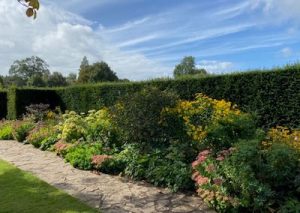
It has been hard work in the garden. The weather, vacillating from drought severe enough to necessitate a hosepipe ban, to torrential rain has caused considerable difficulty. Plantings are being focussed on drought resistant or minimally demanding varieties. More plants are being grown from seed and greater use made of biennials. The policy of conserving Old Sussex apple varieties, now well under way in Donkey meadow, is being extended to part of a meadow adjacent to the mill pond. The area in front of the Visitors’ Reception, freed up by the recent felling of inappropriate pine trees, has been seeded with wildflowers to create a floristic lawn. The Shire Horses again came to mow the meadows. With a single operator. Plans for the redevelopment of the Mulberry Garden behind the tea shop are almost finalised and work will begin soon to attempt to recreate the garden as it was known to the Kiplings.
A new stall by the entrance selling Bateman’s flowers and vegetables has been a great success. It is hoped that the flour from the mill will soon be authorised for sale to the public, no doubt to the dismay of the hens currently enjoying free meals. All in all, management of the house and garden remains dynamic and forward looking with careful appraisal of the history of the artefacts and a determination to make the presentation as authentic as possible, all based on diligent research
David Forsyth – 15 Sept 2025
Bateman’s report 23 June 2025
Summer is Icumen in
Llude sing cuccu
Groweth seed and bloweth med
And Springeth wdepu
Sing cuccu!
[ca 1260 English round song]
This well describes the last few weeks at Batemans’. The herbaceous borders are bursting with colour, the espaliered fruit trees, planted two years ago, are prospering. Donkey Meadow, with the recently established heritage varieties of Sussex apples, awaits a cut of hay hopefully powered by a pair of Sussex horses. Blackbirds, wrens, robins and sparrows perform for their lunch around the tables outside the Mulberry café.
Visitors, encouraged by the current good weather, are coming in substantial numbers, necessitating the use of the overflow car park. The recent house rearrangement has proved very successful with many comments of approval from the public. Diligent scrutiny of extant correspondence and diaries of the Kiplings’ guests and staff has showed that there is no “correct” bedroom arrangement and at various times each was used by different family members and quests. This has justified some reorganisation to show off the bedroom furniture to best effect, notably the four-poster bed which is original to Bateman’s and very likely was the Kipling bed. The single bed now in the West Bedroom is not original. It is similar-ish in style to some of the beds the Kipling’s had in Naulakha, which is why it was purchased for the space.
Some artefacts, such as the silver engraved presentation tray given to Elsie when she launched Kipling in January 1939, have been relocated. The May Morris embroidery and the Burne-Jones watercolour portraits of the three children are both now in the restored Kipling’s Bedroom.
The return of the Detmold ‘Kaa’ illustration for an early edition of the Jungle Books is still awaited. It is currently under restoration at the Natural History Museum.
We are all looking forward to High Summer with the outdoor programme of concerts and children’s entertainment. In the house constant changes will occur as artefacts are sent away or returned from conservation. The three significant clocks, one, in the Hall is said to be the oldest working clock in the NT, are notoriously idiosyncratic and are reliably unreliable. They really merit their own money tree which is rather appropriate for a summer report.
David Forsyth
Bateman’s report for Kipling Society meeting April 2025
Summer has arrived and with it the seasonal increase in visitors. It is gratifying to learn how many families come several times a year and almost regard the house as their own. The annual NT survey of visitors to Bateman’s confirmed that 75% of members gave us the maximum satisfaction score. I can only assume that the remainder were stung by one of Rudyard’s bees. Also, the Aberdeen terriers can be a bit nippy!
A few statistics: Visitor numbers for the last accounting year were 120,000, which is 3,000 less than the previous year. This is credited to our new winter conservation closure as well as two closures due to bad weather; second-hand book sales (as opposed to NT shop sales) reached £32,000, money spent specifically on Bateman’s projects. It is a sad fact that it is becoming increasingly difficult for the NT to source new Kipling books as the demand has decreased to a level which makes new editions unprofitable. Would the KS consider buying out Macmillans?
The café is a great source of revenue. The average spend per NT member is £4.45. 11,000 scones were gratefully devoured, washed down by 27,000 pots of tea. Plans are in hand to restructure the café garden (the Mulberry Garden). Using old photos, it is hoped to recreate the changes the Kiplings made to the old farmyard. That configuration has been modified over the years, particularly by the NT, resulting in its present form. There is a basic principle of trying to recreate the house and gardens as the Kiplings knew them. As the family was notorious for destroying old records, receipts, etc. this is something of a detective game, relying on old photos and the reminiscences of guests and servants. This is nowhere more evident than in the house itself where the rooms on the first floor and the second floor (which now includes the conservation studio) have had multiple uses. The conservation staff has been diligently reorganising the sites and configuration of the bedrooms to give what is thought to be a reasonable representation of the rooms. Moving a four-poster bed through a Jacobean doorway merits an MBE. Only the best for Bateman’s.
Which reminds me. Sadly, Emma, our Deputy House and Collections Manager, has moved on (to another Trust property) and will be replaced in June.
The refurbishment of the Memorial Room has proved a great success. Previously, visitors tended to walk quickly through a rather worthy display of artefacts but the new layout, with objects arranged in groups of clearly organised themes, has much enhanced the experience. Of course, the law of unexpected consequences has resulted in the room becoming rather crowded and something of a bottleneck.
We still await the return of the restored and reframed Kaa from the Natural History Museum. It will then go back to the Powder Room to be displayed alongside its fellow Detmold, the Buffalo Herd.
David Forsyth (Bateman’s Liaison Officer)
Bateman’s report for Kipling Society meeting 5 Feb 2025